

53
dimethylsulfoxide. Textural properties and pore volume distributions could be
restored upon oxidative regeneration and rejuvenation with organic compounds.
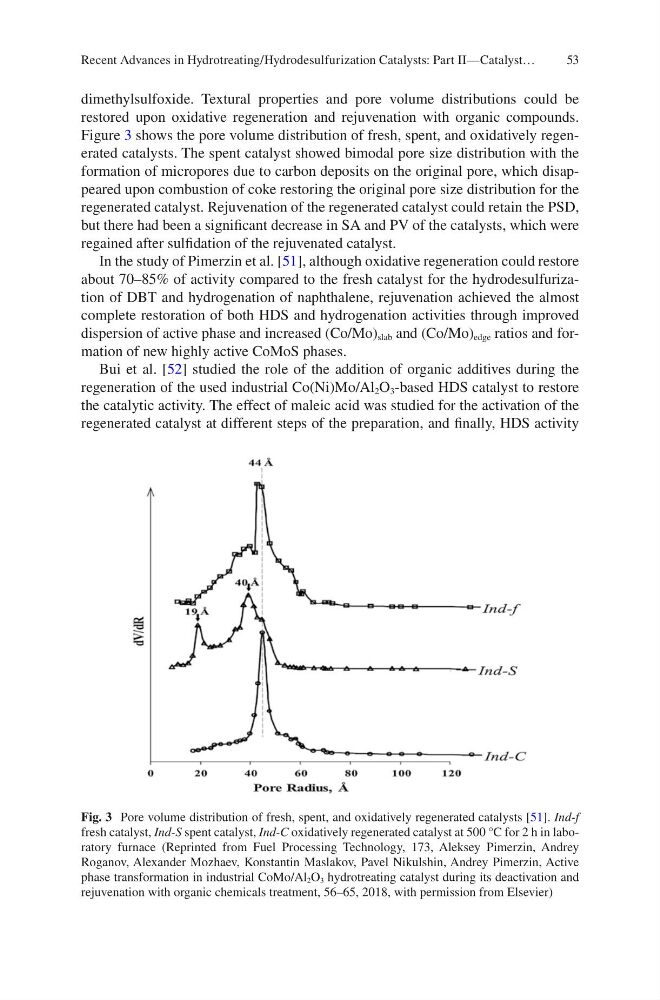
Figure 3 shows the pore volume distribution of fresh, spent, and oxidatively regenerated catalysts. The spent catalyst showed bimodal pore size distribution with the
formation of micropores due to carbon deposits on the original pore, which disappeared upon combustion of coke restoring the original pore size distribution for the
regenerated catalyst. Rejuvenation of the regenerated catalyst could retain the PSD,
but there had been a significant decrease in SA and PV of the catalysts, which were
regained after sulfidation of the rejuvenated catalyst.
In the study of Pimerzin et al. [51], although oxidative regeneration could restore
about 70–85% of activity compared to the fresh catalyst for the hydrodesulfurization of DBT and hydrogenation of naphthalene, rejuvenation achieved the almost
complete restoration of both HDS and hydrogenation activities through improved
dispersion of active phase and increased (Co/Mo) slab and (Co/Mo) edge ratios and formation of new highly active CoMoS phases.
Bui et al. [52] studied the role of the addition of organic additives during the
regeneration of the used industrial Co(Ni)Mo/Al 2 O 3 -based HDS catalyst to restore
the catalytic activity. The effect of maleic acid was studied for the activation of the
regenerated catalyst at different steps of the preparation, and finally, HDS activity
Fig. 3 Pore volume distribution of fresh, spent, and oxidatively regenerated catalysts [51]. Ind-f
fresh catalyst, Ind-S spent catalyst, Ind-C oxidatively regenerated catalyst at 500 °C for 2 h in laboratory furnace (Reprinted from Fuel Processing Technology, 173, Aleksey Pimerzin, Andrey
Roganov, Alexander Mozhaev, Konstantin Maslakov, Pavel Nikulshin, Andrey Pimerzin, Active
phase transformation in industrial CoMo/Al 2 O 3 hydrotreating catalyst during its deactivation and
rejuvenation with organic chemicals treatment, 56–65, 2018, with permission from Elsevier)
Recent Advances in Hydrotreating/Hydrodesulfurization Catalysts: Part II—Catalyst…
dimethylsulfoxide. Textural properties and pore volume distributions could be
restored upon oxidative regeneration and rejuvenation with organic compounds.
Figure 3 shows the pore volume distribution of fresh, spent, and oxidatively regenerated catalysts. The spent catalyst showed bimodal pore size distribution with the
formation of micropores due to carbon deposits on the original pore, which disappeared upon combustion of coke restoring the original pore size distribution for the
regenerated catalyst. Rejuvenation of the regenerated catalyst could retain the PSD,
but there had been a significant decrease in SA and PV of the catalysts, which were
regained after sulfidation of the rejuvenated catalyst.
In the study of Pimerzin et al. [51], although oxidative regeneration could restore
about 70–85% of activity compared to the fresh catalyst for the hydrodesulfurization of DBT and hydrogenation of naphthalene, rejuvenation achieved the almost
complete restoration of both HDS and hydrogenation activities through improved
dispersion of active phase and increased (Co/Mo) slab and (Co/Mo) edge ratios and formation of new highly active CoMoS phases.
Bui et al. [52] studied the role of the addition of organic additives during the
regeneration of the used industrial Co(Ni)Mo/Al 2 O 3 -based HDS catalyst to restore
the catalytic activity. The effect of maleic acid was studied for the activation of the
regenerated catalyst at different steps of the preparation, and finally, HDS activity
Fig. 3 Pore volume distribution of fresh, spent, and oxidatively regenerated catalysts [51]. Ind-f
fresh catalyst, Ind-S spent catalyst, Ind-C oxidatively regenerated catalyst at 500 °C for 2 h in laboratory furnace (Reprinted from Fuel Processing Technology, 173, Aleksey Pimerzin, Andrey
Roganov, Alexander Mozhaev, Konstantin Maslakov, Pavel Nikulshin, Andrey Pimerzin, Active
phase transformation in industrial CoMo/Al 2 O 3 hydrotreating catalyst during its deactivation and
rejuvenation with organic chemicals treatment, 56–65, 2018, with permission from Elsevier)
Recent Advances in Hydrotreating/Hydrodesulfurization Catalysts: Part II—Catalyst…