

606
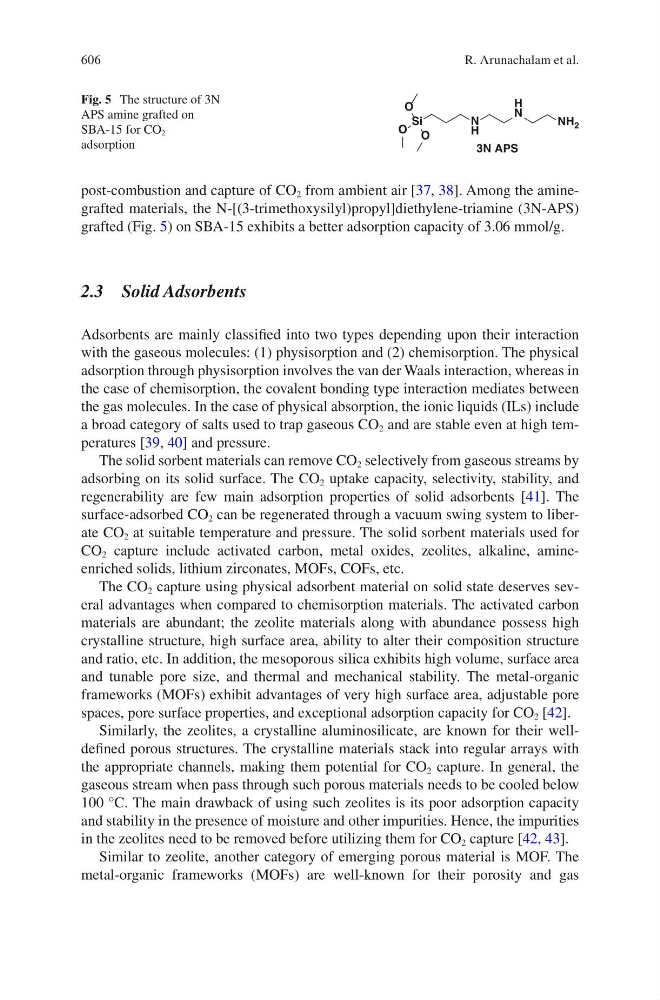
post- combustion and capture of CO 2 from ambient air [37, 38]. Among the aminegrafted materials, the N-[(3-trimethoxysilyl)propyl]diethylene-triamine (3N-APS)
grafted (Fig. 5) on SBA-15 exhibits a better adsorption capacity of 3.06 mmol/g.
2.3 Solid Adsorbents
Adsorbents are mainly classified into two types depending upon their interaction
with the gaseous molecules: (1) physisorption and (2) chemisorption. The physical
adsorption through physisorption involves the van der Waals interaction, whereas in
the case of chemisorption, the covalent bonding type interaction mediates between
the gas molecules. In the case of physical absorption, the ionic liquids (ILs) include
a broad category of salts used to trap gaseous CO 2 and are stable even at high temperatures [39, 40] and pressure.
The solid sorbent materials can remove CO 2 selectively from gaseous streams by
adsorbing on its solid surface. The CO 2 uptake capacity, selectivity, stability, and
regenerability are few main adsorption properties of solid adsorbents [41]. The
surface- adsorbed CO 2 can be regenerated through a vacuum swing system to liberate CO 2 at suitable temperature and pressure. The solid sorbent materials used for
CO 2 capture include activated carbon, metal oxides, zeolites, alkaline, amineenriched solids, lithium zirconates, MOFs, COFs, etc.
The CO 2 capture using physical adsorbent material on solid state deserves several advantages when compared to chemisorption materials. The activated carbon
materials are abundant; the zeolite materials along with abundance possess high
crystalline structure, high surface area, ability to alter their composition structure
and ratio, etc. In addition, the mesoporous silica exhibits high volume, surface area
and tunable pore size, and thermal and mechanical stability. The metal-organic
frameworks (MOFs) exhibit advantages of very high surface area, adjustable pore
spaces, pore surface properties, and exceptional adsorption capacity for CO 2 [42].
Similarly, the zeolites, a crystalline aluminosilicate, are known for their welldefined porous structures. The crystalline materials stack into regular arrays with
the appropriate channels, making them potential for CO 2 capture. In general, the
gaseous stream when pass through such porous materials needs to be cooled below
100 °C. The main drawback of using such zeolites is its poor adsorption capacity
and stability in the presence of moisture and other impurities. Hence, the impurities
in the zeolites need to be removed before utilizing them for CO 2 capture [42, 43].
Similar to zeolite, another category of emerging porous material is MOF. The
metal-organic frameworks (MOFs) are well-known for their porosity and gas
Si
O
O O
N
H
H
N
NH 2
3N APS
Fig. 5 The structure of 3N
APS amine grafted on
SBA-15 for CO 2
adsorption
R. Arunachalam et al.