

604
gasification plant’s emission contains large amount of CO 2 /H 2 gases. In addition to
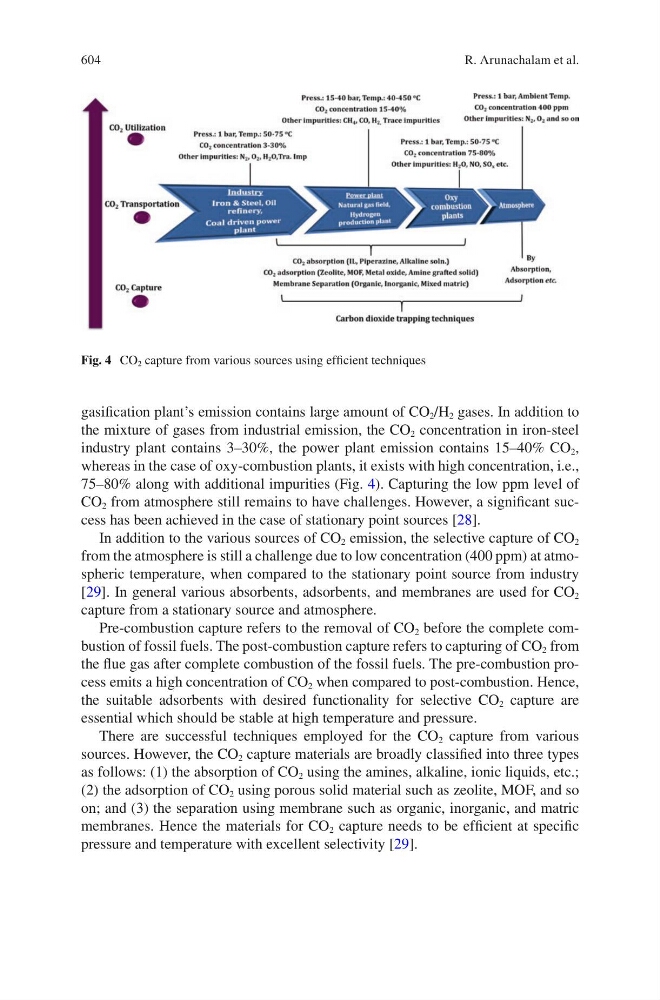
the mixture of gases from industrial emission, the CO 2 concentration in iron-steel
industry plant contains 3–30%, the power plant emission contains 15–40% CO 2 ,
whereas in the case of oxy-combustion plants, it exists with high concentration, i.e.,
75–80% along with additional impurities (Fig. 4). Capturing the low ppm level of
CO 2 from atmosphere still remains to have challenges. However, a significant success has been achieved in the case of stationary point sources [28].
In addition to the various sources of CO 2 emission, the selective capture of CO 2
from the atmosphere is still a challenge due to low concentration (400 ppm) at atmospheric temperature, when compared to the stationary point source from industry
[29]. In general various absorbents, adsorbents, and membranes are used for CO 2
capture from a stationary source and atmosphere.
Pre-combustion capture refers to the removal of CO 2 before the complete combustion of fossil fuels. The post-combustion capture refers to capturing of CO 2 from
the flue gas after complete combustion of the fossil fuels. The pre-combustion process emits a high concentration of CO 2 when compared to post-combustion. Hence,
the suitable adsorbents with desired functionality for selective CO 2 capture are
essential which should be stable at high temperature and pressure.
There are successful techniques employed for the CO 2 capture from various
sources. However, the CO 2 capture materials are broadly classified into three types
as follows: (1) the absorption of CO 2 using the amines, alkaline, ionic liquids, etc.;
(2) the adsorption of CO 2 using porous solid material such as zeolite, MOF, and so
on; and (3) the separation using membrane such as organic, inorganic, and matric
membranes. Hence the materials for CO 2 capture needs to be efficient at specific
pressure and temperature with excellent selectivity [29].
Fig. 4 CO 2 capture from various sources using efficient techniques
R. Arunachalam et al.