

49
pore size distribution toward smaller pores. The extent of coke and metal deposition
on the catalyst is dependent on the properties of the feed and process conditions.
Coke is not a permanent poison, and regeneration of the spent catalyst by burning
off the coke in the presence of air/oxygen usually restores the catalyst activity near
to fresh catalyst conditions.
5.2 Deactivation Due to Metals
Deactivation due to poisoning by metals occurs simultaneously with that of coke
deactivation and depends on the feedstock properties and process conditions. Nickel
and vanadium are the predominant metals present in petroleum, shale oil fractions,
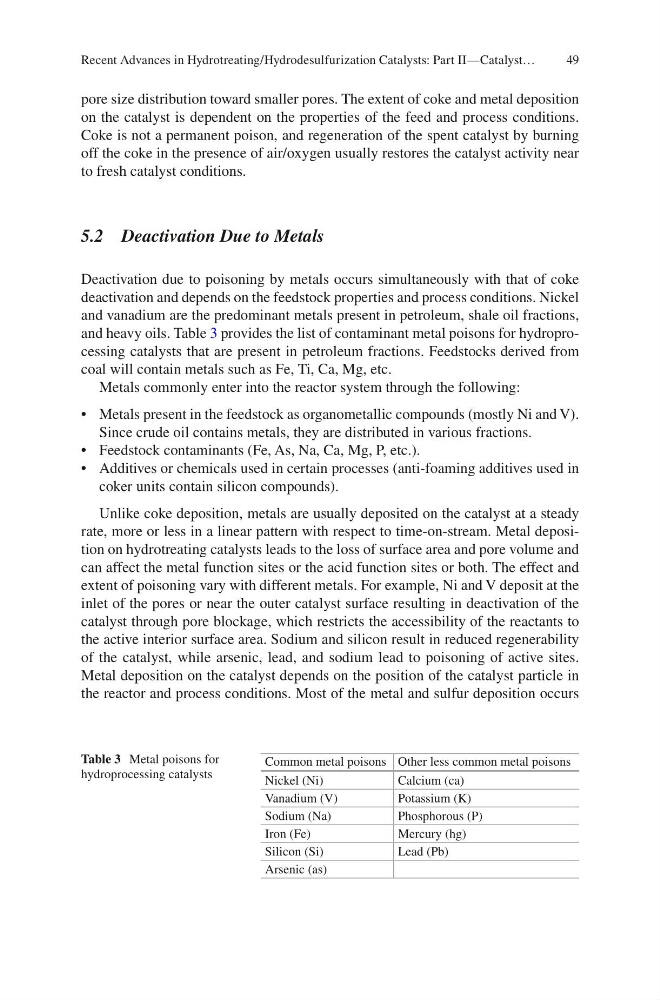
and heavy oils. Table 3 provides the list of contaminant metal poisons for hydroprocessing catalysts that are present in petroleum fractions. Feedstocks derived from
coal will contain metals such as Fe, Ti, Ca, Mg, etc.
Metals commonly enter into the reactor system through the following:
• Metals present in the feedstock as organometallic compounds (mostly Ni and V).
Since crude oil contains metals, they are distributed in various fractions.
• Feedstock contaminants (Fe, As, Na, Ca, Mg, P, etc.).
• Additives or chemicals used in certain processes (anti-foaming additives used in
coker units contain silicon compounds).
Unlike coke deposition, metals are usually deposited on the catalyst at a steady
rate, more or less in a linear pattern with respect to time-on-stream. Metal deposition on hydrotreating catalysts leads to the loss of surface area and pore volume and
can affect the metal function sites or the acid function sites or both. The effect and
extent of poisoning vary with different metals. For example, Ni and V deposit at the
inlet of the pores or near the outer catalyst surface resulting in deactivation of the
catalyst through pore blockage, which restricts the accessibility of the reactants to
the active interior surface area. Sodium and silicon result in reduced regenerability
of the catalyst, while arsenic, lead, and sodium lead to poisoning of active sites.
Metal deposition on the catalyst depends on the position of the catalyst particle in
the reactor and process conditions. Most of the metal and sulfur deposition occurs
Table 3 Metal poisons for
hydroprocessing catalysts
Common metal poisons Other less common metal poisons
Nickel (Ni)
Calcium (ca)
Vanadium (V)
Potassium (K)
Sodium (Na)
Phosphorous (P)
Iron (Fe)
Mercury (hg)
Silicon (Si)
Lead (Pb)
Arsenic (as)
Recent Advances in Hydrotreating/Hydrodesulfurization Catalysts: Part II—Catalyst…
pore size distribution toward smaller pores. The extent of coke and metal deposition
on the catalyst is dependent on the properties of the feed and process conditions.
Coke is not a permanent poison, and regeneration of the spent catalyst by burning
off the coke in the presence of air/oxygen usually restores the catalyst activity near
to fresh catalyst conditions.
5.2 Deactivation Due to Metals
Deactivation due to poisoning by metals occurs simultaneously with that of coke
deactivation and depends on the feedstock properties and process conditions. Nickel
and vanadium are the predominant metals present in petroleum, shale oil fractions,
and heavy oils. Table 3 provides the list of contaminant metal poisons for hydroprocessing catalysts that are present in petroleum fractions. Feedstocks derived from
coal will contain metals such as Fe, Ti, Ca, Mg, etc.
Metals commonly enter into the reactor system through the following:
• Metals present in the feedstock as organometallic compounds (mostly Ni and V).
Since crude oil contains metals, they are distributed in various fractions.
• Feedstock contaminants (Fe, As, Na, Ca, Mg, P, etc.).
• Additives or chemicals used in certain processes (anti-foaming additives used in
coker units contain silicon compounds).
Unlike coke deposition, metals are usually deposited on the catalyst at a steady
rate, more or less in a linear pattern with respect to time-on-stream. Metal deposition on hydrotreating catalysts leads to the loss of surface area and pore volume and
can affect the metal function sites or the acid function sites or both. The effect and
extent of poisoning vary with different metals. For example, Ni and V deposit at the
inlet of the pores or near the outer catalyst surface resulting in deactivation of the
catalyst through pore blockage, which restricts the accessibility of the reactants to
the active interior surface area. Sodium and silicon result in reduced regenerability
of the catalyst, while arsenic, lead, and sodium lead to poisoning of active sites.
Metal deposition on the catalyst depends on the position of the catalyst particle in
the reactor and process conditions. Most of the metal and sulfur deposition occurs
Table 3 Metal poisons for
hydroprocessing catalysts
Common metal poisons Other less common metal poisons
Nickel (Ni)
Calcium (ca)
Vanadium (V)
Potassium (K)
Sodium (Na)
Phosphorous (P)
Iron (Fe)
Mercury (hg)
Silicon (Si)
Lead (Pb)
Arsenic (as)
Recent Advances in Hydrotreating/Hydrodesulfurization Catalysts: Part II—Catalyst…