

576
Homogeneity of temperature leads to high per pass conversion for lower volume of
catalyst than adiabatic reactors. However, for achieving higher reaction rate and
increasing selectivity of methanol, reaction should be carried out at temperature
range of 240–260 °C with high recycle ratio. Application of these reactors is limited
owing to its high installation cost than adiabatic system and size constraints due to
multiple tubes type arrangement [33].
3.1 Fixed Bed Reactors
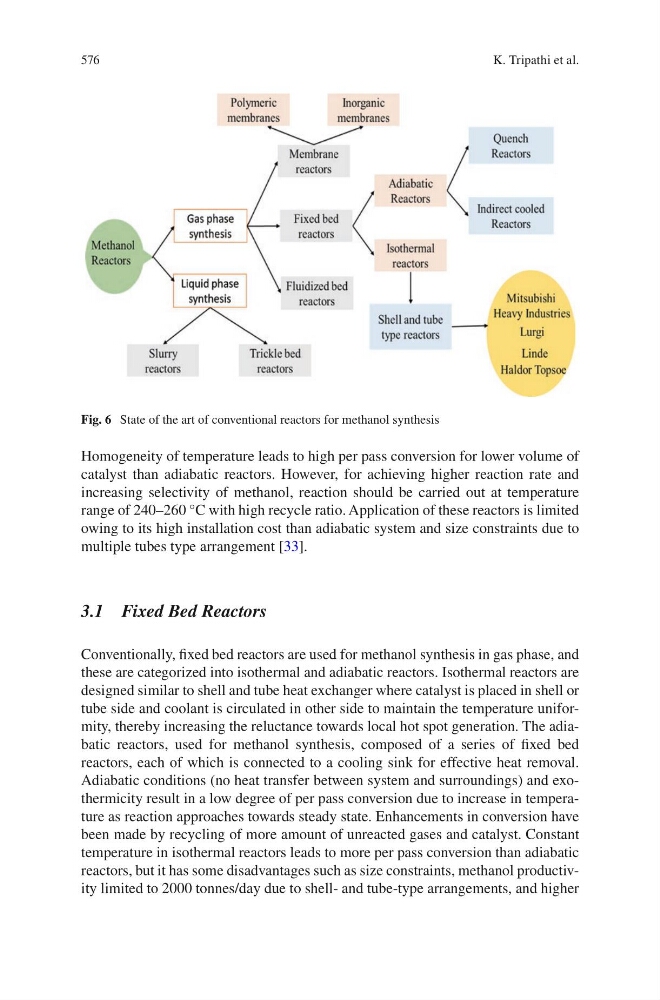
Conventionally, fixed bed reactors are used for methanol synthesis in gas phase, and
these are categorized into isothermal and adiabatic reactors. Isothermal reactors are
designed similar to shell and tube heat exchanger where catalyst is placed in shell or
tube side and coolant is circulated in other side to maintain the temperature uniformity, thereby increasing the reluctance towards local hot spot generation. The adiabatic reactors, used for methanol synthesis, composed of a series of fixed bed
reactors, each of which is connected to a cooling sink for effective heat removal.
Adiabatic conditions (no heat transfer between system and surroundings) and exothermicity result in a low degree of per pass conversion due to increase in temperature as reaction approaches towards steady state. Enhancements in conversion have
been made by recycling of more amount of unreacted gases and catalyst. Constant
temperature in isothermal reactors leads to more per pass conversion than adiabatic
reactors, but it has some disadvantages such as size constraints, methanol productivity limited to 2000 tonnes/day due to shell- and tube-type arrangements, and higher
Fig. 6 State of the art of conventional reactors for methanol synthesis
K. Tripathi et al.
Homogeneity of temperature leads to high per pass conversion for lower volume of
catalyst than adiabatic reactors. However, for achieving higher reaction rate and
increasing selectivity of methanol, reaction should be carried out at temperature
range of 240–260 °C with high recycle ratio. Application of these reactors is limited
owing to its high installation cost than adiabatic system and size constraints due to
multiple tubes type arrangement [33].
3.1 Fixed Bed Reactors
Conventionally, fixed bed reactors are used for methanol synthesis in gas phase, and
these are categorized into isothermal and adiabatic reactors. Isothermal reactors are
designed similar to shell and tube heat exchanger where catalyst is placed in shell or
tube side and coolant is circulated in other side to maintain the temperature uniformity, thereby increasing the reluctance towards local hot spot generation. The adiabatic reactors, used for methanol synthesis, composed of a series of fixed bed
reactors, each of which is connected to a cooling sink for effective heat removal.
Adiabatic conditions (no heat transfer between system and surroundings) and exothermicity result in a low degree of per pass conversion due to increase in temperature as reaction approaches towards steady state. Enhancements in conversion have
been made by recycling of more amount of unreacted gases and catalyst. Constant
temperature in isothermal reactors leads to more per pass conversion than adiabatic
reactors, but it has some disadvantages such as size constraints, methanol productivity limited to 2000 tonnes/day due to shell- and tube-type arrangements, and higher
Fig. 6 State of the art of conventional reactors for methanol synthesis
K. Tripathi et al.