

572
1.5 Deactivation and Remedies
There are a variety of deactivation factors towards which Cu-based methanol catalysts are sensitive enough. Since Cu is the second last metal (above Ag only) in the
list of thermal stability, exposure to high temperature (>300 °C) can lead to drastic
irreversible effects on its properties [79]. The major problems faced by these catalysts are easy sintering, swift agglomeration, and rapid deactivation. Hence, in order
to make catalyst resistant towards these factors and to increase the shelf life of the
catalyst, it is essential to add a suitable promoter to enhance its thermal stability.
Some of the major reasons of catalyst deactivation are:
• Non-uniform distribution of Cu metal particles on the catalyst surface resulting
in metal sintering [80].
• Presence of poisonous compounds like sulfur and chlorine in the feed stream.
• Conducting the reaction at higher pressure that aids in increasing deactivation rate.
• Deposition of carbon and other species on the catalyst surface as a result of side
reactions like boudouard reaction and methanation reaction.
• Formation of water resulting from the unavoidable water gas shift reaction.
After identifying the primary causes for the catalyst deactivation, it has been
observed that there does not exist any guaranteed solution that can prevent the catalyst from getting deactivated. However, the deactivation phenomenon can be
delayed or controlled up to some extent. The major remedies that can be executed
to increase the shelf life of the catalyst are as follows:
• Incorporate co-promoters like ZnO and Al 2 O 3 in the catalyst so as to increase the
active metal dispersion and to stabilize dispersed Cu crystals, thereby making it
reluctant to sintering and agglomeration.
• ZnO reacts with sulfur poison present in the feed gas to form ZnS and Zn(SO 4 )
(favorable thermodynamic reaction in methanol synthesis conditions), thus
inhibiting sulfur to react with active Cu metal.
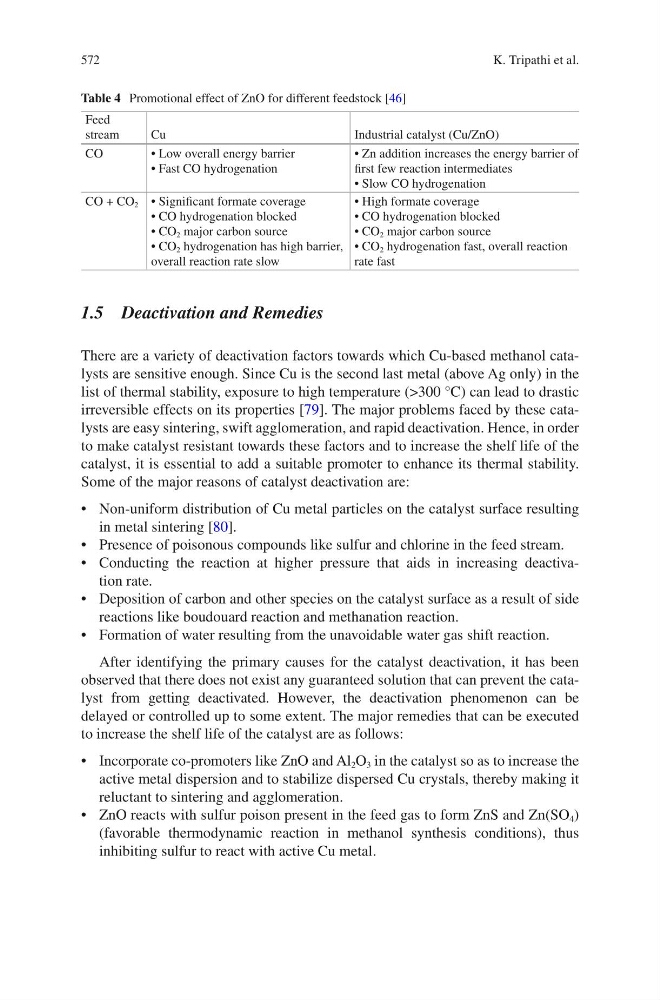
Table 4 Promotional effect of ZnO for different feedstock [46]
Feed
stream
Cu
Industrial catalyst (Cu/ZnO)
CO
• Low overall energy barrier
• Fast CO hydrogenation
• Zn addition increases the energy barrier of
first few reaction intermediates
• Slow CO hydrogenation
CO + CO 2 • Significant formate coverage
• CO hydrogenation blocked
• CO 2 major carbon source
• CO 2 hydrogenation has high barrier,
overall reaction rate slow
• High formate coverage
• CO hydrogenation blocked
• CO 2 major carbon source
• CO 2 hydrogenation fast, overall reaction
rate fast
K. Tripathi et al.
1.5 Deactivation and Remedies
There are a variety of deactivation factors towards which Cu-based methanol catalysts are sensitive enough. Since Cu is the second last metal (above Ag only) in the
list of thermal stability, exposure to high temperature (>300 °C) can lead to drastic
irreversible effects on its properties [79]. The major problems faced by these catalysts are easy sintering, swift agglomeration, and rapid deactivation. Hence, in order
to make catalyst resistant towards these factors and to increase the shelf life of the
catalyst, it is essential to add a suitable promoter to enhance its thermal stability.
Some of the major reasons of catalyst deactivation are:
• Non-uniform distribution of Cu metal particles on the catalyst surface resulting
in metal sintering [80].
• Presence of poisonous compounds like sulfur and chlorine in the feed stream.
• Conducting the reaction at higher pressure that aids in increasing deactivation rate.
• Deposition of carbon and other species on the catalyst surface as a result of side
reactions like boudouard reaction and methanation reaction.
• Formation of water resulting from the unavoidable water gas shift reaction.
After identifying the primary causes for the catalyst deactivation, it has been
observed that there does not exist any guaranteed solution that can prevent the catalyst from getting deactivated. However, the deactivation phenomenon can be
delayed or controlled up to some extent. The major remedies that can be executed
to increase the shelf life of the catalyst are as follows:
• Incorporate co-promoters like ZnO and Al 2 O 3 in the catalyst so as to increase the
active metal dispersion and to stabilize dispersed Cu crystals, thereby making it
reluctant to sintering and agglomeration.
• ZnO reacts with sulfur poison present in the feed gas to form ZnS and Zn(SO 4 )
(favorable thermodynamic reaction in methanol synthesis conditions), thus
inhibiting sulfur to react with active Cu metal.
Table 4 Promotional effect of ZnO for different feedstock [46]
Feed
stream
Cu
Industrial catalyst (Cu/ZnO)
CO
• Low overall energy barrier
• Fast CO hydrogenation
• Zn addition increases the energy barrier of
first few reaction intermediates
• Slow CO hydrogenation
CO + CO 2 • Significant formate coverage
• CO hydrogenation blocked
• CO 2 major carbon source
• CO 2 hydrogenation has high barrier,
overall reaction rate slow
• High formate coverage
• CO hydrogenation blocked
• CO 2 major carbon source
• CO 2 hydrogenation fast, overall reaction
rate fast
K. Tripathi et al.