

538
reactions occur. Reactions that occur in CO 2 reforming processes are shown in
Table 2 [39]. In the overall sense, the reforming reaction is highly endothermic and
subsequently reforming is implemented at high temperatures (800–1000 °C) to
attain high conversions of CO 2 and CH 4 . Also, high temperatures are required to
minimize coking [39]. Although the reforming reactions are more efficient at lower
pressures, reforming is typically implemented at intermediate pressures to optimize
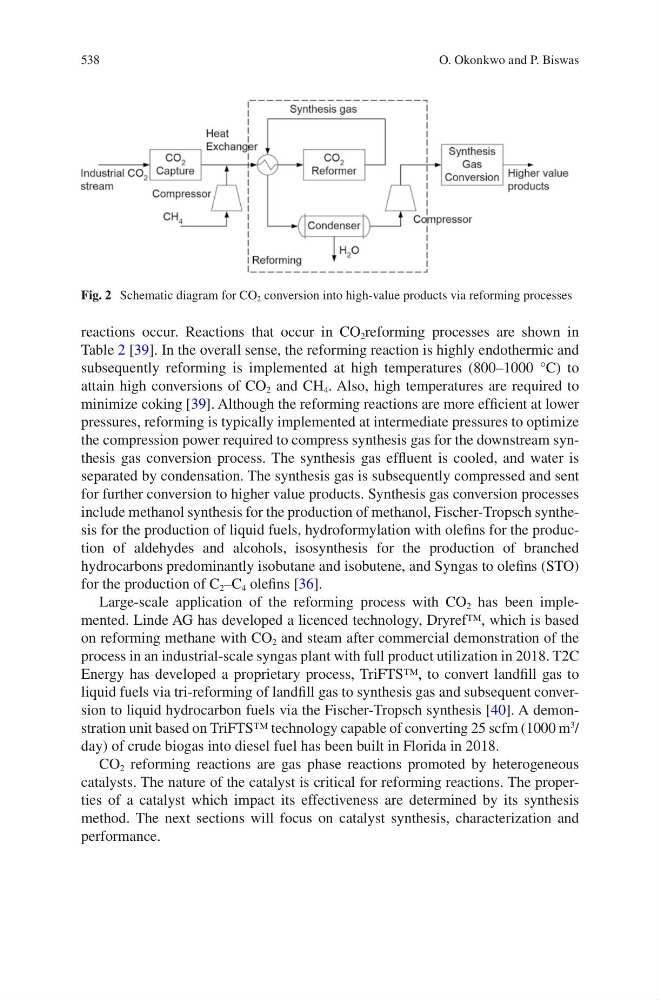
the compression power required to compress synthesis gas for the downstream synthesis gas conversion process. The synthesis gas effluent is cooled, and water is
separated by condensation. The synthesis gas is subsequently compressed and sent
for further conversion to higher value products. Synthesis gas conversion processes
include methanol synthesis for the production of methanol, Fischer-Tropsch synthesis for the production of liquid fuels, hydroformylation with olefins for the production of aldehydes and alcohols, isosynthesis for the production of branched
hydrocarbons predominantly isobutane and isobutene, and Syngas to olefins (STO)
for the production of C 2 –C 4 olefins [36].
Large-scale application of the reforming process with CO 2 has been implemented. Linde AG has developed a licenced technology, Dryref™, which is based
on reforming methane with CO 2 and steam after commercial demonstration of the
process in an industrial-scale syngas plant with full product utilization in 2018. T2C
Energy has developed a proprietary process, TriFTS™, to convert landfill gas to
liquid fuels via tri-reforming of landfill gas to synthesis gas and subsequent conversion to liquid hydrocarbon fuels via the Fischer-Tropsch synthesis [40]. A demonstration unit based on TriFTS™ technology capable of converting 25 scfm (1000 m
3
/
day) of crude biogas into diesel fuel has been built in Florida in 2018.
CO 2 reforming reactions are gas phase reactions promoted by heterogeneous
catalysts. The nature of the catalyst is critical for reforming reactions. The properties of a catalyst which impact its effectiveness are determined by its synthesis
method. The next sections will focus on catalyst synthesis, characterization and
performance.
Fig. 2 Schematic diagram for CO 2 conversion into high-value products via reforming processes
O. Okonkwo and P. Biswas
reactions occur. Reactions that occur in CO 2 reforming processes are shown in
Table 2 [39]. In the overall sense, the reforming reaction is highly endothermic and
subsequently reforming is implemented at high temperatures (800–1000 °C) to
attain high conversions of CO 2 and CH 4 . Also, high temperatures are required to
minimize coking [39]. Although the reforming reactions are more efficient at lower
pressures, reforming is typically implemented at intermediate pressures to optimize
the compression power required to compress synthesis gas for the downstream synthesis gas conversion process. The synthesis gas effluent is cooled, and water is
separated by condensation. The synthesis gas is subsequently compressed and sent
for further conversion to higher value products. Synthesis gas conversion processes
include methanol synthesis for the production of methanol, Fischer-Tropsch synthesis for the production of liquid fuels, hydroformylation with olefins for the production of aldehydes and alcohols, isosynthesis for the production of branched
hydrocarbons predominantly isobutane and isobutene, and Syngas to olefins (STO)
for the production of C 2 –C 4 olefins [36].
Large-scale application of the reforming process with CO 2 has been implemented. Linde AG has developed a licenced technology, Dryref™, which is based
on reforming methane with CO 2 and steam after commercial demonstration of the
process in an industrial-scale syngas plant with full product utilization in 2018. T2C
Energy has developed a proprietary process, TriFTS™, to convert landfill gas to
liquid fuels via tri-reforming of landfill gas to synthesis gas and subsequent conversion to liquid hydrocarbon fuels via the Fischer-Tropsch synthesis [40]. A demonstration unit based on TriFTS™ technology capable of converting 25 scfm (1000 m
3
/
day) of crude biogas into diesel fuel has been built in Florida in 2018.
CO 2 reforming reactions are gas phase reactions promoted by heterogeneous
catalysts. The nature of the catalyst is critical for reforming reactions. The properties of a catalyst which impact its effectiveness are determined by its synthesis
method. The next sections will focus on catalyst synthesis, characterization and
performance.
Fig. 2 Schematic diagram for CO 2 conversion into high-value products via reforming processes
O. Okonkwo and P. Biswas