

45
high surface area, favorable pore size, and acidity characteristics. Xu et al. [35]
prepared NiMo/SiO 2 -Al 2 O 3 -based ULSD catalysts using a novel gemini surfactantassisted synthesis of Mo precursor and reported higher catalytic activity for the
HDS of 4,6-DMDBT and FCC diesel compared to the conventional catalysts synthesized by a hydrothermal method due to better active phase dispersion, improved
stacking, and formation of a large extent of accessible Ni-Mo-S phases after Ni
incorporation.
Huang et al. [36] proposed a hydrothermal deposition method for the preparation
of a Co 4 Mo 12 /Al 2 O 3 -based HDS catalyst through deposition of heteropoly compounds on Al 2 O 3 and showed higher activity for the HDS of DBT compared to the
catalysts prepared using an incipient wetness impregnation method. The reasons
attributed to the high catalytic activity are weak MSI, higher MoS 2 stacking, and
high concentration of CoMoS phases due to high Co/Mo ratios.
Cabello et al. [37] prepared Co 2 Mo 10 - and CoMo 6 -based hetropoly compounds
and showed higher activity for the HDS of thiophene and hydrogenation of cyclohexane compared to conventional Co-Mo-based catalysts. The higher activity was
attributed to the good adsorptive interaction of heteropolyoxometalates with the
support and uniform distribution of active sites on the catalyst surface.
Hensen et al. [38] studied various supported Mo sulfide catalysts and showed
that the HDS and HYD selectivities can be fine-tuned by the morphology of MoS 2
phase and the choice of support. The choice of support material was found to dictate
the morphology and dispersion of active phases. MoS 2 slab structures with a multilayered morphology were reported in the case of Mo/SiO 2 and Mo/ASA catalysts.
Mo/C had the highest MoS 2 dispersion. Carbon support exhibited high HYD
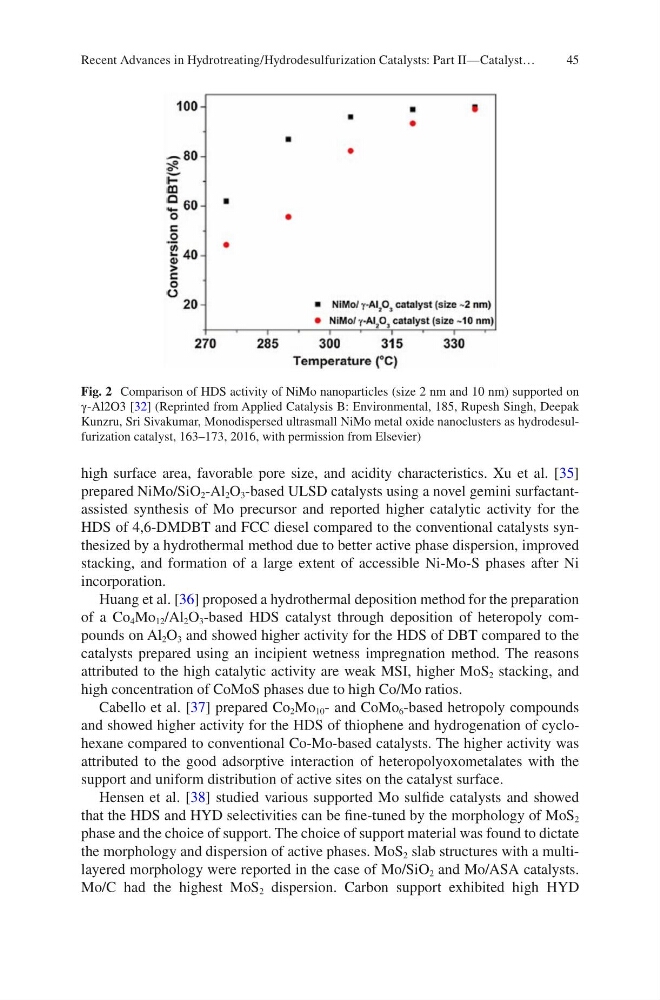
Fig. 2 Comparison of HDS activity of NiMo nanoparticles (size 2 nm and 10 nm) supported on
γ-Al2O3 [32] (Reprinted from Applied Catalysis B: Environmental, 185, Rupesh Singh, Deepak
Kunzru, Sri Sivakumar, Monodispersed ultrasmall NiMo metal oxide nanoclusters as hydrodesulfurization catalyst, 163–173, 2016, with permission from Elsevier)
Recent Advances in Hydrotreating/Hydrodesulfurization Catalysts: Part II—Catalyst…
high surface area, favorable pore size, and acidity characteristics. Xu et al. [35]
prepared NiMo/SiO 2 -Al 2 O 3 -based ULSD catalysts using a novel gemini surfactantassisted synthesis of Mo precursor and reported higher catalytic activity for the
HDS of 4,6-DMDBT and FCC diesel compared to the conventional catalysts synthesized by a hydrothermal method due to better active phase dispersion, improved
stacking, and formation of a large extent of accessible Ni-Mo-S phases after Ni
incorporation.
Huang et al. [36] proposed a hydrothermal deposition method for the preparation
of a Co 4 Mo 12 /Al 2 O 3 -based HDS catalyst through deposition of heteropoly compounds on Al 2 O 3 and showed higher activity for the HDS of DBT compared to the
catalysts prepared using an incipient wetness impregnation method. The reasons
attributed to the high catalytic activity are weak MSI, higher MoS 2 stacking, and
high concentration of CoMoS phases due to high Co/Mo ratios.
Cabello et al. [37] prepared Co 2 Mo 10 - and CoMo 6 -based hetropoly compounds
and showed higher activity for the HDS of thiophene and hydrogenation of cyclohexane compared to conventional Co-Mo-based catalysts. The higher activity was
attributed to the good adsorptive interaction of heteropolyoxometalates with the
support and uniform distribution of active sites on the catalyst surface.
Hensen et al. [38] studied various supported Mo sulfide catalysts and showed
that the HDS and HYD selectivities can be fine-tuned by the morphology of MoS 2
phase and the choice of support. The choice of support material was found to dictate
the morphology and dispersion of active phases. MoS 2 slab structures with a multilayered morphology were reported in the case of Mo/SiO 2 and Mo/ASA catalysts.
Mo/C had the highest MoS 2 dispersion. Carbon support exhibited high HYD
Fig. 2 Comparison of HDS activity of NiMo nanoparticles (size 2 nm and 10 nm) supported on
γ-Al2O3 [32] (Reprinted from Applied Catalysis B: Environmental, 185, Rupesh Singh, Deepak
Kunzru, Sri Sivakumar, Monodispersed ultrasmall NiMo metal oxide nanoclusters as hydrodesulfurization catalyst, 163–173, 2016, with permission from Elsevier)
Recent Advances in Hydrotreating/Hydrodesulfurization Catalysts: Part II—Catalyst…