

530
change) are introduced into the global carbon cycle with no corresponding new CO 2
removal process, leading to a disruption in the pre-existing balance in the global
carbon cycle. This disruption leads to the transfer of carbon stocks from the land
reservoir to the atmosphere and ocean.
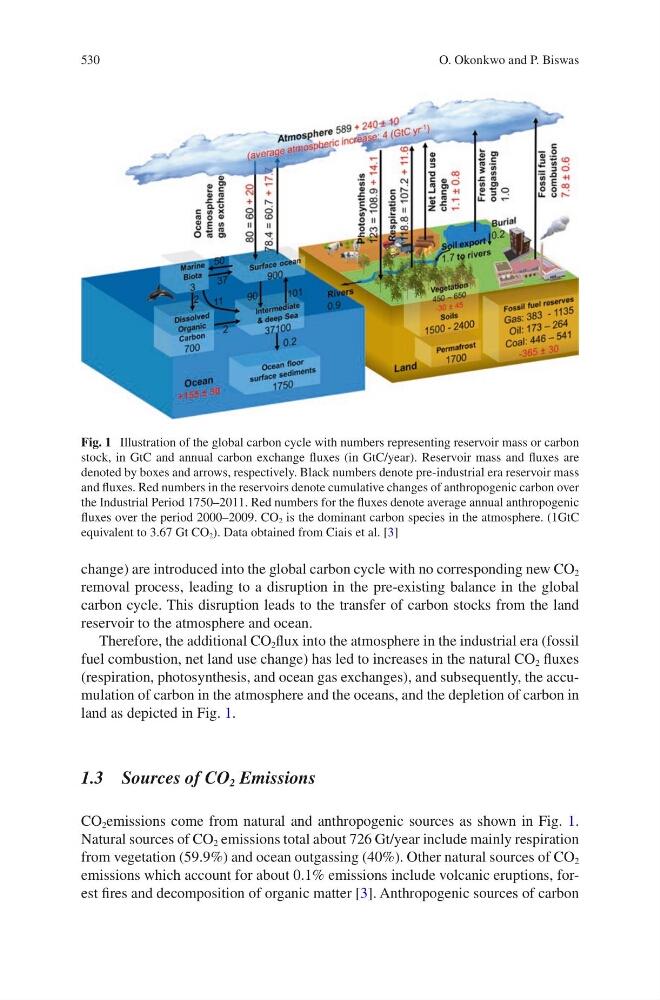
Therefore, the additional CO 2 flux into the atmosphere in the industrial era (fossil
fuel combustion, net land use change) has led to increases in the natural CO 2 fluxes
(respiration, photosynthesis, and ocean gas exchanges), and subsequently, the accumulation of carbon in the atmosphere and the oceans, and the depletion of carbon in
land as depicted in Fig. 1.
1.3 Sources of CO 2 Emissions
CO 2 emissions come from natural and anthropogenic sources as shown in Fig. 1.
Natural sources of CO 2 emissions total about 726 Gt/year include mainly respiration
from vegetation (59.9%) and ocean outgassing (40%). Other natural sources of CO 2
emissions which account for about 0.1% emissions include volcanic eruptions, forest fires and decomposition of organic matter [3]. Anthropogenic sources of carbon
Fig. 1 Illustration of the global carbon cycle with numbers representing reservoir mass or carbon
stock, in GtC and annual carbon exchange fluxes (in GtC/year). Reservoir mass and fluxes are
denoted by boxes and arrows, respectively. Black numbers denote pre-industrial era reservoir mass
and fluxes. Red numbers in the reservoirs denote cumulative changes of anthropogenic carbon over
the Industrial Period 1750–2011. Red numbers for the fluxes denote average annual anthropogenic
fluxes over the period 2000–2009. CO 2 is the dominant carbon species in the atmosphere. (1GtC
equivalent to 3.67 Gt CO 2 ). Data obtained from Ciais et al. [3]
O. Okonkwo and P. Biswas
change) are introduced into the global carbon cycle with no corresponding new CO 2
removal process, leading to a disruption in the pre-existing balance in the global
carbon cycle. This disruption leads to the transfer of carbon stocks from the land
reservoir to the atmosphere and ocean.
Therefore, the additional CO 2 flux into the atmosphere in the industrial era (fossil
fuel combustion, net land use change) has led to increases in the natural CO 2 fluxes
(respiration, photosynthesis, and ocean gas exchanges), and subsequently, the accumulation of carbon in the atmosphere and the oceans, and the depletion of carbon in
land as depicted in Fig. 1.
1.3 Sources of CO 2 Emissions
CO 2 emissions come from natural and anthropogenic sources as shown in Fig. 1.
Natural sources of CO 2 emissions total about 726 Gt/year include mainly respiration
from vegetation (59.9%) and ocean outgassing (40%). Other natural sources of CO 2
emissions which account for about 0.1% emissions include volcanic eruptions, forest fires and decomposition of organic matter [3]. Anthropogenic sources of carbon
Fig. 1 Illustration of the global carbon cycle with numbers representing reservoir mass or carbon
stock, in GtC and annual carbon exchange fluxes (in GtC/year). Reservoir mass and fluxes are
denoted by boxes and arrows, respectively. Black numbers denote pre-industrial era reservoir mass
and fluxes. Red numbers in the reservoirs denote cumulative changes of anthropogenic carbon over
the Industrial Period 1750–2011. Red numbers for the fluxes denote average annual anthropogenic
fluxes over the period 2000–2009. CO 2 is the dominant carbon species in the atmosphere. (1GtC
equivalent to 3.67 Gt CO 2 ). Data obtained from Ciais et al. [3]
O. Okonkwo and P. Biswas