

42
problems in the formation of highly active Type II Co-Mo-S and Ni-Mo-S structures. Chelating agents strongly interact with the promoter ions (Co or Ni), leading
to higher sulfidation temperature of promoter metals compared to Mo, which results
in the formation of sulfided cobalt atoms at the edges of already formed molybdenum sulfide slabs creating highly active Type II sites. Studies by Kubota et al. [20]
and Okamoto et al. [21] illustrate the beneficial effects of chelating agents on the
improvement of HDT/HDS catalyst activity. Chelating agents were also found to
increase the Type II active structures in the catalyst by preventing the strong interactions between metals and support [5]. Some of the chelating agents used in the
preparation of HDT/HDS catalysts along with impregnating solution to improve the
catalytic activity include citric acid, glycol, urea, nitriloacetic acid, and ethylenediaminetetraacetic acid. The activity and selectivity of HDS catalysts are also influenced by the calcination and sulfidation temperatures, and the effects of these
parameters vary for different reaction systems [22].
In one of the studies by van Haandel et al. [9], the effect of organic additives on
catalyst activity was found to be more pronounced in promoted catalysts than in
unpromoted ones by means of enhancing the Co-Mo interaction through better sulfidation of Mo and Co by forming weak complexes. They used α-hydroxycarboxylic
acids (citric acid, tartaric acid, and gluconic acid) and aminopolycarboxylic acids
(NTA, EDTA) as organic additives during preparation of HDS catalysts and found
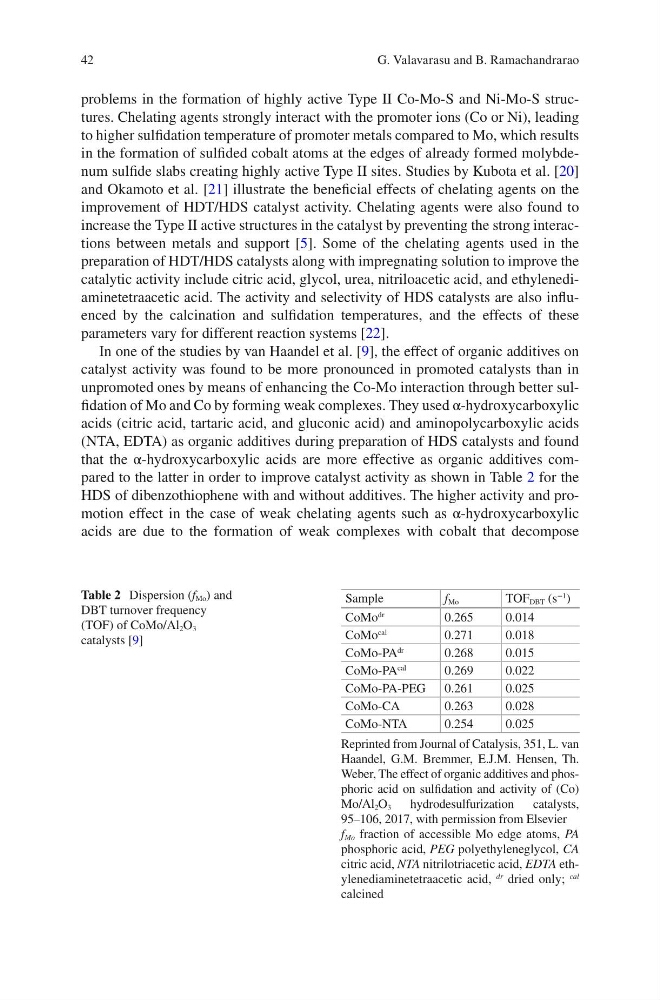
that the α-hydroxycarboxylic acids are more effective as organic additives compared to the latter in order to improve catalyst activity as shown in Table 2 for the
HDS of dibenzothiophene with and without additives. The higher activity and promotion effect in the case of weak chelating agents such as α-hydroxycarboxylic
acids are due to the formation of weak complexes with cobalt that decompose
Table 2 Dispersion (f Mo ) and
DBT turnover frequency
(TOF) of CoMo/Al 2 O 3
catalysts [9]
Sample
f Mo
TOF DBT (s
−1
)
CoMo
dr
0.265
0.014
CoMo
cal
0.271
0.018
CoMo-PA
dr
0.268
0.015
CoMo-PA
cal
0.269
0.022
CoMo-PA-PEG 0.261
0.025
CoMo-CA
0.263
0.028
CoMo-NTA
0.254
0.025
Reprinted from Journal of Catalysis, 351, L. van
Haandel, G.M. Bremmer, E.J.M. Hensen, Th.
Weber, The effect of organic additives and phosphoric acid on sulfidation and activity of (Co)
Mo/Al 2 O 3 hydrodesulfurization catalysts,
95–106, 2017, with permission from Elsevier
f Mo fraction of accessible Mo edge atoms, PA
phosphoric acid, PEG polyethyleneglycol, CA
citric acid, NTA nitrilotriacetic acid, EDTA ethylenediaminetetraacetic acid,
dr dried only;
cal
calcined
G. Valavarasu and B. Ramachandrarao
problems in the formation of highly active Type II Co-Mo-S and Ni-Mo-S structures. Chelating agents strongly interact with the promoter ions (Co or Ni), leading
to higher sulfidation temperature of promoter metals compared to Mo, which results
in the formation of sulfided cobalt atoms at the edges of already formed molybdenum sulfide slabs creating highly active Type II sites. Studies by Kubota et al. [20]
and Okamoto et al. [21] illustrate the beneficial effects of chelating agents on the
improvement of HDT/HDS catalyst activity. Chelating agents were also found to
increase the Type II active structures in the catalyst by preventing the strong interactions between metals and support [5]. Some of the chelating agents used in the
preparation of HDT/HDS catalysts along with impregnating solution to improve the
catalytic activity include citric acid, glycol, urea, nitriloacetic acid, and ethylenediaminetetraacetic acid. The activity and selectivity of HDS catalysts are also influenced by the calcination and sulfidation temperatures, and the effects of these
parameters vary for different reaction systems [22].
In one of the studies by van Haandel et al. [9], the effect of organic additives on
catalyst activity was found to be more pronounced in promoted catalysts than in
unpromoted ones by means of enhancing the Co-Mo interaction through better sulfidation of Mo and Co by forming weak complexes. They used α-hydroxycarboxylic
acids (citric acid, tartaric acid, and gluconic acid) and aminopolycarboxylic acids
(NTA, EDTA) as organic additives during preparation of HDS catalysts and found
that the α-hydroxycarboxylic acids are more effective as organic additives compared to the latter in order to improve catalyst activity as shown in Table 2 for the
HDS of dibenzothiophene with and without additives. The higher activity and promotion effect in the case of weak chelating agents such as α-hydroxycarboxylic
acids are due to the formation of weak complexes with cobalt that decompose
Table 2 Dispersion (f Mo ) and
DBT turnover frequency
(TOF) of CoMo/Al 2 O 3
catalysts [9]
Sample
f Mo
TOF DBT (s
−1
)
CoMo
dr
0.265
0.014
CoMo
cal
0.271
0.018
CoMo-PA
dr
0.268
0.015
CoMo-PA
cal
0.269
0.022
CoMo-PA-PEG 0.261
0.025
CoMo-CA
0.263
0.028
CoMo-NTA
0.254
0.025
Reprinted from Journal of Catalysis, 351, L. van
Haandel, G.M. Bremmer, E.J.M. Hensen, Th.
Weber, The effect of organic additives and phosphoric acid on sulfidation and activity of (Co)
Mo/Al 2 O 3 hydrodesulfurization catalysts,
95–106, 2017, with permission from Elsevier
f Mo fraction of accessible Mo edge atoms, PA
phosphoric acid, PEG polyethyleneglycol, CA
citric acid, NTA nitrilotriacetic acid, EDTA ethylenediaminetetraacetic acid,
dr dried only;
cal
calcined
G. Valavarasu and B. Ramachandrarao