

460
kinetic models and improvements in the results have been discussed. Mainly, the
chapter presents a detailed review of the current status of FT kinetics and its link to
the various prevailing mechanisms responsible for a wide range of FT products.
Keywords Fischer-Tropsch synthesis · Syngas conversion · FTS kinetics · FTS
mechanism · Anderson-Schulz-Flory (ASF) model · Non-ASF model
1 Introduction
The rapid growth of population and the demand for liquid transportation fuels
necessitates the search for its alternative production routes via non-oil-based processes. Limited oil reserves and their rapid depletion is also a major driving force to
turn the research toward the sustainable route to produce liquid fuels. Strong interest
has been received to revisit the X (gas to liquid process) to liquid (XTL) process.
The XTL process can utilize any available hydrocarbon source material such as
coal, natural gas, biomass, and waste material for the production of liquid energy
carriers. The two-step XTL process includes feed to syngas conversion and subsequent conversion of syngas into liquid fuel. Fischer-Tropsch (FT) synthesis is a
well-known and commercially viable process to convert syngas into a range of gaseous and liquid hydrocarbons. The huge spectrum of products makes the analysis of
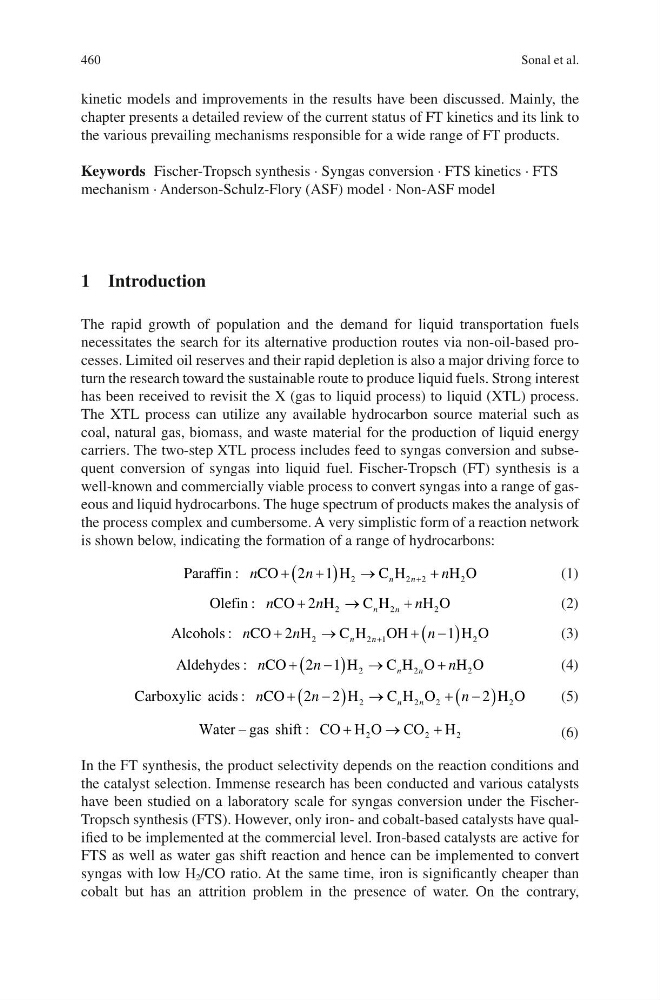
the process complex and cumbersome. A very simplistic form of a reaction network
is shown below, indicating the formation of a range of hydrocarbons:
Paraffin
CO
H
C H
H O
: n
n
n
n
n
+
+
(
) →
+
+
2 1 2
2 2
2
(1)
Olefin
CO
H
C H
H O
: n
n
n
n
n
+
→
+
2 2
2
2
(2)
Alcohols
CO
H
C H OH
H O
: n
n
n
n
n
+
→
+ −
( )
+
2
1
2
2 1
2
(3)
Aldehydes
CO
H
C H O H O
: n
n
n
n
n
+
−
(
) →
+
2 1 2
2
2
(4)
Carboxylic acids
CO
H
C H O
H O
: n
n
n
n
n
+
−
(
) →
+ −
(
)
2 2
2
2
2
2
2
(5)
Water gas shift CO H O CO H
–
:
+
→
+
2
2
2
(6)
In the FT synthesis, the product selectivity depends on the reaction conditions and
the catalyst selection. Immense research has been conducted and various catalysts
have been studied on a laboratory scale for syngas conversion under the FischerTropsch synthesis (FTS). However, only iron- and cobalt-based catalysts have qualified to be implemented at the commercial level. Iron-based catalysts are active for
FTS as well as water gas shift reaction and hence can be implemented to convert
syngas with low H 2 /CO ratio. At the same time, iron is significantly cheaper than
cobalt but has an attrition problem in the presence of water. On the contrary,
Sonal et al.
kinetic models and improvements in the results have been discussed. Mainly, the
chapter presents a detailed review of the current status of FT kinetics and its link to
the various prevailing mechanisms responsible for a wide range of FT products.
Keywords Fischer-Tropsch synthesis · Syngas conversion · FTS kinetics · FTS
mechanism · Anderson-Schulz-Flory (ASF) model · Non-ASF model
1 Introduction
The rapid growth of population and the demand for liquid transportation fuels
necessitates the search for its alternative production routes via non-oil-based processes. Limited oil reserves and their rapid depletion is also a major driving force to
turn the research toward the sustainable route to produce liquid fuels. Strong interest
has been received to revisit the X (gas to liquid process) to liquid (XTL) process.
The XTL process can utilize any available hydrocarbon source material such as
coal, natural gas, biomass, and waste material for the production of liquid energy
carriers. The two-step XTL process includes feed to syngas conversion and subsequent conversion of syngas into liquid fuel. Fischer-Tropsch (FT) synthesis is a
well-known and commercially viable process to convert syngas into a range of gaseous and liquid hydrocarbons. The huge spectrum of products makes the analysis of
the process complex and cumbersome. A very simplistic form of a reaction network
is shown below, indicating the formation of a range of hydrocarbons:
Paraffin
CO
H
C H
H O
: n
n
n
n
n
+
+
(
) →
+
+
2 1 2
2 2
2
(1)
Olefin
CO
H
C H
H O
: n
n
n
n
n
+
→
+
2 2
2
2
(2)
Alcohols
CO
H
C H OH
H O
: n
n
n
n
n
+
→
+ −
( )
+
2
1
2
2 1
2
(3)
Aldehydes
CO
H
C H O H O
: n
n
n
n
n
+
−
(
) →
+
2 1 2
2
2
(4)
Carboxylic acids
CO
H
C H O
H O
: n
n
n
n
n
+
−
(
) →
+ −
(
)
2 2
2
2
2
2
2
(5)
Water gas shift CO H O CO H
–
:
+
→
+
2
2
2
(6)
In the FT synthesis, the product selectivity depends on the reaction conditions and
the catalyst selection. Immense research has been conducted and various catalysts
have been studied on a laboratory scale for syngas conversion under the FischerTropsch synthesis (FTS). However, only iron- and cobalt-based catalysts have qualified to be implemented at the commercial level. Iron-based catalysts are active for
FTS as well as water gas shift reaction and hence can be implemented to convert
syngas with low H 2 /CO ratio. At the same time, iron is significantly cheaper than
cobalt but has an attrition problem in the presence of water. On the contrary,
Sonal et al.