

433
chain termination reactions are presumed to proceed by a solid-surface phenomenon, whereby reactant gases are adsorbed onto the catalyst surface to initiate the
reaction. The section below gives a very brief understanding of the adsorption of
reactants, i.e., CO, H 2 , or both which initiates the FT synthesis [9, 10].
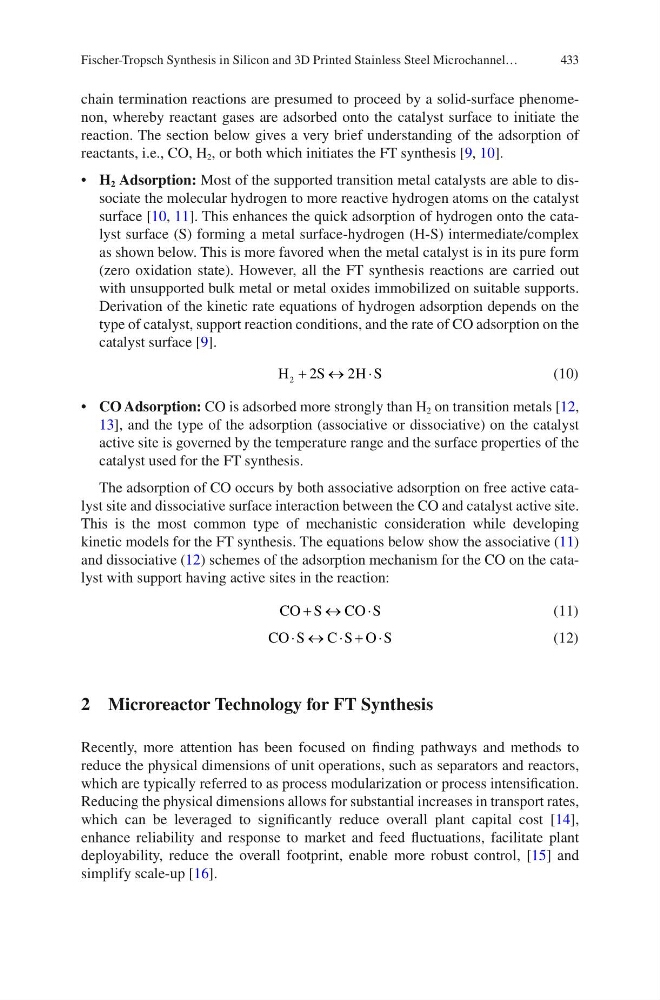
• H 2 Adsorption: Most of the supported transition metal catalysts are able to dissociate the molecular hydrogen to more reactive hydrogen atoms on the catalyst
surface [10, 11]. This enhances the quick adsorption of hydrogen onto the catalyst surface (S) forming a metal surface-hydrogen (H-S) intermediate/complex
as shown below. This is more favored when the metal catalyst is in its pure form
(zero oxidation state). However, all the FT synthesis reactions are carried out
with unsupported bulk metal or metal oxides immobilized on suitable supports.
Derivation of the kinetic rate equations of hydrogen adsorption depends on the
type of catalyst, support reaction conditions, and the rate of CO adsorption on the
catalyst surface [9].
H
S
H S
2
2
2
+ «
×
(10)
• CO Adsorption: CO is adsorbed more strongly than H 2 on transition metals [12,
13], and the type of the adsorption (associative or dissociative) on the catalyst
active site is governed by the temperature range and the surface properties of the
catalyst used for the FT synthesis.
The adsorption of CO occurs by both associative adsorption on free active catalyst site and dissociative surface interaction between the CO and catalyst active site.
This is the most common type of mechanistic consideration while developing
kinetic models for the FT synthesis. The equations below show the associative (11)
and dissociative (12) schemes of the adsorption mechanism for the CO on the catalyst with support having active sites in the reaction:
CO S CO S
+ «
×
(11)
CO S C S O S
× « × + ×
(12)
2 Microreactor Technology for FT Synthesis
Recently, more attention has been focused on finding pathways and methods to
reduce the physical dimensions of unit operations, such as separators and reactors,
which are typically referred to as process modularization or process intensification.
Reducing the physical dimensions allows for substantial increases in transport rates,
which can be leveraged to significantly reduce overall plant capital cost [14],
enhance reliability and response to market and feed fluctuations, facilitate plant
deployability, reduce the overall footprint, enable more robust control, [15] and
simplify scale-up [16].
Fischer-Tropsch Synthesis in Silicon and 3D Printed Stainless Steel Microchannel…
chain termination reactions are presumed to proceed by a solid-surface phenomenon, whereby reactant gases are adsorbed onto the catalyst surface to initiate the
reaction. The section below gives a very brief understanding of the adsorption of
reactants, i.e., CO, H 2 , or both which initiates the FT synthesis [9, 10].
• H 2 Adsorption: Most of the supported transition metal catalysts are able to dissociate the molecular hydrogen to more reactive hydrogen atoms on the catalyst
surface [10, 11]. This enhances the quick adsorption of hydrogen onto the catalyst surface (S) forming a metal surface-hydrogen (H-S) intermediate/complex
as shown below. This is more favored when the metal catalyst is in its pure form
(zero oxidation state). However, all the FT synthesis reactions are carried out
with unsupported bulk metal or metal oxides immobilized on suitable supports.
Derivation of the kinetic rate equations of hydrogen adsorption depends on the
type of catalyst, support reaction conditions, and the rate of CO adsorption on the
catalyst surface [9].
H
S
H S
2
2
2
+ «
×
(10)
• CO Adsorption: CO is adsorbed more strongly than H 2 on transition metals [12,
13], and the type of the adsorption (associative or dissociative) on the catalyst
active site is governed by the temperature range and the surface properties of the
catalyst used for the FT synthesis.
The adsorption of CO occurs by both associative adsorption on free active catalyst site and dissociative surface interaction between the CO and catalyst active site.
This is the most common type of mechanistic consideration while developing
kinetic models for the FT synthesis. The equations below show the associative (11)
and dissociative (12) schemes of the adsorption mechanism for the CO on the catalyst with support having active sites in the reaction:
CO S CO S
+ «
×
(11)
CO S C S O S
× « × + ×
(12)
2 Microreactor Technology for FT Synthesis
Recently, more attention has been focused on finding pathways and methods to
reduce the physical dimensions of unit operations, such as separators and reactors,
which are typically referred to as process modularization or process intensification.
Reducing the physical dimensions allows for substantial increases in transport rates,
which can be leveraged to significantly reduce overall plant capital cost [14],
enhance reliability and response to market and feed fluctuations, facilitate plant
deployability, reduce the overall footprint, enable more robust control, [15] and
simplify scale-up [16].
Fischer-Tropsch Synthesis in Silicon and 3D Printed Stainless Steel Microchannel…