

406
• While using the petcoke as a feed for the fixed bed gasifier, maintaining the permeability of the bed becomes extremely difficult [14].
• Agglomeration of ash is more prominent in both types of the gasifiers as compared to entrained flow gasifier [15].
In fixed-bed reactors the fuels move either concurrent or countercurrent to the
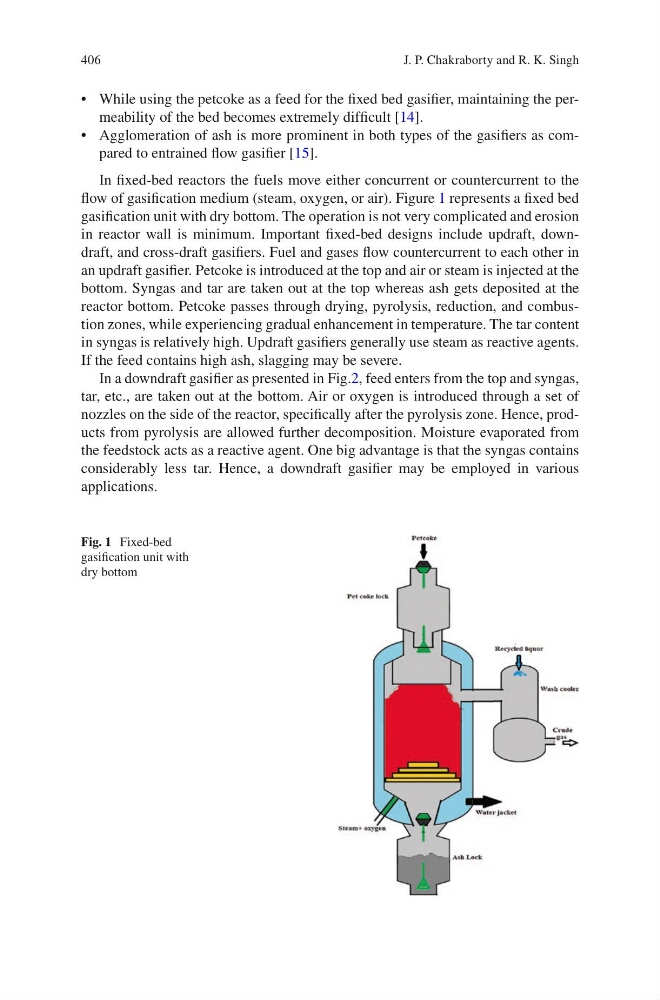
flow of gasification medium (steam, oxygen, or air). Figure 1 represents a fixed bed
gasification unit with dry bottom. The operation is not very complicated and erosion
in reactor wall is minimum. Important fixed-bed designs include updraft, downdraft, and cross-draft gasifiers. Fuel and gases flow countercurrent to each other in
an updraft gasifier. Petcoke is introduced at the top and air or steam is injected at the
bottom. Syngas and tar are taken out at the top whereas ash gets deposited at the
reactor bottom. Petcoke passes through drying, pyrolysis, reduction, and combustion zones, while experiencing gradual enhancement in temperature. The tar content
in syngas is relatively high. Updraft gasifiers generally use steam as reactive agents.
If the feed contains high ash, slagging may be severe.
In a downdraft gasifier as presented in Fig.2, feed enters from the top and syngas,
tar, etc., are taken out at the bottom. Air or oxygen is introduced through a set of
nozzles on the side of the reactor, specifically after the pyrolysis zone. Hence, products from pyrolysis are allowed further decomposition. Moisture evaporated from
the feedstock acts as a reactive agent. One big advantage is that the syngas contains
considerably less tar. Hence, a downdraft gasifier may be employed in various
applications.
Fig. 1 Fixed-bed
gasification unit with
dry bottom
J. P. Chakraborty and R. K. Singh
• While using the petcoke as a feed for the fixed bed gasifier, maintaining the permeability of the bed becomes extremely difficult [14].
• Agglomeration of ash is more prominent in both types of the gasifiers as compared to entrained flow gasifier [15].
In fixed-bed reactors the fuels move either concurrent or countercurrent to the
flow of gasification medium (steam, oxygen, or air). Figure 1 represents a fixed bed
gasification unit with dry bottom. The operation is not very complicated and erosion
in reactor wall is minimum. Important fixed-bed designs include updraft, downdraft, and cross-draft gasifiers. Fuel and gases flow countercurrent to each other in
an updraft gasifier. Petcoke is introduced at the top and air or steam is injected at the
bottom. Syngas and tar are taken out at the top whereas ash gets deposited at the
reactor bottom. Petcoke passes through drying, pyrolysis, reduction, and combustion zones, while experiencing gradual enhancement in temperature. The tar content
in syngas is relatively high. Updraft gasifiers generally use steam as reactive agents.
If the feed contains high ash, slagging may be severe.
In a downdraft gasifier as presented in Fig.2, feed enters from the top and syngas,
tar, etc., are taken out at the bottom. Air or oxygen is introduced through a set of
nozzles on the side of the reactor, specifically after the pyrolysis zone. Hence, products from pyrolysis are allowed further decomposition. Moisture evaporated from
the feedstock acts as a reactive agent. One big advantage is that the syngas contains
considerably less tar. Hence, a downdraft gasifier may be employed in various
applications.
Fig. 1 Fixed-bed
gasification unit with
dry bottom
J. P. Chakraborty and R. K. Singh