

403
moisture is significant. Feedstock with high moisture content may be suitable for
liquid phase reactions like fermentation, etc., where there is no need to remove or
reduce moisture before actual operation. It has been observed that a high volatile
matter generally produces liquid product (bio-oil, etc.) with higher yield. On the
contrary, a high fixed carbon will give more syngas at high temperature, or enhanced
formation of biochar in case of slow pyrolysis. Hence, from the above table, it may
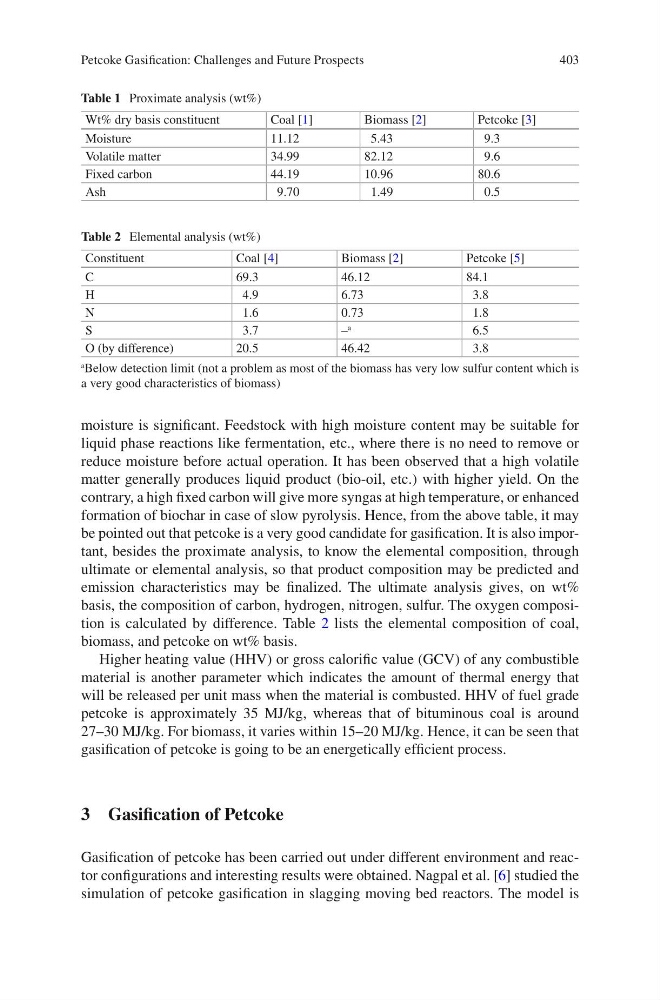
be pointed out that petcoke is a very good candidate for gasification. It is also important, besides the proximate analysis, to know the elemental composition, through
ultimate or elemental analysis, so that product composition may be predicted and
emission characteristics may be finalized. The ultimate analysis gives, on wt%
basis, the composition of carbon, hydrogen, nitrogen, sulfur. The oxygen composition is calculated by difference. Table 2 lists the elemental composition of coal,
biomass, and petcoke on wt% basis.
Higher heating value (HHV) or gross calorific value (GCV) of any combustible
material is another parameter which indicates the amount of thermal energy that
will be released per unit mass when the material is combusted. HHV of fuel grade
petcoke is approximately 35 MJ/kg, whereas that of bituminous coal is around
27–30 MJ/kg. For biomass, it varies within 15–20 MJ/kg. Hence, it can be seen that
gasification of petcoke is going to be an energetically efficient process.
3 Gasification of Petcoke
Gasification of petcoke has been carried out under different environment and reactor configurations and interesting results were obtained. Nagpal et al. [6] studied the
simulation of petcoke gasification in slagging moving bed reactors. The model is
Table 1 Proximate analysis (wt%)
Wt% dry basis constituent
Coal [1]
Biomass [2]
Petcoke [3]
Moisture
11.12
5.43
9.3
Volatile matter
34.99
82.12
9.6
Fixed carbon
44.19
10.96
80.6
Ash
9.70
1.49
0.5
Table 2 Elemental analysis (wt%)
Constituent
Coal [4]
Biomass [2]
Petcoke [5]
C
69.3
46.12
84.1
H
4.9
6.73
3.8
N
1.6
0.73
1.8
S
3.7
–
a
6.5
O (by difference)
20.5
46.42
3.8
a
Below detection limit (not a problem as most of the biomass has very low sulfur content which is
a very good characteristics of biomass)
Petcoke Gasification: Challenges and Future Prospects
moisture is significant. Feedstock with high moisture content may be suitable for
liquid phase reactions like fermentation, etc., where there is no need to remove or
reduce moisture before actual operation. It has been observed that a high volatile
matter generally produces liquid product (bio-oil, etc.) with higher yield. On the
contrary, a high fixed carbon will give more syngas at high temperature, or enhanced
formation of biochar in case of slow pyrolysis. Hence, from the above table, it may
be pointed out that petcoke is a very good candidate for gasification. It is also important, besides the proximate analysis, to know the elemental composition, through
ultimate or elemental analysis, so that product composition may be predicted and
emission characteristics may be finalized. The ultimate analysis gives, on wt%
basis, the composition of carbon, hydrogen, nitrogen, sulfur. The oxygen composition is calculated by difference. Table 2 lists the elemental composition of coal,
biomass, and petcoke on wt% basis.
Higher heating value (HHV) or gross calorific value (GCV) of any combustible
material is another parameter which indicates the amount of thermal energy that
will be released per unit mass when the material is combusted. HHV of fuel grade
petcoke is approximately 35 MJ/kg, whereas that of bituminous coal is around
27–30 MJ/kg. For biomass, it varies within 15–20 MJ/kg. Hence, it can be seen that
gasification of petcoke is going to be an energetically efficient process.
3 Gasification of Petcoke
Gasification of petcoke has been carried out under different environment and reactor configurations and interesting results were obtained. Nagpal et al. [6] studied the
simulation of petcoke gasification in slagging moving bed reactors. The model is
Table 1 Proximate analysis (wt%)
Wt% dry basis constituent
Coal [1]
Biomass [2]
Petcoke [3]
Moisture
11.12
5.43
9.3
Volatile matter
34.99
82.12
9.6
Fixed carbon
44.19
10.96
80.6
Ash
9.70
1.49
0.5
Table 2 Elemental analysis (wt%)
Constituent
Coal [4]
Biomass [2]
Petcoke [5]
C
69.3
46.12
84.1
H
4.9
6.73
3.8
N
1.6
0.73
1.8
S
3.7
–
a
6.5
O (by difference)
20.5
46.42
3.8
a
Below detection limit (not a problem as most of the biomass has very low sulfur content which is
a very good characteristics of biomass)
Petcoke Gasification: Challenges and Future Prospects