

396
includes the judicial selection of metal centere and ligands, a variety of new porous
materials can be synthesized endlessly.
3.3 Application of MOFs
Various organic linkers and metal nodes can be combined in a number of ways in
order to improve its selectivity and sensitivity toward particular applications.
Potential applications of MOFs in various fields are as follows:
• Storage of energy-relevant gases (especially hydrogen)
• Gas separation
• Luminescence
• Chemical sensors
• Adsorbents
• Electrochemistry (coated on positive electrodes as corrosion inhibitors of metal
surfaces)
• Biological applications (controlled delivery of drugs)
Porosity of MOFs makes them exceptional adsorbents due to the availability of
higher pore volume [19]. Higher porosity of MOFs also favors them to be used as
chemical sensors and adsorbents. Recently various membrane separation applications like steam separation, desalination, pervaporation, and wastewater treatment
have incorporated water-stable MOFs extensively. Water-stable MOFs are also
employed in taking gases under moist conditions. The liberty of tailoring the properties of MOFs to desired level makes them significant catalysts in various important reactions of chemical industries. Mostly, the MOFs are used as oxidizing
catalysts with the incorporation of various transition metals like Cr, Mn, Fe, Co, Cu,
and Ti into their framework. These MOFs-based oxidizing catalysts support selective oxidation reactions by functionalization of C–C bonds. This selective oxidation
reaction can occur in two ways:
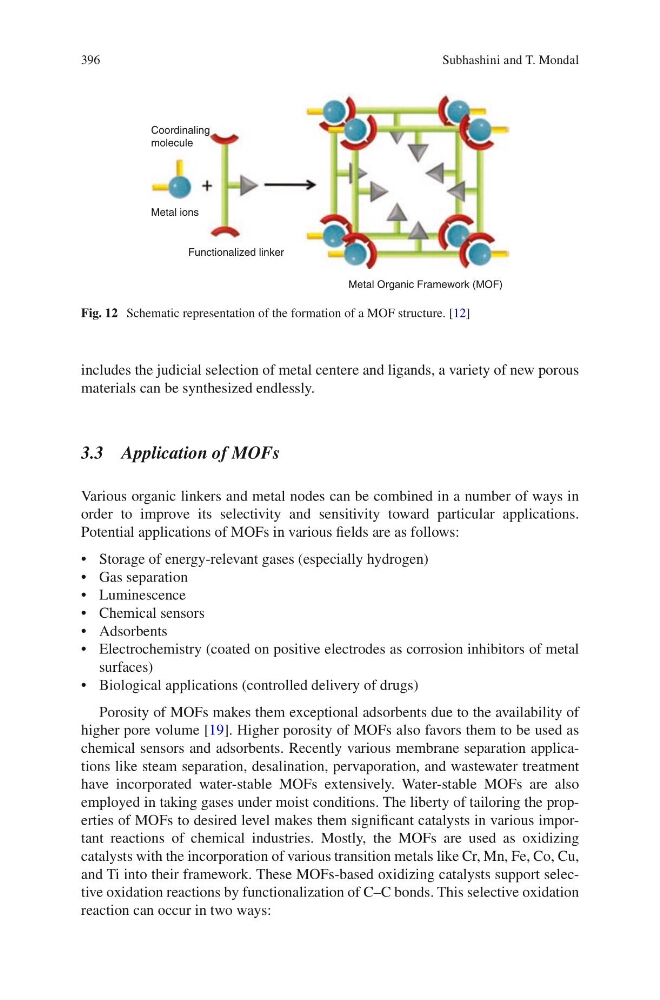
Coordinaling
molecule
Metal ions
Functionalized linker
Metal Organic Framework (MOF)
Fig. 12 Schematic representation of the formation of a MOF structure. [12]
Subhashini and T. Mondal
includes the judicial selection of metal centere and ligands, a variety of new porous
materials can be synthesized endlessly.
3.3 Application of MOFs
Various organic linkers and metal nodes can be combined in a number of ways in
order to improve its selectivity and sensitivity toward particular applications.
Potential applications of MOFs in various fields are as follows:
• Storage of energy-relevant gases (especially hydrogen)
• Gas separation
• Luminescence
• Chemical sensors
• Adsorbents
• Electrochemistry (coated on positive electrodes as corrosion inhibitors of metal
surfaces)
• Biological applications (controlled delivery of drugs)
Porosity of MOFs makes them exceptional adsorbents due to the availability of
higher pore volume [19]. Higher porosity of MOFs also favors them to be used as
chemical sensors and adsorbents. Recently various membrane separation applications like steam separation, desalination, pervaporation, and wastewater treatment
have incorporated water-stable MOFs extensively. Water-stable MOFs are also
employed in taking gases under moist conditions. The liberty of tailoring the properties of MOFs to desired level makes them significant catalysts in various important reactions of chemical industries. Mostly, the MOFs are used as oxidizing
catalysts with the incorporation of various transition metals like Cr, Mn, Fe, Co, Cu,
and Ti into their framework. These MOFs-based oxidizing catalysts support selective oxidation reactions by functionalization of C–C bonds. This selective oxidation
reaction can occur in two ways:
Coordinaling
molecule
Metal ions
Functionalized linker
Metal Organic Framework (MOF)
Fig. 12 Schematic representation of the formation of a MOF structure. [12]
Subhashini and T. Mondal