

365
mesoporosity effect must be carefully studied. Overall, these approaches help in
increasing catalyst utilization with a better lifetime, and at times better product
selectivity.
2.3 Performance
The performance of catalysts in delivering the desired product with a sustainable
and economically viable process is the ultimate test for any technology and innovation. For the firsthand feasibility analysis, we look at the conversion of limiting
reactants, the selectivity of the desired product, and the lifetime of the catalyst.
Under various circumstances, these parameters are antagonistic in nature with each
other. The success lies in finding a sweet spot of the optimal structural features and
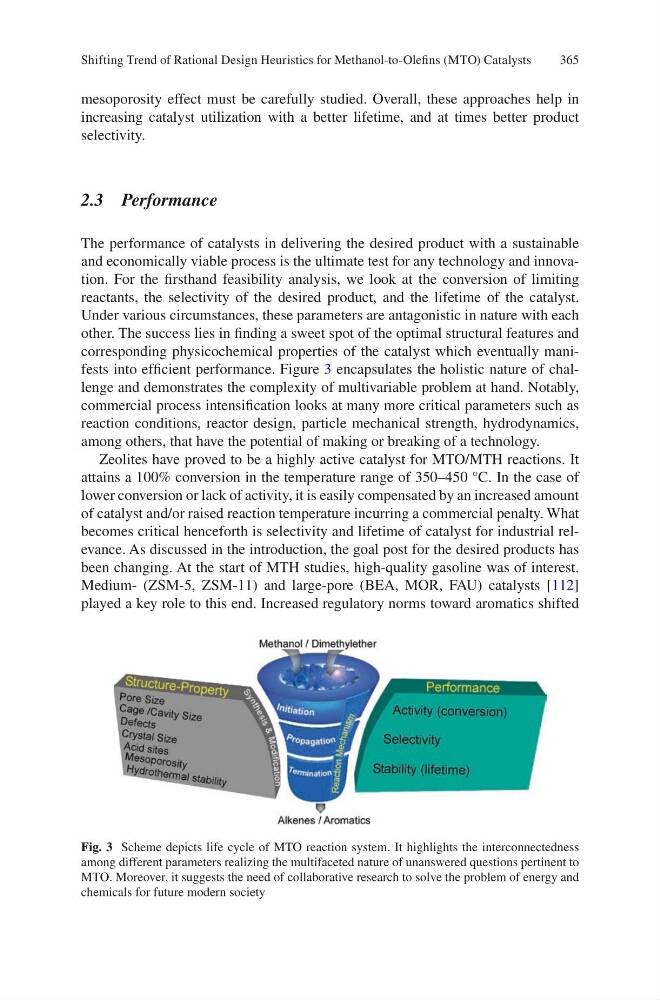
corresponding physicochemical properties of the catalyst which eventually manifests into efficient performance. Figure 3 encapsulates the holistic nature of challenge and demonstrates the complexity of multivariable problem at hand. Notably,
commercial process intensification looks at many more critical parameters such as
reaction conditions, reactor design, particle mechanical strength, hydrodynamics,
among others, that have the potential of making or breaking of a technology.
Zeolites have proved to be a highly active catalyst for MTO/MTH reactions. It
attains a 100% conversion in the temperature range of 350–450 °C. In the case of
lower conversion or lack of activity, it is easily compensated by an increased amount
of catalyst and/or raised reaction temperature incurring a commercial penalty. What
becomes critical henceforth is selectivity and lifetime of catalyst for industrial relevance. As discussed in the introduction, the goal post for the desired products has
been changing. At the start of MTH studies, high-quality gasoline was of interest.
Medium- (ZSM-5, ZSM-11) and large-pore (BEA, MOR, FAU) catalysts [112]
played a key role to this end. Increased regulatory norms toward aromatics shifted
Fig. 3 Scheme depicts life cycle of MTO reaction system. It highlights the interconnectedness
among different parameters realizing the multifaceted nature of unanswered questions pertinent to
MTO. Moreover, it suggests the need of collaborative research to solve the problem of energy and
chemicals for future modern society
Shifting Trend of Rational Design Heuristics for Methanol-to-Olefins (MTO) Catalysts
mesoporosity effect must be carefully studied. Overall, these approaches help in
increasing catalyst utilization with a better lifetime, and at times better product
selectivity.
2.3 Performance
The performance of catalysts in delivering the desired product with a sustainable
and economically viable process is the ultimate test for any technology and innovation. For the firsthand feasibility analysis, we look at the conversion of limiting
reactants, the selectivity of the desired product, and the lifetime of the catalyst.
Under various circumstances, these parameters are antagonistic in nature with each
other. The success lies in finding a sweet spot of the optimal structural features and
corresponding physicochemical properties of the catalyst which eventually manifests into efficient performance. Figure 3 encapsulates the holistic nature of challenge and demonstrates the complexity of multivariable problem at hand. Notably,
commercial process intensification looks at many more critical parameters such as
reaction conditions, reactor design, particle mechanical strength, hydrodynamics,
among others, that have the potential of making or breaking of a technology.
Zeolites have proved to be a highly active catalyst for MTO/MTH reactions. It
attains a 100% conversion in the temperature range of 350–450 °C. In the case of
lower conversion or lack of activity, it is easily compensated by an increased amount
of catalyst and/or raised reaction temperature incurring a commercial penalty. What
becomes critical henceforth is selectivity and lifetime of catalyst for industrial relevance. As discussed in the introduction, the goal post for the desired products has
been changing. At the start of MTH studies, high-quality gasoline was of interest.
Medium- (ZSM-5, ZSM-11) and large-pore (BEA, MOR, FAU) catalysts [112]
played a key role to this end. Increased regulatory norms toward aromatics shifted
Fig. 3 Scheme depicts life cycle of MTO reaction system. It highlights the interconnectedness
among different parameters realizing the multifaceted nature of unanswered questions pertinent to
MTO. Moreover, it suggests the need of collaborative research to solve the problem of energy and
chemicals for future modern society
Shifting Trend of Rational Design Heuristics for Methanol-to-Olefins (MTO) Catalysts