

361
showed that small (0.2μm) and larger (2.5μm) particles were less active and selective but olefin yield increased for medium-size crystallite (0.4–0.5μm) with average
activity. It was also observed that the coking rate increased with crystal size. Despite
faster coking rate, smaller particles plateau with higher coke content compared to
larger particles. Olsbye and coworker [56] showed the same effect using different
sized catalyst particles. Interestingly, coke build-up promotes the product selectivity
toward lighter ethene or ethane. There is extensive study [57–60] showing the
impact of crystal size on an increased lifetime. Among other factors, the short diffusion path length is a key determinant. BET surface area qualitatively corresponds to
the size of catalyst particle and hence catalyst lifetime. Lu group [61] showed a
similar order by synthesizing zeolite with varied sizes using a different combination
of organics. A systematic investigation of size vs. lifetime was presented by Xu and
coworker [62]. They synthesized four varied size crystallites (from 20 nm to 8μm)
with different morphology (nanoflakes to cubic) and studied deactivation phenomenon using MTO reaction. Nanosized flake showed the longest lifetime compared to
cubic 8μm crystals. Particles of an intermediate size such as 80 nm (spheroidal) and
1μm (cubic) fell in between. It should be noted that crystal morphology plays a big
role but we will skip the discussion here. To rationally design the catalyst, different
synthesis strategies have been explored. It is most common to vary the composition
[63], organic phase [44, 64–67], or growth protocol [68] of mother liquor used for
synthesis [4]. Hunger group [69] used different structure-directing agents to obtain
the three different crystallite sizes referred to as small (S), medium (M), large (L).
Catalytic studies showed the anticipated trend as SAPO-34-S > SAPO-34-M > SA
PO- 34- L because longer residence time promotes higher methylation eventually
clogging the cage with polyaromatics and highly branched methylbenzene. Coking
does not only reduce the lifetime but decrease the catalyst utilization efficiency.
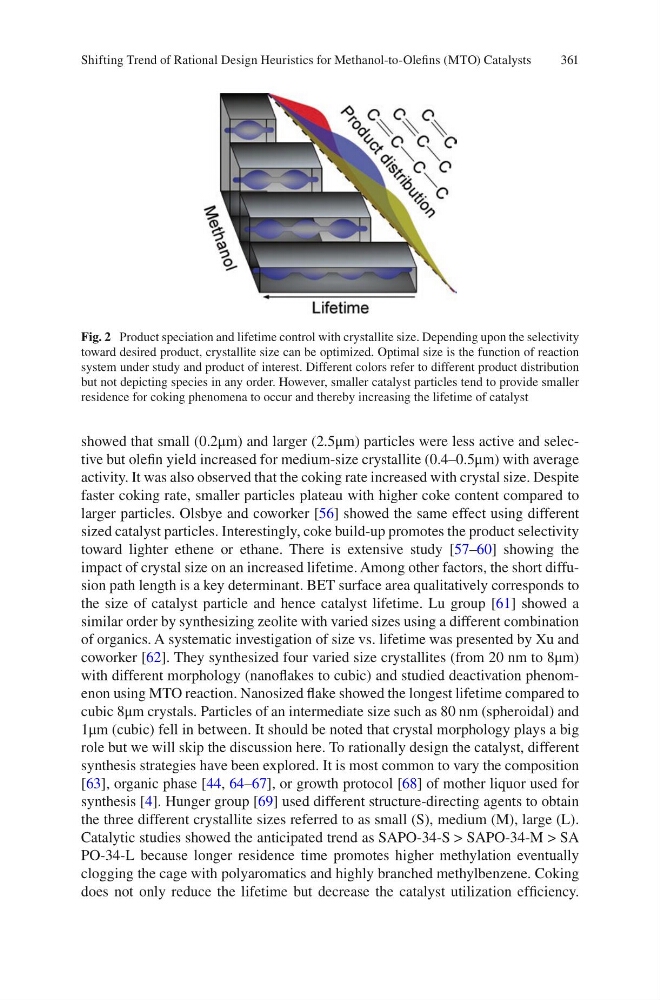
Fig. 2 Product speciation and lifetime control with crystallite size. Depending upon the selectivity
toward desired product, crystallite size can be optimized. Optimal size is the function of reaction
system under study and product of interest. Different colors refer to different product distribution
but not depicting species in any order. However, smaller catalyst particles tend to provide smaller
residence for coking phenomena to occur and thereby increasing the lifetime of catalyst
Shifting Trend of Rational Design Heuristics for Methanol-to-Olefins (MTO) Catalysts
showed that small (0.2μm) and larger (2.5μm) particles were less active and selective but olefin yield increased for medium-size crystallite (0.4–0.5μm) with average
activity. It was also observed that the coking rate increased with crystal size. Despite
faster coking rate, smaller particles plateau with higher coke content compared to
larger particles. Olsbye and coworker [56] showed the same effect using different
sized catalyst particles. Interestingly, coke build-up promotes the product selectivity
toward lighter ethene or ethane. There is extensive study [57–60] showing the
impact of crystal size on an increased lifetime. Among other factors, the short diffusion path length is a key determinant. BET surface area qualitatively corresponds to
the size of catalyst particle and hence catalyst lifetime. Lu group [61] showed a
similar order by synthesizing zeolite with varied sizes using a different combination
of organics. A systematic investigation of size vs. lifetime was presented by Xu and
coworker [62]. They synthesized four varied size crystallites (from 20 nm to 8μm)
with different morphology (nanoflakes to cubic) and studied deactivation phenomenon using MTO reaction. Nanosized flake showed the longest lifetime compared to
cubic 8μm crystals. Particles of an intermediate size such as 80 nm (spheroidal) and
1μm (cubic) fell in between. It should be noted that crystal morphology plays a big
role but we will skip the discussion here. To rationally design the catalyst, different
synthesis strategies have been explored. It is most common to vary the composition
[63], organic phase [44, 64–67], or growth protocol [68] of mother liquor used for
synthesis [4]. Hunger group [69] used different structure-directing agents to obtain
the three different crystallite sizes referred to as small (S), medium (M), large (L).
Catalytic studies showed the anticipated trend as SAPO-34-S > SAPO-34-M > SA
PO- 34- L because longer residence time promotes higher methylation eventually
clogging the cage with polyaromatics and highly branched methylbenzene. Coking
does not only reduce the lifetime but decrease the catalyst utilization efficiency.
Fig. 2 Product speciation and lifetime control with crystallite size. Depending upon the selectivity
toward desired product, crystallite size can be optimized. Optimal size is the function of reaction
system under study and product of interest. Different colors refer to different product distribution
but not depicting species in any order. However, smaller catalyst particles tend to provide smaller
residence for coking phenomena to occur and thereby increasing the lifetime of catalyst
Shifting Trend of Rational Design Heuristics for Methanol-to-Olefins (MTO) Catalysts