

357
Among the small pore zeolite family, silicoaluminophosphate SAPO-34 (CHA
framework) [7, 11, 12] (structural analogue SSZ-13) has gained commercial popularity for MTO reactions owing to lighter olefin selectivity. To explore other possibilities, research groups are looking for other small-pore zeolites (RUB, KFI, DNL,
etc.) for better efficacy and commercial viability. To this end, the variation of smallpore SAPOs was explored by Hong group [13]. They obtained similar performance
for STA-7 (SAV) and poor performance with STA-14 (KFI) attributed to the pore
topology and connectivity. Other small-pore zeolites have been studied by various
other groups for MTO activity such as Weckhuysen [14], Zheng [15], Corma [16–
18], and Davis [19] which might pave a path for a new and more efficient catalyst
for MTO. On the other hand, medium- and large-pore zeolites (i.e., ZSM-5, FER,
BEA, MOR, Zeolite-Y) [8, 20] provide a conduit to aromatics and higher alkenes
which is desirable for MTG or GTL processes. There are extensive studies [20–23]
establishing the comparative product speciation for different pore zeolites. We
escaped the topology in the discussion, but it is well established that the same pore
size zeolite with 1D, 2D, and 3D geometry has a significant impact on the lifetime
of catalyst and product distribution. However, it must be noted that a major role in
controlling or activating reaction pathways is played by the cage explained in the
next section.
2.1.2 Cage/Cavity/Pockets Shape and Size
Cages, cavities, or pockets are the inherent attributes of crystallite which is formed
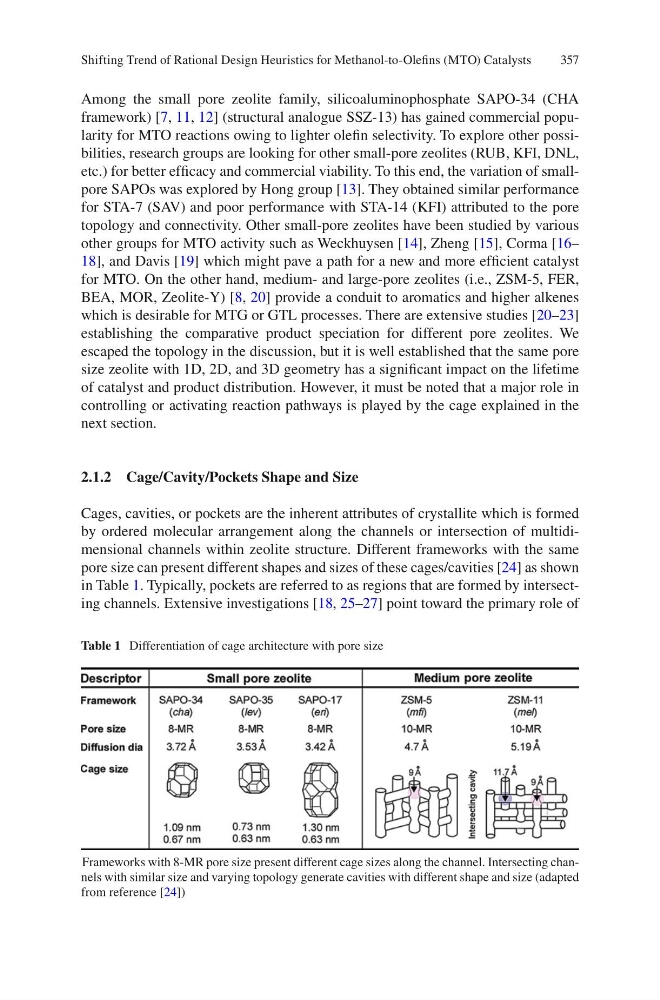
by ordered molecular arrangement along the channels or intersection of multidimensional channels within zeolite structure. Different frameworks with the same
pore size can present different shapes and sizes of these cages/cavities [24] as shown
in Table 1. Typically, pockets are referred to as regions that are formed by intersecting channels. Extensive investigations [18, 25–27] point toward the primary role of
Table 1 Differentiation of cage architecture with pore size
Frameworks with 8-MR pore size present different cage sizes along the channel. Intersecting channels with similar size and varying topology generate cavities with different shape and size (adapted
from reference [24])
Shifting Trend of Rational Design Heuristics for Methanol-to-Olefins (MTO) Catalysts
Among the small pore zeolite family, silicoaluminophosphate SAPO-34 (CHA
framework) [7, 11, 12] (structural analogue SSZ-13) has gained commercial popularity for MTO reactions owing to lighter olefin selectivity. To explore other possibilities, research groups are looking for other small-pore zeolites (RUB, KFI, DNL,
etc.) for better efficacy and commercial viability. To this end, the variation of smallpore SAPOs was explored by Hong group [13]. They obtained similar performance
for STA-7 (SAV) and poor performance with STA-14 (KFI) attributed to the pore
topology and connectivity. Other small-pore zeolites have been studied by various
other groups for MTO activity such as Weckhuysen [14], Zheng [15], Corma [16–
18], and Davis [19] which might pave a path for a new and more efficient catalyst
for MTO. On the other hand, medium- and large-pore zeolites (i.e., ZSM-5, FER,
BEA, MOR, Zeolite-Y) [8, 20] provide a conduit to aromatics and higher alkenes
which is desirable for MTG or GTL processes. There are extensive studies [20–23]
establishing the comparative product speciation for different pore zeolites. We
escaped the topology in the discussion, but it is well established that the same pore
size zeolite with 1D, 2D, and 3D geometry has a significant impact on the lifetime
of catalyst and product distribution. However, it must be noted that a major role in
controlling or activating reaction pathways is played by the cage explained in the
next section.
2.1.2 Cage/Cavity/Pockets Shape and Size
Cages, cavities, or pockets are the inherent attributes of crystallite which is formed
by ordered molecular arrangement along the channels or intersection of multidimensional channels within zeolite structure. Different frameworks with the same
pore size can present different shapes and sizes of these cages/cavities [24] as shown
in Table 1. Typically, pockets are referred to as regions that are formed by intersecting channels. Extensive investigations [18, 25–27] point toward the primary role of
Table 1 Differentiation of cage architecture with pore size
Frameworks with 8-MR pore size present different cage sizes along the channel. Intersecting channels with similar size and varying topology generate cavities with different shape and size (adapted
from reference [24])
Shifting Trend of Rational Design Heuristics for Methanol-to-Olefins (MTO) Catalysts