

354
1 Introduction
The developmental footprint of catalysts and catalysis and their usage trace a long
time back in history alleviating the daily experience of life. Among many success
stories, sources of energy have been key movers and shakers of modern civilization,
and subsequently, the petroleum and petrochemical sectors have been key players.
A bird’s eye view of the processes involved in these sectors quickly establishes the
critical role of catalysts, and subsequently the need for innovation. These quests led
to the inception of new chemistry that started in the lab of ExxonMobil in the
mid- 1970s when a coincidence led to the discovery of new species in reaction product leading to the emergence of methanol to hydrocarbons (commonly known as
MTH) chemistry. The novelty of this process emerged from the product distribution
which contained aromatics, alkanes, and alkenes providing high octane gasoline
from methanol. The advent led to the licensing of methanol-to-gasoline (MTG) processes [1]. Interestingly, these facets of catalysis emerged from the exploratory
work of newly found ZSM-5 aluminosilicate catalyst to gauge its potential. While
the findings were fascinating, but the questions about different aspects of chemistry
pertaining to the mechanism, catalyst role and design, and scale-up were still elusive. In the meantime, it became evident that aromatics in the product pose an environmental challenge; and hence the norms from the regulatory agencies become
strict. Additionally, there was a decline in the petrochemical industries in the 1990s.
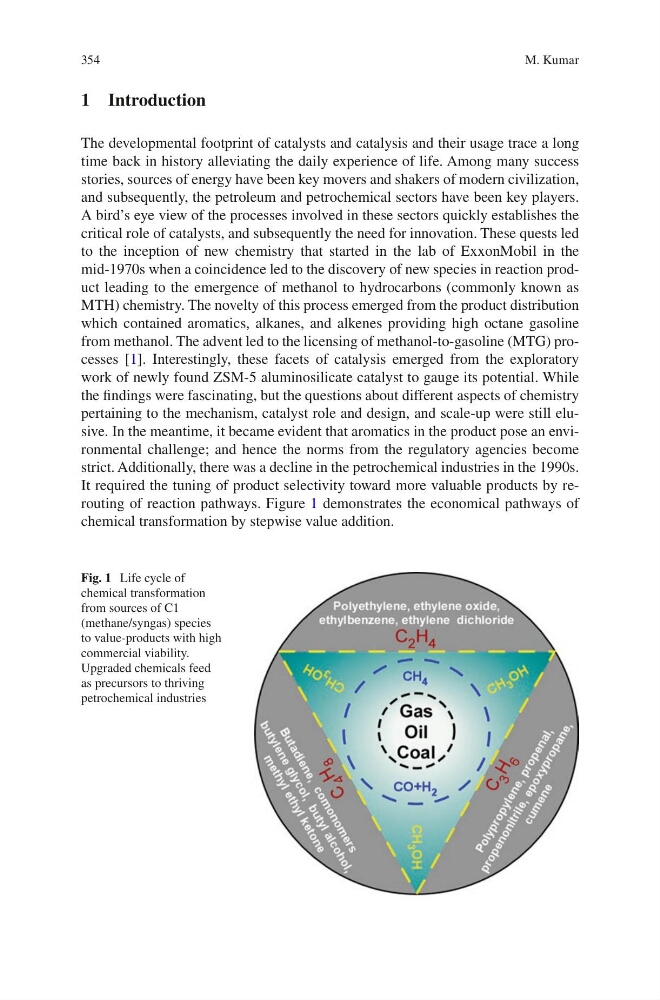
It required the tuning of product selectivity toward more valuable products by rerouting of reaction pathways. Figure 1 demonstrates the economical pathways of
chemical transformation by stepwise value addition.
Fig. 1 Life cycle of
chemical transformation
from sources of C1
(methane/syngas) species
to value-products with high
commercial viability.
Upgraded chemicals feed
as precursors to thriving
petrochemical industries
M. Kumar
1 Introduction
The developmental footprint of catalysts and catalysis and their usage trace a long
time back in history alleviating the daily experience of life. Among many success
stories, sources of energy have been key movers and shakers of modern civilization,
and subsequently, the petroleum and petrochemical sectors have been key players.
A bird’s eye view of the processes involved in these sectors quickly establishes the
critical role of catalysts, and subsequently the need for innovation. These quests led
to the inception of new chemistry that started in the lab of ExxonMobil in the
mid- 1970s when a coincidence led to the discovery of new species in reaction product leading to the emergence of methanol to hydrocarbons (commonly known as
MTH) chemistry. The novelty of this process emerged from the product distribution
which contained aromatics, alkanes, and alkenes providing high octane gasoline
from methanol. The advent led to the licensing of methanol-to-gasoline (MTG) processes [1]. Interestingly, these facets of catalysis emerged from the exploratory
work of newly found ZSM-5 aluminosilicate catalyst to gauge its potential. While
the findings were fascinating, but the questions about different aspects of chemistry
pertaining to the mechanism, catalyst role and design, and scale-up were still elusive. In the meantime, it became evident that aromatics in the product pose an environmental challenge; and hence the norms from the regulatory agencies become
strict. Additionally, there was a decline in the petrochemical industries in the 1990s.
It required the tuning of product selectivity toward more valuable products by rerouting of reaction pathways. Figure 1 demonstrates the economical pathways of
chemical transformation by stepwise value addition.
Fig. 1 Life cycle of
chemical transformation
from sources of C1
(methane/syngas) species
to value-products with high
commercial viability.
Upgraded chemicals feed
as precursors to thriving
petrochemical industries
M. Kumar