

293
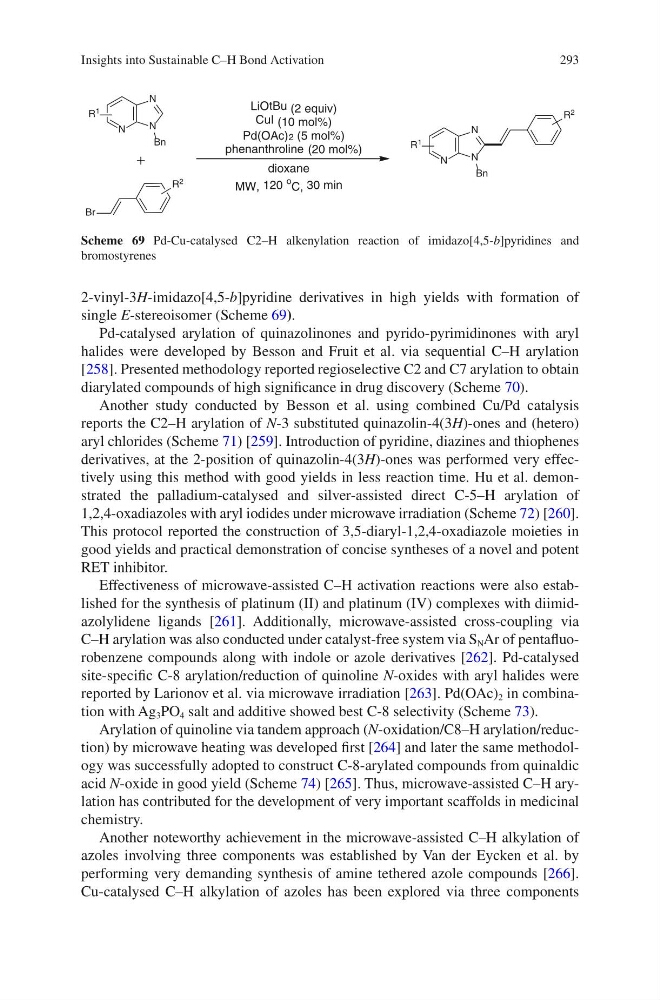
2-vinyl- 3H-imidazo[4,5-b]pyridine derivatives in high yields with formation of
single E-stereoisomer (Scheme 69).
Pd-catalysed arylation of quinazolinones and pyrido-pyrimidinones with aryl
halides were developed by Besson and Fruit et al. via sequential C–H arylation
[258]. Presented methodology reported regioselective C2 and C7 arylation to obtain
diarylated compounds of high significance in drug discovery (Scheme 70).
Another study conducted by Besson et al. using combined Cu/Pd catalysis
reports the C2–H arylation of N-3 substituted quinazolin-4(3H)-ones and (hetero)
aryl chlorides (Scheme 71) [259]. Introduction of pyridine, diazines and thiophenes
derivatives, at the 2-position of quinazolin-4(3H)-ones was performed very effectively using this method with good yields in less reaction time. Hu et al. demonstrated the palladium-catalysed and silver-assisted direct C-5–H arylation of
1,2,4-oxadiazoles with aryl iodides under microwave irradiation (Scheme 72) [260].
This protocol reported the construction of 3,5-diaryl-1,2,4-oxadiazole moieties in
good yields and practical demonstration of concise syntheses of a novel and potent
RET inhibitor.
Effectiveness of microwave-assisted C–H activation reactions were also established for the synthesis of platinum (II) and platinum (IV) complexes with diimidazolylidene ligands [261]. Additionally, microwave-assisted cross-coupling via
C–H arylation was also conducted under catalyst-free system via S N Ar of pentafluorobenzene compounds along with indole or azole derivatives [262]. Pd-catalysed
site-specific C-8 arylation/reduction of quinoline N-oxides with aryl halides were
reported by Larionov et al. via microwave irradiation [263]. Pd(OAc) 2 in combination with Ag 3 PO 4 salt and additive showed best C-8 selectivity (Scheme 73).
Arylation of quinoline via tandem approach (N-oxidation/C8–H arylation/reduction) by microwave heating was developed first [264] and later the same methodology was successfully adopted to construct C-8-arylated compounds from quinaldic
acid N-oxide in good yield (Scheme 74) [265]. Thus, microwave-assisted C–H arylation has contributed for the development of very important scaffolds in medicinal
chemistry.
Another noteworthy achievement in the microwave-assisted C–H alkylation of
azoles involving three components was established by Van der Eycken et al. by
performing very demanding synthesis of amine tethered azole compounds [266].
Cu-catalysed C–H alkylation of azoles has been explored via three components
LiOtBu (2 equiv)
CuI (10 mol%)
Pd(OAc)2 (5 mol%)
phenanthroline (20 mol%)
dioxane
MW, 120
o C, 30 min
R 2
N
N
Bn
N
R 1
Br
N
N
Bn
N
R 1
R 2
Scheme 69 Pd-Cu-catalysed C2–H alkenylation reaction of imidazo[4,5-b]pyridines and
bromostyrenes
Insights into Sustainable C–H Bond Activation
2-vinyl- 3H-imidazo[4,5-b]pyridine derivatives in high yields with formation of
single E-stereoisomer (Scheme 69).
Pd-catalysed arylation of quinazolinones and pyrido-pyrimidinones with aryl
halides were developed by Besson and Fruit et al. via sequential C–H arylation
[258]. Presented methodology reported regioselective C2 and C7 arylation to obtain
diarylated compounds of high significance in drug discovery (Scheme 70).
Another study conducted by Besson et al. using combined Cu/Pd catalysis
reports the C2–H arylation of N-3 substituted quinazolin-4(3H)-ones and (hetero)
aryl chlorides (Scheme 71) [259]. Introduction of pyridine, diazines and thiophenes
derivatives, at the 2-position of quinazolin-4(3H)-ones was performed very effectively using this method with good yields in less reaction time. Hu et al. demonstrated the palladium-catalysed and silver-assisted direct C-5–H arylation of
1,2,4-oxadiazoles with aryl iodides under microwave irradiation (Scheme 72) [260].
This protocol reported the construction of 3,5-diaryl-1,2,4-oxadiazole moieties in
good yields and practical demonstration of concise syntheses of a novel and potent
RET inhibitor.
Effectiveness of microwave-assisted C–H activation reactions were also established for the synthesis of platinum (II) and platinum (IV) complexes with diimidazolylidene ligands [261]. Additionally, microwave-assisted cross-coupling via
C–H arylation was also conducted under catalyst-free system via S N Ar of pentafluorobenzene compounds along with indole or azole derivatives [262]. Pd-catalysed
site-specific C-8 arylation/reduction of quinoline N-oxides with aryl halides were
reported by Larionov et al. via microwave irradiation [263]. Pd(OAc) 2 in combination with Ag 3 PO 4 salt and additive showed best C-8 selectivity (Scheme 73).
Arylation of quinoline via tandem approach (N-oxidation/C8–H arylation/reduction) by microwave heating was developed first [264] and later the same methodology was successfully adopted to construct C-8-arylated compounds from quinaldic
acid N-oxide in good yield (Scheme 74) [265]. Thus, microwave-assisted C–H arylation has contributed for the development of very important scaffolds in medicinal
chemistry.
Another noteworthy achievement in the microwave-assisted C–H alkylation of
azoles involving three components was established by Van der Eycken et al. by
performing very demanding synthesis of amine tethered azole compounds [266].
Cu-catalysed C–H alkylation of azoles has been explored via three components
LiOtBu (2 equiv)
CuI (10 mol%)
Pd(OAc)2 (5 mol%)
phenanthroline (20 mol%)
dioxane
MW, 120
o C, 30 min
R 2
N
N
Bn
N
R 1
Br
N
N
Bn
N
R 1
R 2
Scheme 69 Pd-Cu-catalysed C2–H alkenylation reaction of imidazo[4,5-b]pyridines and
bromostyrenes
Insights into Sustainable C–H Bond Activation