

19
edge sites of adjacent MoS 2 nanoslabs. The electronic effect facilitates the formation of CUS and enhances the acidity of -SH species and also exhibits high isomerization activity in addition to promoting HDS and HDN activity of the catalyst.
Although Y zeolite has been reported to be an effective support for carrying out
HDS reactions, the strong acid strength and acid site density of Y zeolite may result
in hydrocarbon yield loss. Modification of Y zeolites using different metals assumed
significance to moderate and adjust the acidic properties and improve the pore structure. Zhou et al. [52] modified USY zeolites with gallium, phosphorous, and a combination of gallium and phosphorous and used them as support for the preparation
of NiMo-based HDS catalysts for application in the HDS of FCC diesel. Ga- and
P-modified USY zeolite catalysts showed higher HDS and HDN efficiencies compared to conventional NiMo-based catalysts.
Zhang et al. [51] synthesized CoMo-based HDS catalysts using crystalline zeolite nanorods modified with Ti as support material and showed higher activity and
stability for the HDS of 4,6-DMDBT than CoMo catalysts supported on Ti-free
mesoporous ZSM-5 and pure silicon silicalite-1 zeolites, SiO 2 –TiO 2 and γ-Al 2 O 3 .
Sun et al. [54] studied the effect of divalent tin on the molecular sieve SnSAPO-5
and its modulation to alumina support through formulation of efficient NiW-based
deep HDS catalysts using 4,6-DMDBT as a model compound. Substitution of trivalent aluminum by divalent tin in the framework of SnSAPO-5 resulted in an
increased number of Lewis and Brönsted sites and higher HDS rates compared to
other catalysts synthesized with the same active metal content. The higher HDS
performance and TOF in the case of tin-modified SAPO-5-Al 2 O 3 composite catalyst
was attributed to suitable catalyst acidity, higher sulfidation degree, and increased
stacking of WS 2 slabs, which are essential for the development of ultra-deep desulfurization of petroleum fractions such as diesel to meet the increasingly stringent
sulfur specifications.
Meng et al. [55] prepared a highly active trimetallic NiMoW-based HDS catalyst
using Zr modified mesoporous KIT-5 material as support and showed highest activities for the HDS of DBT and 4,6-DMDBT due to enhanced catalyst acidity and
better active metal distribution.
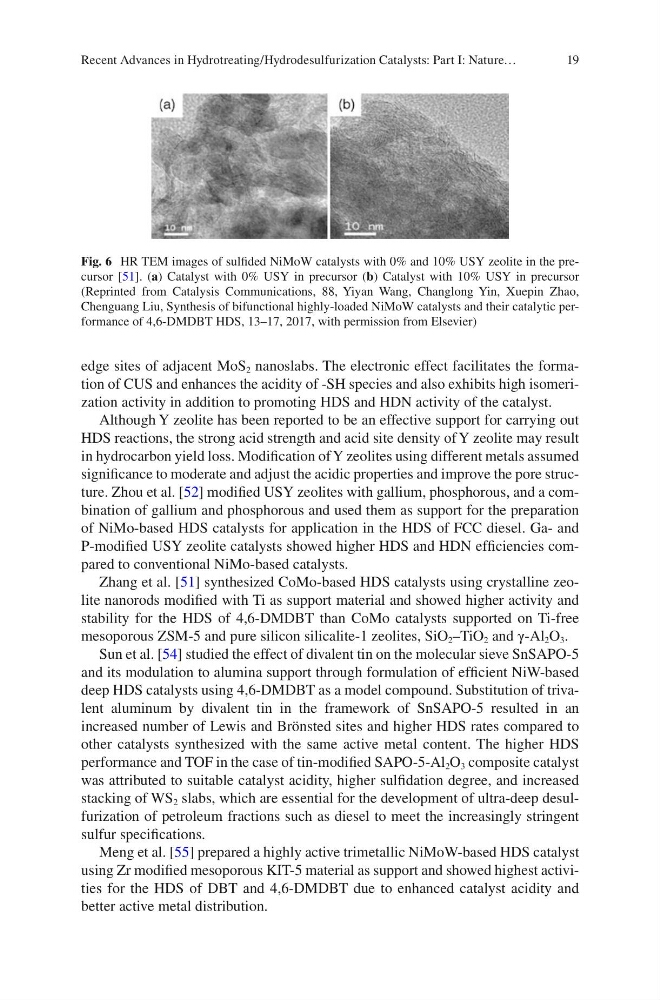
Fig. 6 HR TEM images of sulfided NiMoW catalysts with 0% and 10% USY zeolite in the precursor [51]. (a) Catalyst with 0% USY in precursor (b) Catalyst with 10% USY in precursor
(Reprinted from Catalysis Communications, 88, Yiyan Wang, Changlong Yin, Xuepin Zhao,
Chenguang Liu, Synthesis of bifunctional highly-loaded NiMoW catalysts and their catalytic performance of 4,6-DMDBT HDS, 13–17, 2017, with permission from Elsevier)
Recent Advances in Hydrotreating/Hydrodesulfurization Catalysts: Part I: Nature…
edge sites of adjacent MoS 2 nanoslabs. The electronic effect facilitates the formation of CUS and enhances the acidity of -SH species and also exhibits high isomerization activity in addition to promoting HDS and HDN activity of the catalyst.
Although Y zeolite has been reported to be an effective support for carrying out
HDS reactions, the strong acid strength and acid site density of Y zeolite may result
in hydrocarbon yield loss. Modification of Y zeolites using different metals assumed
significance to moderate and adjust the acidic properties and improve the pore structure. Zhou et al. [52] modified USY zeolites with gallium, phosphorous, and a combination of gallium and phosphorous and used them as support for the preparation
of NiMo-based HDS catalysts for application in the HDS of FCC diesel. Ga- and
P-modified USY zeolite catalysts showed higher HDS and HDN efficiencies compared to conventional NiMo-based catalysts.
Zhang et al. [51] synthesized CoMo-based HDS catalysts using crystalline zeolite nanorods modified with Ti as support material and showed higher activity and
stability for the HDS of 4,6-DMDBT than CoMo catalysts supported on Ti-free
mesoporous ZSM-5 and pure silicon silicalite-1 zeolites, SiO 2 –TiO 2 and γ-Al 2 O 3 .
Sun et al. [54] studied the effect of divalent tin on the molecular sieve SnSAPO-5
and its modulation to alumina support through formulation of efficient NiW-based
deep HDS catalysts using 4,6-DMDBT as a model compound. Substitution of trivalent aluminum by divalent tin in the framework of SnSAPO-5 resulted in an
increased number of Lewis and Brönsted sites and higher HDS rates compared to
other catalysts synthesized with the same active metal content. The higher HDS
performance and TOF in the case of tin-modified SAPO-5-Al 2 O 3 composite catalyst
was attributed to suitable catalyst acidity, higher sulfidation degree, and increased
stacking of WS 2 slabs, which are essential for the development of ultra-deep desulfurization of petroleum fractions such as diesel to meet the increasingly stringent
sulfur specifications.
Meng et al. [55] prepared a highly active trimetallic NiMoW-based HDS catalyst
using Zr modified mesoporous KIT-5 material as support and showed highest activities for the HDS of DBT and 4,6-DMDBT due to enhanced catalyst acidity and
better active metal distribution.
Fig. 6 HR TEM images of sulfided NiMoW catalysts with 0% and 10% USY zeolite in the precursor [51]. (a) Catalyst with 0% USY in precursor (b) Catalyst with 10% USY in precursor
(Reprinted from Catalysis Communications, 88, Yiyan Wang, Changlong Yin, Xuepin Zhao,
Chenguang Liu, Synthesis of bifunctional highly-loaded NiMoW catalysts and their catalytic performance of 4,6-DMDBT HDS, 13–17, 2017, with permission from Elsevier)
Recent Advances in Hydrotreating/Hydrodesulfurization Catalysts: Part I: Nature…