

268
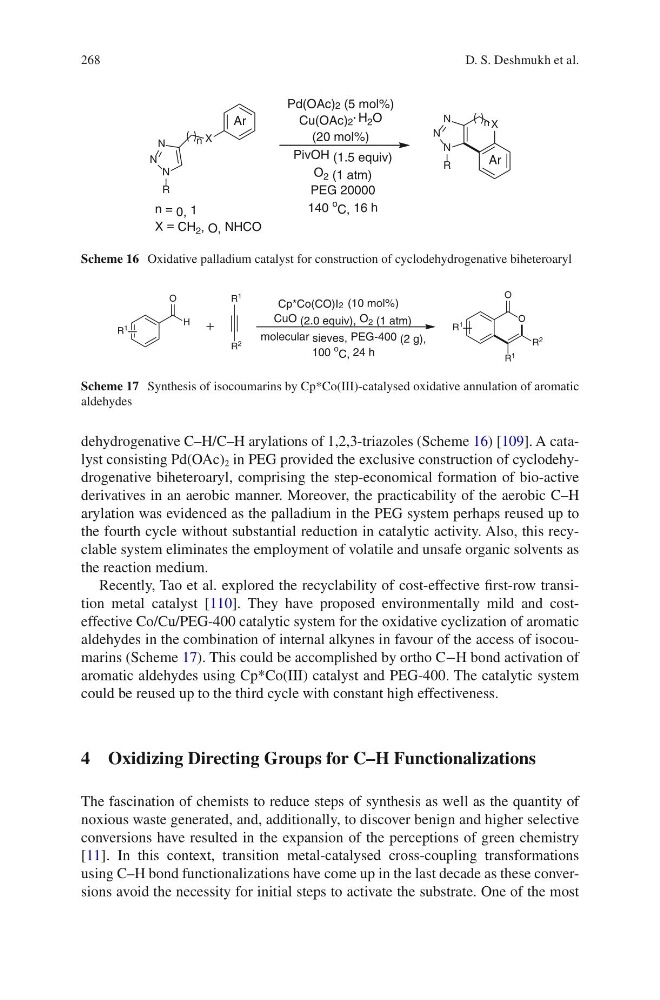
dehydrogenative C–H/C–H arylations of 1,2,3-triazoles (Scheme 16) [109]. A catalyst consisting Pd(OAc) 2 in PEG provided the exclusive construction of cyclodehydrogenative biheteroaryl, comprising the step-economical formation of bio-active
derivatives in an aerobic manner. Moreover, the practicability of the aerobic C–H
arylation was evidenced as the palladium in the PEG system perhaps reused up to
the fourth cycle without substantial reduction in catalytic activity. Also, this recyclable system eliminates the employment of volatile and unsafe organic solvents as
the reaction medium.
Recently, Tao et al. explored the recyclability of cost-effective first-row transition metal catalyst [110]. They have proposed environmentally mild and costeffective Co/Cu/PEG-400 catalytic system for the oxidative cyclization of aromatic
aldehydes in the combination of internal alkynes in favour of the access of isocoumarins (Scheme 17). This could be accomplished by ortho C−H bond activation of
aromatic aldehydes using Cp*Co(III) catalyst and PEG-400. The catalytic system
could be reused up to the third cycle with constant high effectiveness.
4 Oxidizing Directing Groups for C–H Functionalizations
The fascination of chemists to reduce steps of synthesis as well as the quantity of
noxious waste generated, and, additionally, to discover benign and higher selective
conversions have resulted in the expansion of the perceptions of green chemistry
[11]. In this context, transition metal-catalysed cross-coupling transformations
using C–H bond functionalizations have come up in the last decade as these conversions avoid the necessity for initial steps to activate the substrate. One of the most
X
N
N
N
R
Ar
n
X
N
N
N
n
Ar
R
Pd(OAc)2 (5 mol%)
Cu(OAc)2 H 2 O
(20 mol%)
PivOH (1.5 equiv)
O 2 (1 atm)
PEG 20000
140
o C, 16 h
n = 0, 1
X = CH 2 , O, NHCO
Scheme 16 Oxidative palladium catalyst for construction of cyclodehydrogenative biheteroaryl
O
H
R 1
Cp*Co(CO)I2 (10 mol%)
CuO (2.0 equiv), O 2 (1 atm)
molecular sieves, PEG-400 (2 g),
100
o C, 24 h
R 1
R 1
R 2
O
O
R 2
R 1
Scheme 17 Synthesis of isocoumarins by Cp*Co(III)-catalysed oxidative annulation of aromatic
aldehydes
D. S. Deshmukh et al.
dehydrogenative C–H/C–H arylations of 1,2,3-triazoles (Scheme 16) [109]. A catalyst consisting Pd(OAc) 2 in PEG provided the exclusive construction of cyclodehydrogenative biheteroaryl, comprising the step-economical formation of bio-active
derivatives in an aerobic manner. Moreover, the practicability of the aerobic C–H
arylation was evidenced as the palladium in the PEG system perhaps reused up to
the fourth cycle without substantial reduction in catalytic activity. Also, this recyclable system eliminates the employment of volatile and unsafe organic solvents as
the reaction medium.
Recently, Tao et al. explored the recyclability of cost-effective first-row transition metal catalyst [110]. They have proposed environmentally mild and costeffective Co/Cu/PEG-400 catalytic system for the oxidative cyclization of aromatic
aldehydes in the combination of internal alkynes in favour of the access of isocoumarins (Scheme 17). This could be accomplished by ortho C−H bond activation of
aromatic aldehydes using Cp*Co(III) catalyst and PEG-400. The catalytic system
could be reused up to the third cycle with constant high effectiveness.
4 Oxidizing Directing Groups for C–H Functionalizations
The fascination of chemists to reduce steps of synthesis as well as the quantity of
noxious waste generated, and, additionally, to discover benign and higher selective
conversions have resulted in the expansion of the perceptions of green chemistry
[11]. In this context, transition metal-catalysed cross-coupling transformations
using C–H bond functionalizations have come up in the last decade as these conversions avoid the necessity for initial steps to activate the substrate. One of the most
X
N
N
N
R
Ar
n
X
N
N
N
n
Ar
R
Pd(OAc)2 (5 mol%)
Cu(OAc)2 H 2 O
(20 mol%)
PivOH (1.5 equiv)
O 2 (1 atm)
PEG 20000
140
o C, 16 h
n = 0, 1
X = CH 2 , O, NHCO
Scheme 16 Oxidative palladium catalyst for construction of cyclodehydrogenative biheteroaryl
O
H
R 1
Cp*Co(CO)I2 (10 mol%)
CuO (2.0 equiv), O 2 (1 atm)
molecular sieves, PEG-400 (2 g),
100
o C, 24 h
R 1
R 1
R 2
O
O
R 2
R 1
Scheme 17 Synthesis of isocoumarins by Cp*Co(III)-catalysed oxidative annulation of aromatic
aldehydes
D. S. Deshmukh et al.