

266
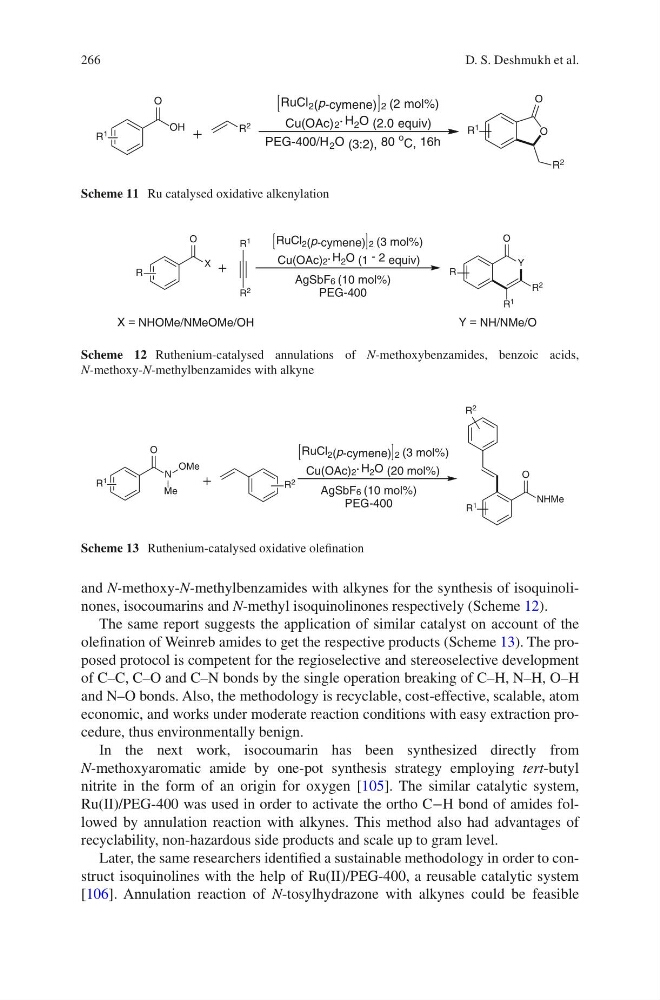
and N-methoxy-N-methylbenzamides with alkynes for the synthesis of isoquinolinones, isocoumarins and N-methyl isoquinolinones respectively (Scheme 12).
The same report suggests the application of similar catalyst on account of the
olefination of Weinreb amides to get the respective products (Scheme 13). The proposed protocol is competent for the regioselective and stereoselective development
of C–C, C–O and C–N bonds by the single operation breaking of C–H, N–H, O–H
and N–O bonds. Also, the methodology is recyclable, cost-effective, scalable, atom
economic, and works under moderate reaction conditions with easy extraction procedure, thus environmentally benign.
In the next work, isocoumarin has been synthesized directly from
N-methoxyaromatic amide by one-pot synthesis strategy employing tert-butyl
nitrite in the form of an origin for oxygen [105]. The similar catalytic system,
Ru(II)/PEG-400 was used in order to activate the ortho C−H bond of amides followed by annulation reaction with alkynes. This method also had advantages of
recyclability, non-hazardous side products and scale up to gram level.
Later, the same researchers identified a sustainable methodology in order to construct isoquinolines with the help of Ru(II)/PEG-400, a reusable catalytic system
[106]. Annulation reaction of N-tosylhydrazone with alkynes could be feasible
O
R 1
RuCl 2( p-cymene) 2 (2 mol%)
Cu(OAc)2 H 2 O (2.0 equiv)
PEG-400/H 2 O (3:2), 80
o C, 16h
R 1
R 2
OH
O
O
R 2
Scheme 11 Ru catalysed oxidative alkenylation
O
X
R
RuCl 2( p-cymene) 2 (3 mol%)
Cu(OAc)2 H 2 O (1 - 2 equiv)
AgSbF6 (10 mol%)
PEG-400
R
R 1
R 2
X = NHOMe/NMeOMe/OH
Y
O
R 2
R 1
Y = NH/NMe/O
Scheme 12 Ruthenium-catalysed annulations of N-methoxybenzamides, benzoic acids,
N-methoxy-N-methylbenzamides with alkyne
O
N
R 1
RuCl 2( p-cymene) 2 (3 mol%)
Cu(OAc)2 H 2 O (20 mol%)
AgSbF6 (10 mol%)
PEG-400
R 1
NHMe
O
OMe
Me
R 2
R 2
Scheme 13 Ruthenium-catalysed oxidative olefination
D. S. Deshmukh et al.
and N-methoxy-N-methylbenzamides with alkynes for the synthesis of isoquinolinones, isocoumarins and N-methyl isoquinolinones respectively (Scheme 12).
The same report suggests the application of similar catalyst on account of the
olefination of Weinreb amides to get the respective products (Scheme 13). The proposed protocol is competent for the regioselective and stereoselective development
of C–C, C–O and C–N bonds by the single operation breaking of C–H, N–H, O–H
and N–O bonds. Also, the methodology is recyclable, cost-effective, scalable, atom
economic, and works under moderate reaction conditions with easy extraction procedure, thus environmentally benign.
In the next work, isocoumarin has been synthesized directly from
N-methoxyaromatic amide by one-pot synthesis strategy employing tert-butyl
nitrite in the form of an origin for oxygen [105]. The similar catalytic system,
Ru(II)/PEG-400 was used in order to activate the ortho C−H bond of amides followed by annulation reaction with alkynes. This method also had advantages of
recyclability, non-hazardous side products and scale up to gram level.
Later, the same researchers identified a sustainable methodology in order to construct isoquinolines with the help of Ru(II)/PEG-400, a reusable catalytic system
[106]. Annulation reaction of N-tosylhydrazone with alkynes could be feasible
O
R 1
RuCl 2( p-cymene) 2 (2 mol%)
Cu(OAc)2 H 2 O (2.0 equiv)
PEG-400/H 2 O (3:2), 80
o C, 16h
R 1
R 2
OH
O
O
R 2
Scheme 11 Ru catalysed oxidative alkenylation
O
X
R
RuCl 2( p-cymene) 2 (3 mol%)
Cu(OAc)2 H 2 O (1 - 2 equiv)
AgSbF6 (10 mol%)
PEG-400
R
R 1
R 2
X = NHOMe/NMeOMe/OH
Y
O
R 2
R 1
Y = NH/NMe/O
Scheme 12 Ruthenium-catalysed annulations of N-methoxybenzamides, benzoic acids,
N-methoxy-N-methylbenzamides with alkyne
O
N
R 1
RuCl 2( p-cymene) 2 (3 mol%)
Cu(OAc)2 H 2 O (20 mol%)
AgSbF6 (10 mol%)
PEG-400
R 1
NHMe
O
OMe
Me
R 2
R 2
Scheme 13 Ruthenium-catalysed oxidative olefination
D. S. Deshmukh et al.