

247
comparable H 2 penetration rate to its formation rate in MDA process. For this membrane type configuration, different reports are available performing MDA reaction.
Ichikawa and co-workers [19] in 2003 have claimed that formation rates of desired
aromatics products in MDA reaction with 3%Mo/ZSM-5 catalyst are improved
2–10 times by removal of hydrogen by-product using a Pd membrane reactor. In
overall 100 h of MDA reaction time, >60% of total H 2 produced has been selectively
removed by Pd membrane unit. Similarly, Grandjean et al. in 2003 have reported
Pd–Ag membrane type reactor for H 2 consumption in MDA reaction using
0.5%Ru–3%Mo/HZSM-5 catalyst at 873 K [49]. Maximum of 8% methane conversion was claimed which was observed to increase up to 17% at 973 K temperature
due to higher formation rate of hydrogen. In 2002, Iglesia et al. have claimed a
dense SrCe0.95Yb0.05O 3 , a thin film (ca. 2 μm) as membrane unit to remove H 2
during the non-oxidative methane conversion into aromatic range of hydrocarbons
over Mo/HZSM-5 catalyst [68]. It was observed that at 950 K, only 7% of hydrogen
was consumed showing similar results of methane conversion and product
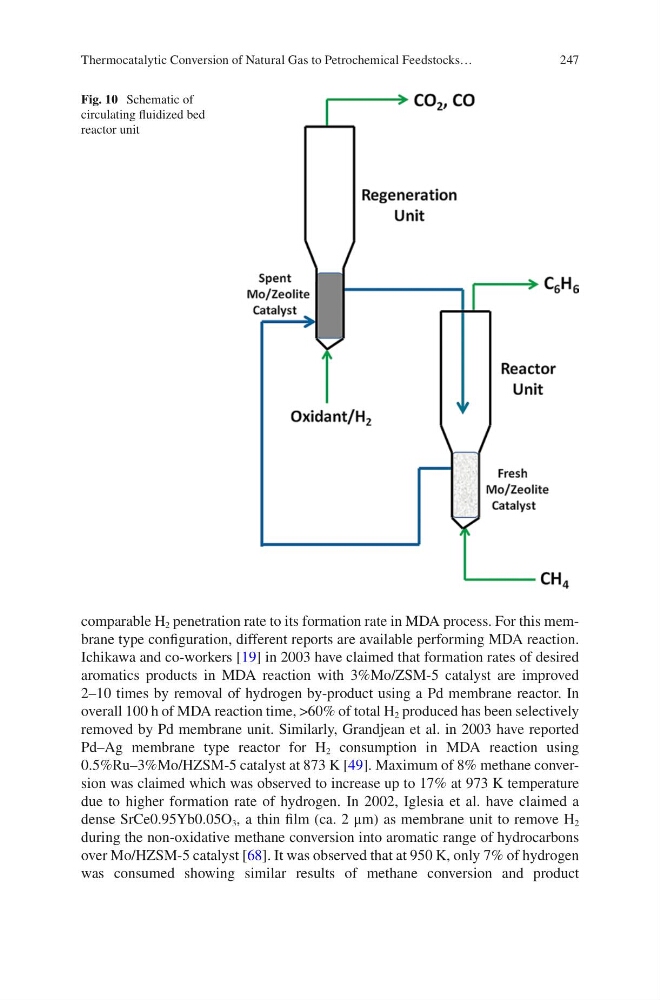
Fig. 10 Schematic of
circulating fluidized bed
reactor unit
Thermocatalytic Conversion of Natural Gas to Petrochemical Feedstocks…
comparable H 2 penetration rate to its formation rate in MDA process. For this membrane type configuration, different reports are available performing MDA reaction.
Ichikawa and co-workers [19] in 2003 have claimed that formation rates of desired
aromatics products in MDA reaction with 3%Mo/ZSM-5 catalyst are improved
2–10 times by removal of hydrogen by-product using a Pd membrane reactor. In
overall 100 h of MDA reaction time, >60% of total H 2 produced has been selectively
removed by Pd membrane unit. Similarly, Grandjean et al. in 2003 have reported
Pd–Ag membrane type reactor for H 2 consumption in MDA reaction using
0.5%Ru–3%Mo/HZSM-5 catalyst at 873 K [49]. Maximum of 8% methane conversion was claimed which was observed to increase up to 17% at 973 K temperature
due to higher formation rate of hydrogen. In 2002, Iglesia et al. have claimed a
dense SrCe0.95Yb0.05O 3 , a thin film (ca. 2 μm) as membrane unit to remove H 2
during the non-oxidative methane conversion into aromatic range of hydrocarbons
over Mo/HZSM-5 catalyst [68]. It was observed that at 950 K, only 7% of hydrogen
was consumed showing similar results of methane conversion and product
Fig. 10 Schematic of
circulating fluidized bed
reactor unit
Thermocatalytic Conversion of Natural Gas to Petrochemical Feedstocks…