

237
Mo x C y (Mo 2 C) at which methane dehydrogenation and coupling to ethylene occurs.
In the second step, ethylene intermediate oligomerizes to benzene at the Brønsted
acid sites (BAS) of the zeolites and hence the concentration of BAS plays a crucial
role in MDA catalyst. In the previous reports, several studies on acidity effect by
varying SiO 2 /Al 2 O 3 (SAR) ratio of zeolite framework has been performed for MDA
catalyst activity [31]. Lower SAR results in higher BAS concentration over the
framework and has been reported most effective for MDA activity as compared to
higher SAR value [32]. Different techniques such as NH 3 -TPD and pyridine FT-IR
are the basic tools to analyse the acidity concentration and strength. In MDA reaction, HZSM-5 and HMCM-22 with SiO 2 /Al 2 O 3 = 30 (Si/Al = 15) have been widely
studied showing high activity along with molybdenum [32, 33]. Besides acidity
incorporation to the Mo/Zeolite catalyst, BAS controls MoO x diffusion and its
anchoring inside the zeolite channels which affect the catalytic activity. According
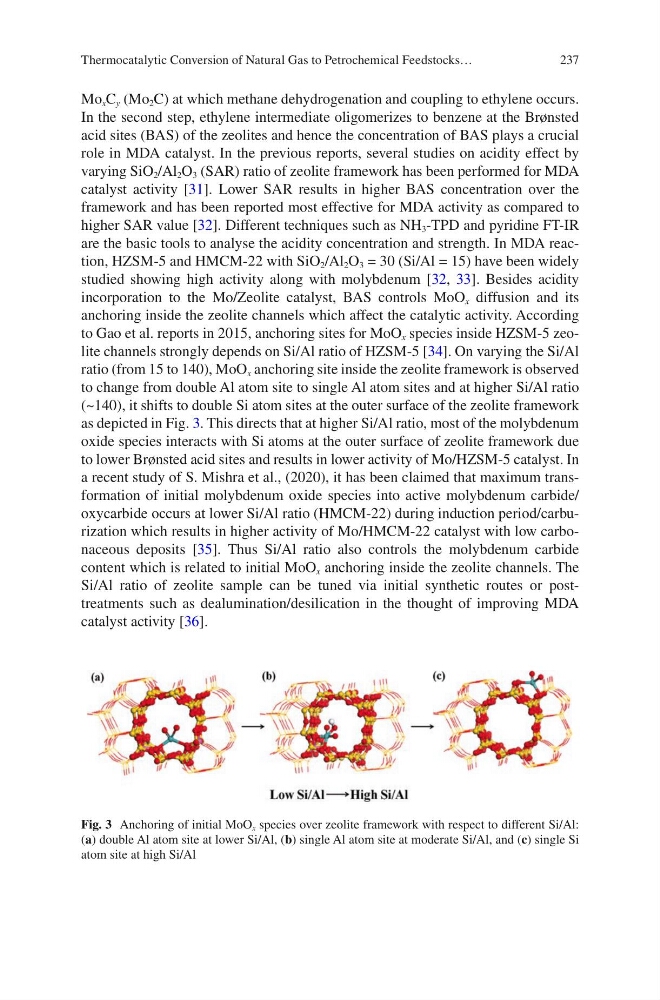
to Gao et al. reports in 2015, anchoring sites for MoO x species inside HZSM-5 zeolite channels strongly depends on Si/Al ratio of HZSM-5 [34]. On varying the Si/Al
ratio (from 15 to 140), MoO x anchoring site inside the zeolite framework is observed
to change from double Al atom site to single Al atom sites and at higher Si/Al ratio
(~140), it shifts to double Si atom sites at the outer surface of the zeolite framework
as depicted in Fig. 3. This directs that at higher Si/Al ratio, most of the molybdenum
oxide species interacts with Si atoms at the outer surface of zeolite framework due
to lower Brønsted acid sites and results in lower activity of Mo/HZSM-5 catalyst. In
a recent study of S. Mishra et al., (2020), it has been claimed that maximum transformation of initial molybdenum oxide species into active molybdenum carbide/
oxycarbide occurs at lower Si/Al ratio (HMCM-22) during induction period/carburization which results in higher activity of Mo/HMCM-22 catalyst with low carbonaceous deposits [35]. Thus Si/Al ratio also controls the molybdenum carbide
content which is related to initial MoO x anchoring inside the zeolite channels. The
Si/Al ratio of zeolite sample can be tuned via initial synthetic routes or posttreatments such as dealumination/desilication in the thought of improving MDA
catalyst activity [36].
Fig. 3 Anchoring of initial MoO x species over zeolite framework with respect to different Si/Al:
(a) double Al atom site at lower Si/Al, (b) single Al atom site at moderate Si/Al, and (c) single Si
atom site at high Si/Al
Thermocatalytic Conversion of Natural Gas to Petrochemical Feedstocks…
Mo x C y (Mo 2 C) at which methane dehydrogenation and coupling to ethylene occurs.
In the second step, ethylene intermediate oligomerizes to benzene at the Brønsted
acid sites (BAS) of the zeolites and hence the concentration of BAS plays a crucial
role in MDA catalyst. In the previous reports, several studies on acidity effect by
varying SiO 2 /Al 2 O 3 (SAR) ratio of zeolite framework has been performed for MDA
catalyst activity [31]. Lower SAR results in higher BAS concentration over the
framework and has been reported most effective for MDA activity as compared to
higher SAR value [32]. Different techniques such as NH 3 -TPD and pyridine FT-IR
are the basic tools to analyse the acidity concentration and strength. In MDA reaction, HZSM-5 and HMCM-22 with SiO 2 /Al 2 O 3 = 30 (Si/Al = 15) have been widely
studied showing high activity along with molybdenum [32, 33]. Besides acidity
incorporation to the Mo/Zeolite catalyst, BAS controls MoO x diffusion and its
anchoring inside the zeolite channels which affect the catalytic activity. According
to Gao et al. reports in 2015, anchoring sites for MoO x species inside HZSM-5 zeolite channels strongly depends on Si/Al ratio of HZSM-5 [34]. On varying the Si/Al
ratio (from 15 to 140), MoO x anchoring site inside the zeolite framework is observed
to change from double Al atom site to single Al atom sites and at higher Si/Al ratio
(~140), it shifts to double Si atom sites at the outer surface of the zeolite framework
as depicted in Fig. 3. This directs that at higher Si/Al ratio, most of the molybdenum
oxide species interacts with Si atoms at the outer surface of zeolite framework due
to lower Brønsted acid sites and results in lower activity of Mo/HZSM-5 catalyst. In
a recent study of S. Mishra et al., (2020), it has been claimed that maximum transformation of initial molybdenum oxide species into active molybdenum carbide/
oxycarbide occurs at lower Si/Al ratio (HMCM-22) during induction period/carburization which results in higher activity of Mo/HMCM-22 catalyst with low carbonaceous deposits [35]. Thus Si/Al ratio also controls the molybdenum carbide
content which is related to initial MoO x anchoring inside the zeolite channels. The
Si/Al ratio of zeolite sample can be tuned via initial synthetic routes or posttreatments such as dealumination/desilication in the thought of improving MDA
catalyst activity [36].
Fig. 3 Anchoring of initial MoO x species over zeolite framework with respect to different Si/Al:
(a) double Al atom site at lower Si/Al, (b) single Al atom site at moderate Si/Al, and (c) single Si
atom site at high Si/Al
Thermocatalytic Conversion of Natural Gas to Petrochemical Feedstocks…