

14
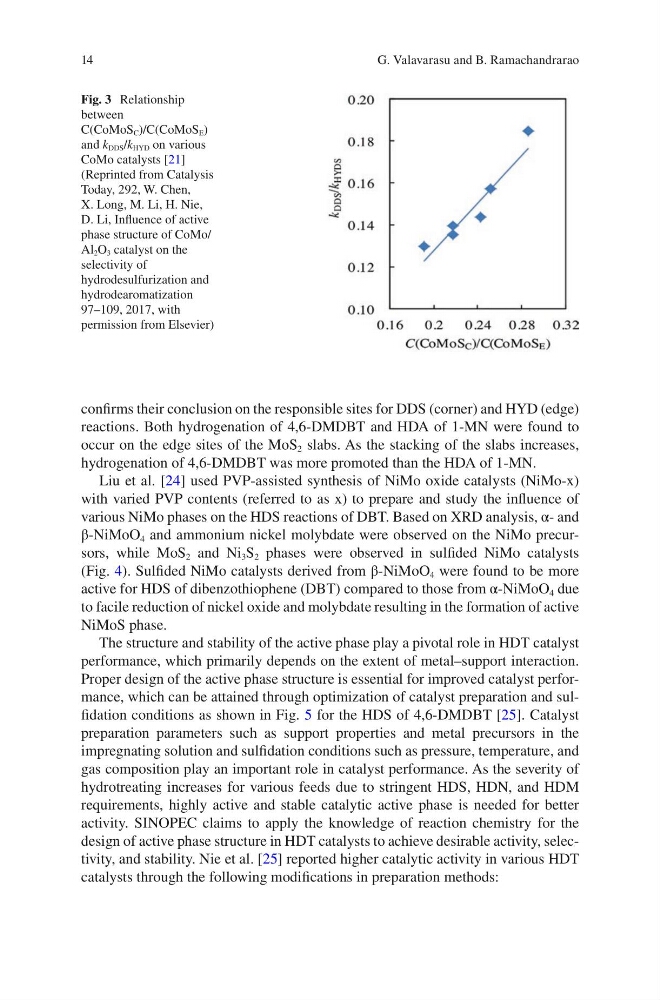
confirms their conclusion on the responsible sites for DDS (corner) and HYD (edge)
reactions. Both hydrogenation of 4,6-DMDBT and HDA of 1-MN were found to
occur on the edge sites of the MoS 2 slabs. As the stacking of the slabs increases,
hydrogenation of 4,6-DMDBT was more promoted than the HDA of 1-MN.
Liu et al. [24] used PVP-assisted synthesis of NiMo oxide catalysts (NiMo-x)
with varied PVP contents (referred to as x) to prepare and study the influence of
various NiMo phases on the HDS reactions of DBT. Based on XRD analysis, α- and
β-NiMoO 4 and ammonium nickel molybdate were observed on the NiMo precursors, while MoS 2 and Ni 3 S 2 phases were observed in sulfided NiMo catalysts
(Fig. 4). Sulfided NiMo catalysts derived from β-NiMoO 4 were found to be more
active for HDS of dibenzothiophene (DBT) compared to those from α-NiMoO 4 due
to facile reduction of nickel oxide and molybdate resulting in the formation of active
NiMoS phase.
The structure and stability of the active phase play a pivotal role in HDT catalyst
performance, which primarily depends on the extent of metal–support interaction.
Proper design of the active phase structure is essential for improved catalyst performance, which can be attained through optimization of catalyst preparation and sulfidation conditions as shown in Fig. 5 for the HDS of 4,6-DMDBT [25]. Catalyst
preparation parameters such as support properties and metal precursors in the
impregnating solution and sulfidation conditions such as pressure, temperature, and
gas composition play an important role in catalyst performance. As the severity of
hydrotreating increases for various feeds due to stringent HDS, HDN, and HDM
requirements, highly active and stable catalytic active phase is needed for better
activity. SINOPEC claims to apply the knowledge of reaction chemistry for the
design of active phase structure in HDT catalysts to achieve desirable activity, selectivity, and stability. Nie et al. [25] reported higher catalytic activity in various HDT
catalysts through the following modifications in preparation methods:
Fig. 3 Relationship
between
C(CoMoS C )/C(CoMoS E )
and k DDS /k HYD on various
CoMo catalysts [21]
(Reprinted from Catalysis
Today, 292, W. Chen,
X. Long, M. Li, H. Nie,
D. Li, Influence of active
phase structure of CoMo/
Al 2 O 3 catalyst on the
selectivity of
hydrodesulfurization and
hydrodearomatization
97–109, 2017, with
permission from Elsevier)
G. Valavarasu and B. Ramachandrarao
confirms their conclusion on the responsible sites for DDS (corner) and HYD (edge)
reactions. Both hydrogenation of 4,6-DMDBT and HDA of 1-MN were found to
occur on the edge sites of the MoS 2 slabs. As the stacking of the slabs increases,
hydrogenation of 4,6-DMDBT was more promoted than the HDA of 1-MN.
Liu et al. [24] used PVP-assisted synthesis of NiMo oxide catalysts (NiMo-x)
with varied PVP contents (referred to as x) to prepare and study the influence of
various NiMo phases on the HDS reactions of DBT. Based on XRD analysis, α- and
β-NiMoO 4 and ammonium nickel molybdate were observed on the NiMo precursors, while MoS 2 and Ni 3 S 2 phases were observed in sulfided NiMo catalysts
(Fig. 4). Sulfided NiMo catalysts derived from β-NiMoO 4 were found to be more
active for HDS of dibenzothiophene (DBT) compared to those from α-NiMoO 4 due
to facile reduction of nickel oxide and molybdate resulting in the formation of active
NiMoS phase.
The structure and stability of the active phase play a pivotal role in HDT catalyst
performance, which primarily depends on the extent of metal–support interaction.
Proper design of the active phase structure is essential for improved catalyst performance, which can be attained through optimization of catalyst preparation and sulfidation conditions as shown in Fig. 5 for the HDS of 4,6-DMDBT [25]. Catalyst
preparation parameters such as support properties and metal precursors in the
impregnating solution and sulfidation conditions such as pressure, temperature, and
gas composition play an important role in catalyst performance. As the severity of
hydrotreating increases for various feeds due to stringent HDS, HDN, and HDM
requirements, highly active and stable catalytic active phase is needed for better
activity. SINOPEC claims to apply the knowledge of reaction chemistry for the
design of active phase structure in HDT catalysts to achieve desirable activity, selectivity, and stability. Nie et al. [25] reported higher catalytic activity in various HDT
catalysts through the following modifications in preparation methods:
Fig. 3 Relationship
between
C(CoMoS C )/C(CoMoS E )
and k DDS /k HYD on various
CoMo catalysts [21]
(Reprinted from Catalysis
Today, 292, W. Chen,
X. Long, M. Li, H. Nie,
D. Li, Influence of active
phase structure of CoMo/
Al 2 O 3 catalyst on the
selectivity of
hydrodesulfurization and
hydrodearomatization
97–109, 2017, with
permission from Elsevier)
G. Valavarasu and B. Ramachandrarao