

222
the butenes hydrogenation and isomerization (to cis- and trans-2-butene) were
hardly affected. In addition, the presence of CO reduces the surface concentration
of hydrogen which is also still adequate for hydrogenation (of 1,3-butadiene) and
isomerization (of 1-butene) and is insufficient for butene hydrogenation. Further,
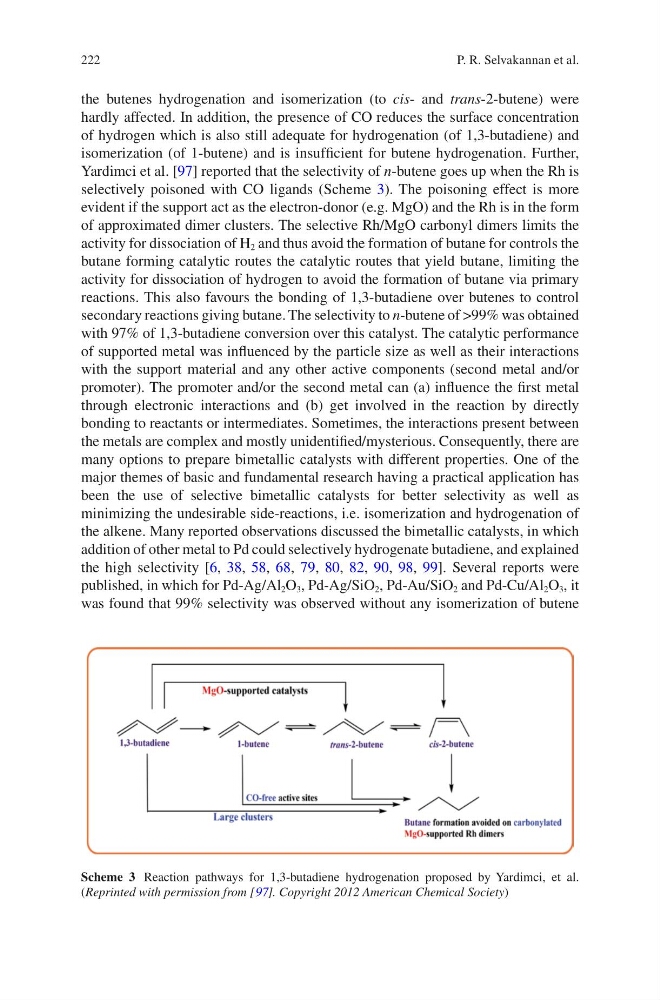
Yardimci et al. [97] reported that the selectivity of n-butene goes up when the Rh is
selectively poisoned with CO ligands (Scheme 3). The poisoning effect is more
evident if the support act as the electron-donor (e.g. MgO) and the Rh is in the form
of approximated dimer clusters. The selective Rh/MgO carbonyl dimers limits the
activity for dissociation of H 2 and thus avoid the formation of butane for controls the
butane forming catalytic routes the catalytic routes that yield butane, limiting the
activity for dissociation of hydrogen to avoid the formation of butane via primary
reactions. This also favours the bonding of 1,3-butadiene over butenes to control
secondary reactions giving butane. The selectivity to n-butene of >99% was obtained
with 97% of 1,3-butadiene conversion over this catalyst. The catalytic performance
of supported metal was influenced by the particle size as well as their interactions
with the support material and any other active components (second metal and/or
promoter). The promoter and/or the second metal can (a) influence the first metal
through electronic interactions and (b) get involved in the reaction by directly
bonding to reactants or intermediates. Sometimes, the interactions present between
the metals are complex and mostly unidentified/mysterious. Consequently, there are
many options to prepare bimetallic catalysts with different properties. One of the
major themes of basic and fundamental research having a practical application has
been the use of selective bimetallic catalysts for better selectivity as well as
minimizing the undesirable side-reactions, i.e. isomerization and hydrogenation of
the alkene. Many reported observations discussed the bimetallic catalysts, in which
addition of other metal to Pd could selectively hydrogenate butadiene, and explained
the high selectivity [6, 38, 58, 68, 79, 80, 82, 90, 98, 99]. Several reports were
published, in which for Pd-Ag/Al 2 O 3 , Pd-Ag/SiO 2 , Pd-Au/SiO 2 and Pd-Cu/Al 2 O 3 , it
was found that 99% selectivity was observed without any isomerization of butene
Scheme 3 Reaction pathways for 1,3-butadiene hydrogenation proposed by Yardimci, et al.
(Reprinted with permission from [97]. Copyright 2012 American Chemical Society)
P. R. Selvakannan et al.
the butenes hydrogenation and isomerization (to cis- and trans-2-butene) were
hardly affected. In addition, the presence of CO reduces the surface concentration
of hydrogen which is also still adequate for hydrogenation (of 1,3-butadiene) and
isomerization (of 1-butene) and is insufficient for butene hydrogenation. Further,
Yardimci et al. [97] reported that the selectivity of n-butene goes up when the Rh is
selectively poisoned with CO ligands (Scheme 3). The poisoning effect is more
evident if the support act as the electron-donor (e.g. MgO) and the Rh is in the form
of approximated dimer clusters. The selective Rh/MgO carbonyl dimers limits the
activity for dissociation of H 2 and thus avoid the formation of butane for controls the
butane forming catalytic routes the catalytic routes that yield butane, limiting the
activity for dissociation of hydrogen to avoid the formation of butane via primary
reactions. This also favours the bonding of 1,3-butadiene over butenes to control
secondary reactions giving butane. The selectivity to n-butene of >99% was obtained
with 97% of 1,3-butadiene conversion over this catalyst. The catalytic performance
of supported metal was influenced by the particle size as well as their interactions
with the support material and any other active components (second metal and/or
promoter). The promoter and/or the second metal can (a) influence the first metal
through electronic interactions and (b) get involved in the reaction by directly
bonding to reactants or intermediates. Sometimes, the interactions present between
the metals are complex and mostly unidentified/mysterious. Consequently, there are
many options to prepare bimetallic catalysts with different properties. One of the
major themes of basic and fundamental research having a practical application has
been the use of selective bimetallic catalysts for better selectivity as well as
minimizing the undesirable side-reactions, i.e. isomerization and hydrogenation of
the alkene. Many reported observations discussed the bimetallic catalysts, in which
addition of other metal to Pd could selectively hydrogenate butadiene, and explained
the high selectivity [6, 38, 58, 68, 79, 80, 82, 90, 98, 99]. Several reports were
published, in which for Pd-Ag/Al 2 O 3 , Pd-Ag/SiO 2 , Pd-Au/SiO 2 and Pd-Cu/Al 2 O 3 , it
was found that 99% selectivity was observed without any isomerization of butene
Scheme 3 Reaction pathways for 1,3-butadiene hydrogenation proposed by Yardimci, et al.
(Reprinted with permission from [97]. Copyright 2012 American Chemical Society)
P. R. Selvakannan et al.