

12
• Widely accepted model proposes Co-Mo-S or Ni-Mo-S as the active phase for
promoting hydrogenation and hydrogenolysis reactions in the case of promoted
Co-Mo- or Ni-Mo-based HDT catalysts [12–14]. In this Co-Mo-S or Ni-Mo-S
model, MoS 2 nanocrystals are reported to be the basic building blocks of the
catalytic structure with the promoter atoms (Co or Ni) located at the edges of the
MoS 2 layers in the same plane as that of Mo atoms. The active catalytic sites are
considered to be the edge sites of the MoS 2 nanocrystallites with the promoter
atoms such as Co or Ni located in the same plane forming Co-Mo-S or Ni-Mo-S
active sites.
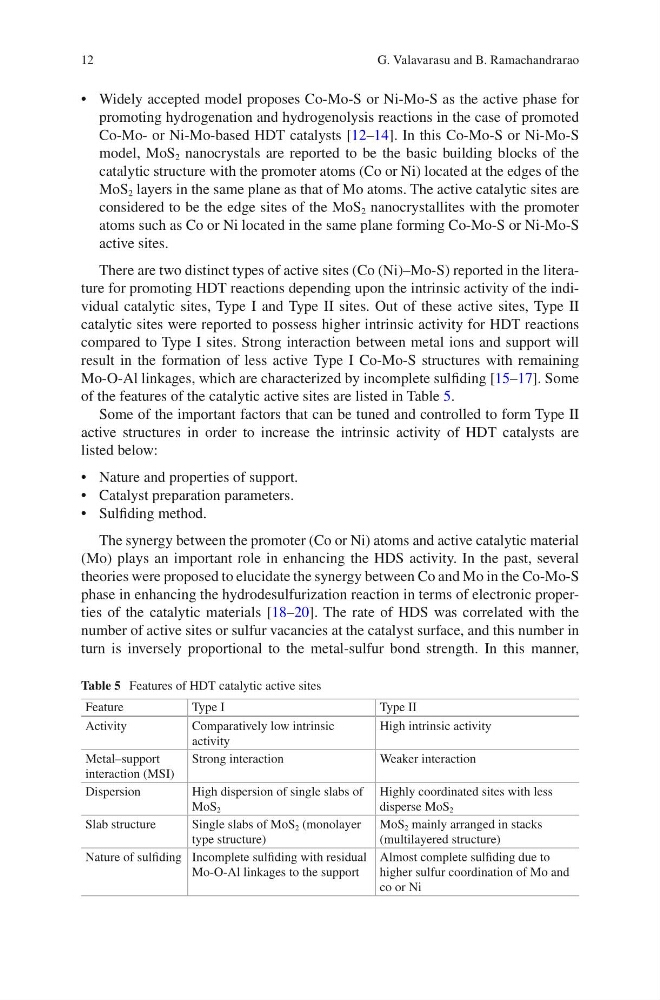
There are two distinct types of active sites (Co (Ni)–Mo-S) reported in the literature for promoting HDT reactions depending upon the intrinsic activity of the individual catalytic sites, Type I and Type II sites. Out of these active sites, Type II
catalytic sites were reported to possess higher intrinsic activity for HDT reactions
compared to Type I sites. Strong interaction between metal ions and support will
result in the formation of less active Type I Co-Mo-S structures with remaining
Mo-O-Al linkages, which are characterized by incomplete sulfiding [15–17]. Some
of the features of the catalytic active sites are listed in Table 5.
Some of the important factors that can be tuned and controlled to form Type II
active structures in order to increase the intrinsic activity of HDT catalysts are
listed below:
• Nature and properties of support.
• Catalyst preparation parameters.
• Sulfiding method.
The synergy between the promoter (Co or Ni) atoms and active catalytic material
(Mo) plays an important role in enhancing the HDS activity. In the past, several
theories were proposed to elucidate the synergy between Co and Mo in the Co-Mo-S
phase in enhancing the hydrodesulfurization reaction in terms of electronic properties of the catalytic materials [18–20]. The rate of HDS was correlated with the
number of active sites or sulfur vacancies at the catalyst surface, and this number in
turn is inversely proportional to the metal-sulfur bond strength. In this manner,
Table 5 Features of HDT catalytic active sites
Feature
Type I
Type II
Activity
Comparatively low intrinsic
activity
High intrinsic activity
Metal–support
interaction (MSI)
Strong interaction
Weaker interaction
Dispersion
High dispersion of single slabs of
MoS 2
Highly coordinated sites with less
disperse MoS 2
Slab structure
Single slabs of MoS 2 (monolayer
type structure)
MoS 2 mainly arranged in stacks
(multilayered structure)
Nature of sulfiding Incomplete sulfiding with residual
Mo-O-Al linkages to the support
Almost complete sulfiding due to
higher sulfur coordination of Mo and
co or Ni
G. Valavarasu and B. Ramachandrarao
• Widely accepted model proposes Co-Mo-S or Ni-Mo-S as the active phase for
promoting hydrogenation and hydrogenolysis reactions in the case of promoted
Co-Mo- or Ni-Mo-based HDT catalysts [12–14]. In this Co-Mo-S or Ni-Mo-S
model, MoS 2 nanocrystals are reported to be the basic building blocks of the
catalytic structure with the promoter atoms (Co or Ni) located at the edges of the
MoS 2 layers in the same plane as that of Mo atoms. The active catalytic sites are
considered to be the edge sites of the MoS 2 nanocrystallites with the promoter
atoms such as Co or Ni located in the same plane forming Co-Mo-S or Ni-Mo-S
active sites.
There are two distinct types of active sites (Co (Ni)–Mo-S) reported in the literature for promoting HDT reactions depending upon the intrinsic activity of the individual catalytic sites, Type I and Type II sites. Out of these active sites, Type II
catalytic sites were reported to possess higher intrinsic activity for HDT reactions
compared to Type I sites. Strong interaction between metal ions and support will
result in the formation of less active Type I Co-Mo-S structures with remaining
Mo-O-Al linkages, which are characterized by incomplete sulfiding [15–17]. Some
of the features of the catalytic active sites are listed in Table 5.
Some of the important factors that can be tuned and controlled to form Type II
active structures in order to increase the intrinsic activity of HDT catalysts are
listed below:
• Nature and properties of support.
• Catalyst preparation parameters.
• Sulfiding method.
The synergy between the promoter (Co or Ni) atoms and active catalytic material
(Mo) plays an important role in enhancing the HDS activity. In the past, several
theories were proposed to elucidate the synergy between Co and Mo in the Co-Mo-S
phase in enhancing the hydrodesulfurization reaction in terms of electronic properties of the catalytic materials [18–20]. The rate of HDS was correlated with the
number of active sites or sulfur vacancies at the catalyst surface, and this number in
turn is inversely proportional to the metal-sulfur bond strength. In this manner,
Table 5 Features of HDT catalytic active sites
Feature
Type I
Type II
Activity
Comparatively low intrinsic
activity
High intrinsic activity
Metal–support
interaction (MSI)
Strong interaction
Weaker interaction
Dispersion
High dispersion of single slabs of
MoS 2
Highly coordinated sites with less
disperse MoS 2
Slab structure
Single slabs of MoS 2 (monolayer
type structure)
MoS 2 mainly arranged in stacks
(multilayered structure)
Nature of sulfiding Incomplete sulfiding with residual
Mo-O-Al linkages to the support
Almost complete sulfiding due to
higher sulfur coordination of Mo and
co or Ni
G. Valavarasu and B. Ramachandrarao