

210
generated from a syn-adsorbed 1,3-butadiene, from which cis-2-butenes are formed.
Addition of hydrogen occurs mostly/largely in the 1,2 positions, and to some extent
at the 1,4 position. Further hydrogenation of 1-butene starts only after a high conversion of butadiene. Pradier et al. [23] reported the hydrogenation of 1,3-butadiene
over Pt(110) and Pt(100) and it was found that the process to re-adsorb 1-butene at
>50% conversion level, when desorption of a fraction of butadiene occurs, is likely
to occur than the process of second hydrogenation of 1-butene in the adsorbate state
before it leaves the surface. The proposed pathway was found to be similar to the
earlier observation that 1-butene is more strongly bonded to transition metals as
compared to that for 2-butenes. Butane formation by the readsorption of 2-butene
on the metal site was not considered significant enough to be considered in the
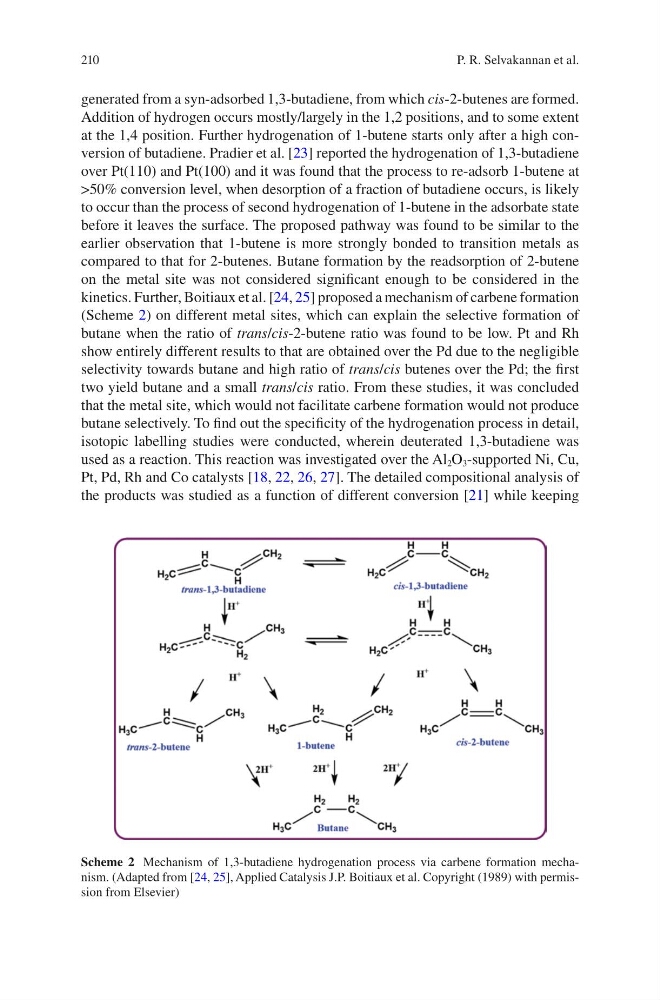
kinetics. Further, Boitiaux et al. [24, 25] proposed a mechanism of carbene formation
(Scheme 2) on different metal sites, which can explain the selective formation of
butane when the ratio of trans/cis-2-butene ratio was found to be low. Pt and Rh
show entirely different results to that are obtained over the Pd due to the negligible
selectivity towards butane and high ratio of trans/cis butenes over the Pd; the first
two yield butane and a small trans/cis ratio. From these studies, it was concluded
that the metal site, which would not facilitate carbene formation would not produce
butane selectively. To find out the specificity of the hydrogenation process in detail,
isotopic labelling studies were conducted, wherein deuterated 1,3-butadiene was
used as a reaction. This reaction was investigated over the Al 2 O 3 -supported Ni, Cu,
Pt, Pd, Rh and Co catalysts [18, 22, 26, 27]. The detailed compositional analysis of
the products was studied as a function of different conversion [21] while keeping
Scheme 2 Mechanism of 1,3-butadiene hydrogenation process via carbene formation mechanism. (Adapted from [24, 25], Applied Catalysis J.P. Boitiaux et al. Copyright (1989) with permission from Elsevier)
P. R. Selvakannan et al.
generated from a syn-adsorbed 1,3-butadiene, from which cis-2-butenes are formed.
Addition of hydrogen occurs mostly/largely in the 1,2 positions, and to some extent
at the 1,4 position. Further hydrogenation of 1-butene starts only after a high conversion of butadiene. Pradier et al. [23] reported the hydrogenation of 1,3-butadiene
over Pt(110) and Pt(100) and it was found that the process to re-adsorb 1-butene at
>50% conversion level, when desorption of a fraction of butadiene occurs, is likely
to occur than the process of second hydrogenation of 1-butene in the adsorbate state
before it leaves the surface. The proposed pathway was found to be similar to the
earlier observation that 1-butene is more strongly bonded to transition metals as
compared to that for 2-butenes. Butane formation by the readsorption of 2-butene
on the metal site was not considered significant enough to be considered in the
kinetics. Further, Boitiaux et al. [24, 25] proposed a mechanism of carbene formation
(Scheme 2) on different metal sites, which can explain the selective formation of
butane when the ratio of trans/cis-2-butene ratio was found to be low. Pt and Rh
show entirely different results to that are obtained over the Pd due to the negligible
selectivity towards butane and high ratio of trans/cis butenes over the Pd; the first
two yield butane and a small trans/cis ratio. From these studies, it was concluded
that the metal site, which would not facilitate carbene formation would not produce
butane selectively. To find out the specificity of the hydrogenation process in detail,
isotopic labelling studies were conducted, wherein deuterated 1,3-butadiene was
used as a reaction. This reaction was investigated over the Al 2 O 3 -supported Ni, Cu,
Pt, Pd, Rh and Co catalysts [18, 22, 26, 27]. The detailed compositional analysis of
the products was studied as a function of different conversion [21] while keeping
Scheme 2 Mechanism of 1,3-butadiene hydrogenation process via carbene formation mechanism. (Adapted from [24, 25], Applied Catalysis J.P. Boitiaux et al. Copyright (1989) with permission from Elsevier)
P. R. Selvakannan et al.