

170
The choice between EBHP and TBHP process largely depends on the utilization
of co-product in the existing refinery complex and demand of the co-product, especially in the domestic market. If the refinery is intregated with downstream petrochemicals complex, EBHP is a preferred choice, while TBHP process is suitable for
integrating with refineries since MTBE can be produced and utilized as gasoline
octane booster additive. Interestingly, both EBHP and TBHP processes are attractive in China and India since there are high demand for both styrene and
MTBE. However, cost of styrene and TBA are severely affected by market conditions. Thus, PO production economics through THBP or EBHP process is not the
optimal one and therefore companies have strategically shifted toward better
alternatives.
An improved hydroperoxide process based on using cumene as a feedstock
instead of ethylbenzene has been invented and commercialized by Sumitomo
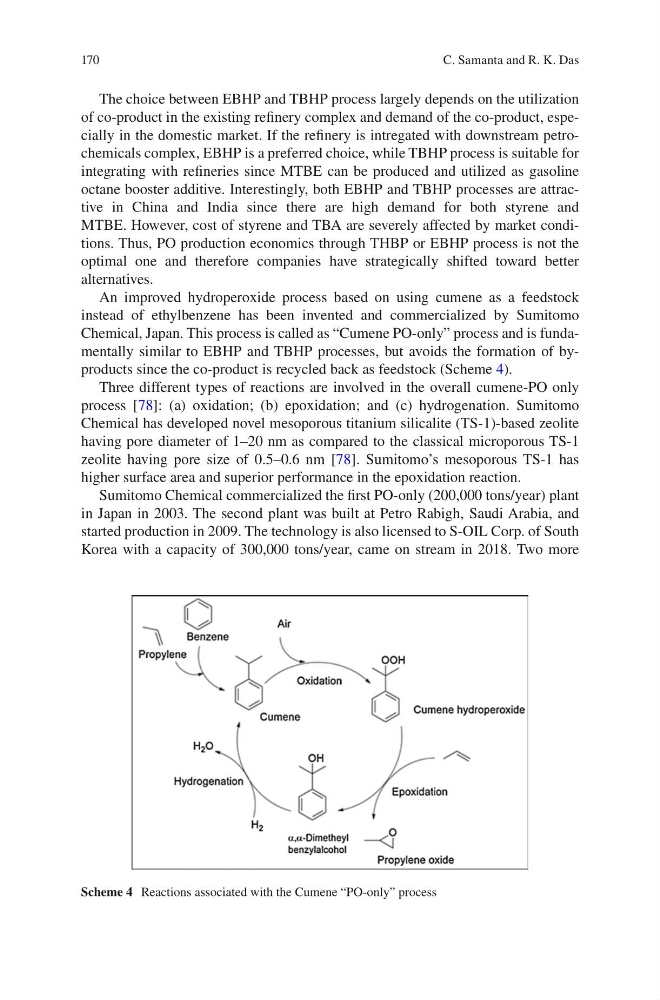
Chemical, Japan. This process is called as “Cumene PO-only” process and is fundamentally similar to EBHP and TBHP processes, but avoids the formation of byproducts since the co-product is recycled back as feedstock (Scheme 4).
Three different types of reactions are involved in the overall cumene-PO only
process [78]: (a) oxidation; (b) epoxidation; and (c) hydrogenation. Sumitomo
Chemical has developed novel mesoporous titanium silicalite (TS-1)-based zeolite
having pore diameter of 1–20 nm as compared to the classical microporous TS-1
zeolite having pore size of 0.5–0.6 nm [78]. Sumitomo’s mesoporous TS-1 has
higher surface area and superior performance in the epoxidation reaction.
Sumitomo Chemical commercialized the first PO-only (200,000 tons/year) plant
in Japan in 2003. The second plant was built at Petro Rabigh, Saudi Arabia, and
started production in 2009. The technology is also licensed to S-OIL Corp. of South
Korea with a capacity of 300,000 tons/year, came on stream in 2018. Two more
Scheme 4 Reactions associated with the Cumene “PO-only” process
C. Samanta and R. K. Das
The choice between EBHP and TBHP process largely depends on the utilization
of co-product in the existing refinery complex and demand of the co-product, especially in the domestic market. If the refinery is intregated with downstream petrochemicals complex, EBHP is a preferred choice, while TBHP process is suitable for
integrating with refineries since MTBE can be produced and utilized as gasoline
octane booster additive. Interestingly, both EBHP and TBHP processes are attractive in China and India since there are high demand for both styrene and
MTBE. However, cost of styrene and TBA are severely affected by market conditions. Thus, PO production economics through THBP or EBHP process is not the
optimal one and therefore companies have strategically shifted toward better
alternatives.
An improved hydroperoxide process based on using cumene as a feedstock
instead of ethylbenzene has been invented and commercialized by Sumitomo
Chemical, Japan. This process is called as “Cumene PO-only” process and is fundamentally similar to EBHP and TBHP processes, but avoids the formation of byproducts since the co-product is recycled back as feedstock (Scheme 4).
Three different types of reactions are involved in the overall cumene-PO only
process [78]: (a) oxidation; (b) epoxidation; and (c) hydrogenation. Sumitomo
Chemical has developed novel mesoporous titanium silicalite (TS-1)-based zeolite
having pore diameter of 1–20 nm as compared to the classical microporous TS-1
zeolite having pore size of 0.5–0.6 nm [78]. Sumitomo’s mesoporous TS-1 has
higher surface area and superior performance in the epoxidation reaction.
Sumitomo Chemical commercialized the first PO-only (200,000 tons/year) plant
in Japan in 2003. The second plant was built at Petro Rabigh, Saudi Arabia, and
started production in 2009. The technology is also licensed to S-OIL Corp. of South
Korea with a capacity of 300,000 tons/year, came on stream in 2018. Two more
Scheme 4 Reactions associated with the Cumene “PO-only” process
C. Samanta and R. K. Das