

7
HDT catalysts. In some special HDT applications, Group VIII noble metals such as
Pt and/or Pd are also used on suitable supports. These noble metal-based HDT catalysts are used predominantly in the clean second stage of distillate hydrotreating
units, especially to promote hydrogenation reactions and improve the cetane number of gas oils. The various combinations of metal sulfides (active components and
promoters) do not have similar activity for promoting various hydrotreating reactions. The combinations of sulfide pairs are carefully chosen based on the type of
feed and desired conversion.
Most common catalysts employed in refineries for various HDT applications are
sulfided Co-Mo or Ni-Mo oxides supported on alumina. Co-Mo catalysts are the
preferred choice when HDS is the desired reaction, and Ni-Mo catalysts are preferred when HDN and hydrogenation are the desired reactions. Hydrotreating catalysts typically contain about 2–6 wt% of promoter Co or Ni and 8–20 wt% of Mo
active component or 10–25 wt% W active component. Catalyst composition, especially the chemical composition of active components, plays a major role in determining the overall activity of the hydrotreating catalysts. Typical physicochemical
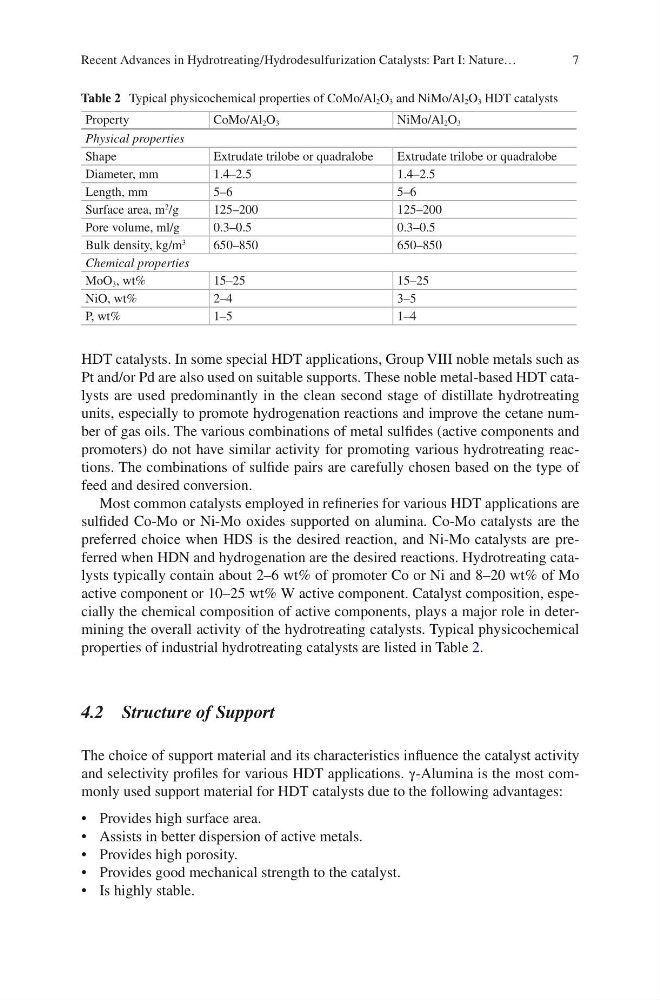
properties of industrial hydrotreating catalysts are listed in Table 2.
4.2 Structure of Support
The choice of support material and its characteristics influence the catalyst activity
and selectivity profiles for various HDT applications. γ-Alumina is the most commonly used support material for HDT catalysts due to the following advantages:
• Provides high surface area.
• Assists in better dispersion of active metals.
• Provides high porosity.
• Provides good mechanical strength to the catalyst.
• Is highly stable.
Table 2 Typical physicochemical properties of CoMo/Al 2 O 3 and NiMo/Al 2 O 3 HDT catalysts
Property
CoMo/Al 2 O 3
NiMo/Al 2 O 3
Physical properties
Shape
Extrudate trilobe or quadralobe
Extrudate trilobe or quadralobe
Diameter, mm
1.4–2.5
1.4–2.5
Length, mm
5–6
5–6
Surface area, m
2 /g
125–200
125–200
Pore volume, ml/g
0.3–0.5
0.3–0.5
Bulk density, kg/m
3
650–850
650–850
Chemical properties
MoO 3 , wt%
15–25
15–25
NiO, wt%
2–4
3–5
P, wt%
1–5
1–4
Recent Advances in Hydrotreating/Hydrodesulfurization Catalysts: Part I: Nature…
HDT catalysts. In some special HDT applications, Group VIII noble metals such as
Pt and/or Pd are also used on suitable supports. These noble metal-based HDT catalysts are used predominantly in the clean second stage of distillate hydrotreating
units, especially to promote hydrogenation reactions and improve the cetane number of gas oils. The various combinations of metal sulfides (active components and
promoters) do not have similar activity for promoting various hydrotreating reactions. The combinations of sulfide pairs are carefully chosen based on the type of
feed and desired conversion.
Most common catalysts employed in refineries for various HDT applications are
sulfided Co-Mo or Ni-Mo oxides supported on alumina. Co-Mo catalysts are the
preferred choice when HDS is the desired reaction, and Ni-Mo catalysts are preferred when HDN and hydrogenation are the desired reactions. Hydrotreating catalysts typically contain about 2–6 wt% of promoter Co or Ni and 8–20 wt% of Mo
active component or 10–25 wt% W active component. Catalyst composition, especially the chemical composition of active components, plays a major role in determining the overall activity of the hydrotreating catalysts. Typical physicochemical
properties of industrial hydrotreating catalysts are listed in Table 2.
4.2 Structure of Support
The choice of support material and its characteristics influence the catalyst activity
and selectivity profiles for various HDT applications. γ-Alumina is the most commonly used support material for HDT catalysts due to the following advantages:
• Provides high surface area.
• Assists in better dispersion of active metals.
• Provides high porosity.
• Provides good mechanical strength to the catalyst.
• Is highly stable.
Table 2 Typical physicochemical properties of CoMo/Al 2 O 3 and NiMo/Al 2 O 3 HDT catalysts
Property
CoMo/Al 2 O 3
NiMo/Al 2 O 3
Physical properties
Shape
Extrudate trilobe or quadralobe
Extrudate trilobe or quadralobe
Diameter, mm
1.4–2.5
1.4–2.5
Length, mm
5–6
5–6
Surface area, m
2 /g
125–200
125–200
Pore volume, ml/g
0.3–0.5
0.3–0.5
Bulk density, kg/m
3
650–850
650–850
Chemical properties
MoO 3 , wt%
15–25
15–25
NiO, wt%
2–4
3–5
P, wt%
1–5
1–4
Recent Advances in Hydrotreating/Hydrodesulfurization Catalysts: Part I: Nature…