

158
(FBD) process [29]. The reactor system is similar like cracking reactor. Alkane/
propane is fed to the reactor at 550–600 °C and at 1.1–1.5 bar with catalyst system
of CrO x /Al 2 O 3 with added alkaline metal-based promoter. Linde-BASF process [27,
28] is mostly similar to STAR process with little different in catalyst system and
operating condition. Pt-Sn-based catalyst with ZrO 2 support is used for coprocessing of feed/propane and steam (at 590 °C) for dehydrogenation reaction.
PDH technology is proven and reasonably well established. However, the main
drawbacks of this route are relatively high capital costs due to multiple reactor system, rapid deactivation of catalyst due to coke deposition, and importantly it needs
for the long-term supply of low-cost propane which becomes region-specific such
as propane is available in the Middle East. The advantage of the PDH process is that
selectivity and yield of propylene can reach up to 95% and 90%, respectively.
Among the five PDH technologies mentioned above, Catofin and Oleflex are the
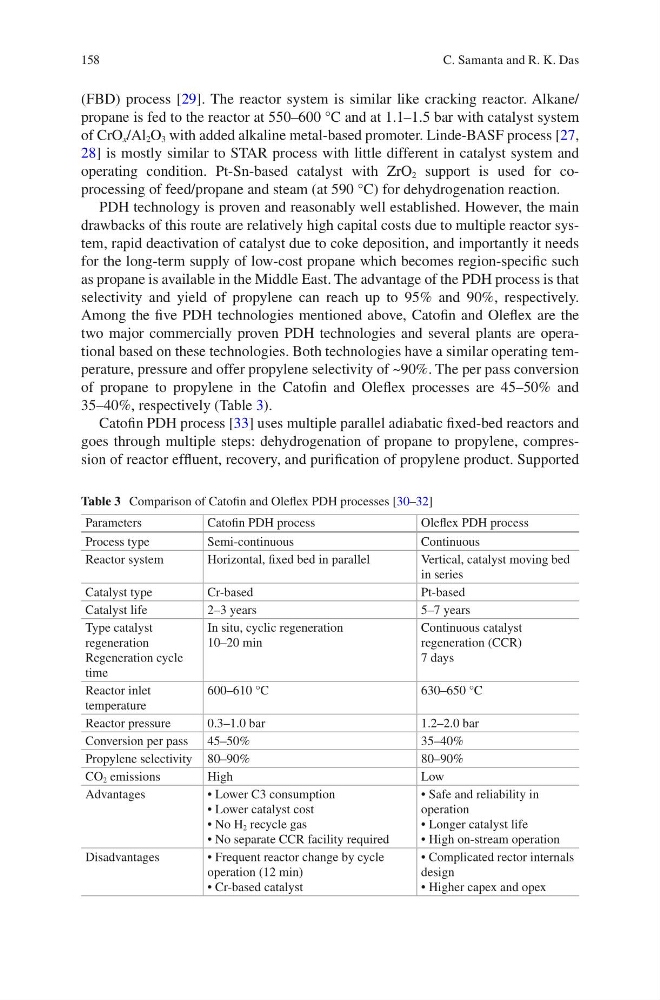
two major commercially proven PDH technologies and several plants are operational based on these technologies. Both technologies have a similar operating temperature, pressure and offer propylene selectivity of ~90%. The per pass conversion
of propane to propylene in the Catofin and Oleflex processes are 45–50% and
35–40%, respectively (Table 3).
Catofin PDH process [33] uses multiple parallel adiabatic fixed-bed reactors and
goes through multiple steps: dehydrogenation of propane to propylene, compression of reactor effluent, recovery, and purification of propylene product. Supported
Table 3 Comparison of Catofin and Oleflex PDH processes [30–32]
Parameters
Catofin PDH process
Oleflex PDH process
Process type
Semi-continuous
Continuous
Reactor system
Horizontal, fixed bed in parallel
Vertical, catalyst moving bed
in series
Catalyst type
Cr-based
Pt-based
Catalyst life
2–3 years
5–7 years
Type catalyst
regeneration
Regeneration cycle
time
In situ, cyclic regeneration
10–20 min
Continuous catalyst
regeneration (CCR)
7 days
Reactor inlet
temperature
600–610 °C
630–650 °C
Reactor pressure
0.3–1.0 bar
1.2–2.0 bar
Conversion per pass
45–50%
35–40%
Propylene selectivity 80–90%
80–90%
CO 2 emissions
High
Low
Advantages
• Lower C3 consumption
• Lower catalyst cost
• No H 2 recycle gas
• No separate CCR facility required
• Safe and reliability in
operation
• Longer catalyst life
• High on-stream operation
Disadvantages
• Frequent reactor change by cycle
operation (12 min)
• Cr-based catalyst
• Complicated rector internals
design
• Higher capex and opex
C. Samanta and R. K. Das
(FBD) process [29]. The reactor system is similar like cracking reactor. Alkane/
propane is fed to the reactor at 550–600 °C and at 1.1–1.5 bar with catalyst system
of CrO x /Al 2 O 3 with added alkaline metal-based promoter. Linde-BASF process [27,
28] is mostly similar to STAR process with little different in catalyst system and
operating condition. Pt-Sn-based catalyst with ZrO 2 support is used for coprocessing of feed/propane and steam (at 590 °C) for dehydrogenation reaction.
PDH technology is proven and reasonably well established. However, the main
drawbacks of this route are relatively high capital costs due to multiple reactor system, rapid deactivation of catalyst due to coke deposition, and importantly it needs
for the long-term supply of low-cost propane which becomes region-specific such
as propane is available in the Middle East. The advantage of the PDH process is that
selectivity and yield of propylene can reach up to 95% and 90%, respectively.
Among the five PDH technologies mentioned above, Catofin and Oleflex are the
two major commercially proven PDH technologies and several plants are operational based on these technologies. Both technologies have a similar operating temperature, pressure and offer propylene selectivity of ~90%. The per pass conversion
of propane to propylene in the Catofin and Oleflex processes are 45–50% and
35–40%, respectively (Table 3).
Catofin PDH process [33] uses multiple parallel adiabatic fixed-bed reactors and
goes through multiple steps: dehydrogenation of propane to propylene, compression of reactor effluent, recovery, and purification of propylene product. Supported
Table 3 Comparison of Catofin and Oleflex PDH processes [30–32]
Parameters
Catofin PDH process
Oleflex PDH process
Process type
Semi-continuous
Continuous
Reactor system
Horizontal, fixed bed in parallel
Vertical, catalyst moving bed
in series
Catalyst type
Cr-based
Pt-based
Catalyst life
2–3 years
5–7 years
Type catalyst
regeneration
Regeneration cycle
time
In situ, cyclic regeneration
10–20 min
Continuous catalyst
regeneration (CCR)
7 days
Reactor inlet
temperature
600–610 °C
630–650 °C
Reactor pressure
0.3–1.0 bar
1.2–2.0 bar
Conversion per pass
45–50%
35–40%
Propylene selectivity 80–90%
80–90%
CO 2 emissions
High
Low
Advantages
• Lower C3 consumption
• Lower catalyst cost
• No H 2 recycle gas
• No separate CCR facility required
• Safe and reliability in
operation
• Longer catalyst life
• High on-stream operation
Disadvantages
• Frequent reactor change by cycle
operation (12 min)
• Cr-based catalyst
• Complicated rector internals
design
• Higher capex and opex
C. Samanta and R. K. Das