

140
1.4.2 Hydroalkylation of Benzene
In future, there are high chances of this process getting commercialized keeping in
view of the applicative potential of CHB. The effluent stream of the hydroalkylation
process can be separated into three fractions: (a) C6 stream consisting of benzene
and cyclohexane, (b) cyclohexylbenzene, and (c) C18 stream consisting of dicyclohexylbenzene (DCHB). As the raw material benzene is a stream from the refinery,
the proposed process can be integrated with commonly practiced continuous catalytic reforming (CCR) operation for naphtha up-gradation in refinery operation to
produce high RON gasoline blendstock. The flow scheme of the process for such
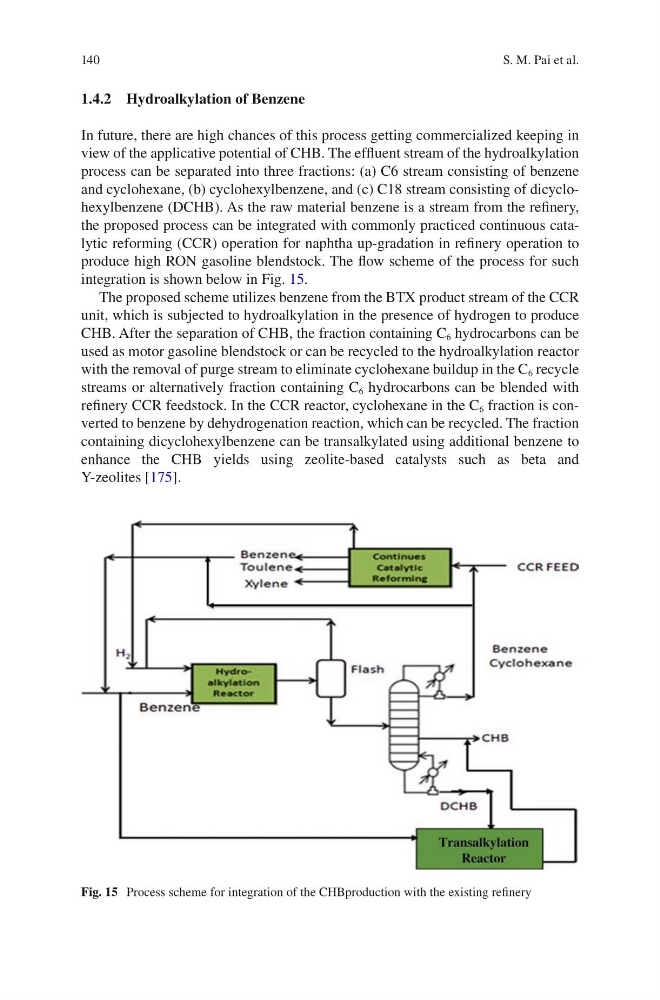
integration is shown below in Fig. 15.
The proposed scheme utilizes benzene from the BTX product stream of the CCR
unit, which is subjected to hydroalkylation in the presence of hydrogen to produce
CHB. After the separation of CHB, the fraction containing C 6 hydrocarbons can be
used as motor gasoline blendstock or can be recycled to the hydroalkylation reactor
with the removal of purge stream to eliminate cyclohexane buildup in the C 6 recycle
streams or alternatively fraction containing C 6 hydrocarbons can be blended with
refinery CCR feedstock. In the CCR reactor, cyclohexane in the C 6 fraction is converted to benzene by dehydrogenation reaction, which can be recycled. The fraction
containing dicyclohexylbenzene can be transalkylated using additional benzene to
enhance the CHB yields using zeolite-based catalysts such as beta and
Y-zeolites [175].
Fig. 15 Process scheme for integration of the CHBproduction with the existing refinery
S. M. Pai et al.
1.4.2 Hydroalkylation of Benzene
In future, there are high chances of this process getting commercialized keeping in
view of the applicative potential of CHB. The effluent stream of the hydroalkylation
process can be separated into three fractions: (a) C6 stream consisting of benzene
and cyclohexane, (b) cyclohexylbenzene, and (c) C18 stream consisting of dicyclohexylbenzene (DCHB). As the raw material benzene is a stream from the refinery,
the proposed process can be integrated with commonly practiced continuous catalytic reforming (CCR) operation for naphtha up-gradation in refinery operation to
produce high RON gasoline blendstock. The flow scheme of the process for such
integration is shown below in Fig. 15.
The proposed scheme utilizes benzene from the BTX product stream of the CCR
unit, which is subjected to hydroalkylation in the presence of hydrogen to produce
CHB. After the separation of CHB, the fraction containing C 6 hydrocarbons can be
used as motor gasoline blendstock or can be recycled to the hydroalkylation reactor
with the removal of purge stream to eliminate cyclohexane buildup in the C 6 recycle
streams or alternatively fraction containing C 6 hydrocarbons can be blended with
refinery CCR feedstock. In the CCR reactor, cyclohexane in the C 6 fraction is converted to benzene by dehydrogenation reaction, which can be recycled. The fraction
containing dicyclohexylbenzene can be transalkylated using additional benzene to
enhance the CHB yields using zeolite-based catalysts such as beta and
Y-zeolites [175].
Fig. 15 Process scheme for integration of the CHBproduction with the existing refinery
S. M. Pai et al.