

93
5.4.7 Bottom-Cracking Additives
In recent years, the crude oils available to refineries are becoming heavier.
Meanwhile, the demand for high-value products such as gasoline and middle distillates is increasing. Therefore, designing of FCC catalyst for processing heavy
crudes is the key challenge to a catalyst developer for achieving these targets.
The addition of a non-zeolitic active matrix material to the catalyst formulation
is an accepted method to improve catalyst performance when processing heavier
hydrocarbons. As different hydrocarbon feeds contain varying amounts of heavier
components, independent balancing of zeolite and matrix material is required for
optimized product yields. Bottom-cracking additives are separately formulated
mesoporous catalyst particles characterized by high active matrix surface area.
Adding them to the catalyst inventory will improve product selectivity and reduce
bottom yields [83]. Designing catalyst pore structure for efficient diffusion is an
important consideration in all catalytic cracking applications, especially when processing heavier feedstocks. Molecular simulations have shown that molecules boiling in the 700–1000 °F range are about 10–30 Å in diameter [84]. Configurational
diffusion models indicate that the catalyst pore size must be 10–20 times larger than
the size of the molecules to avoid significant diffusional limitations [85]. Thus, if
these two results are considered together, we conclude that an FCC catalyst must
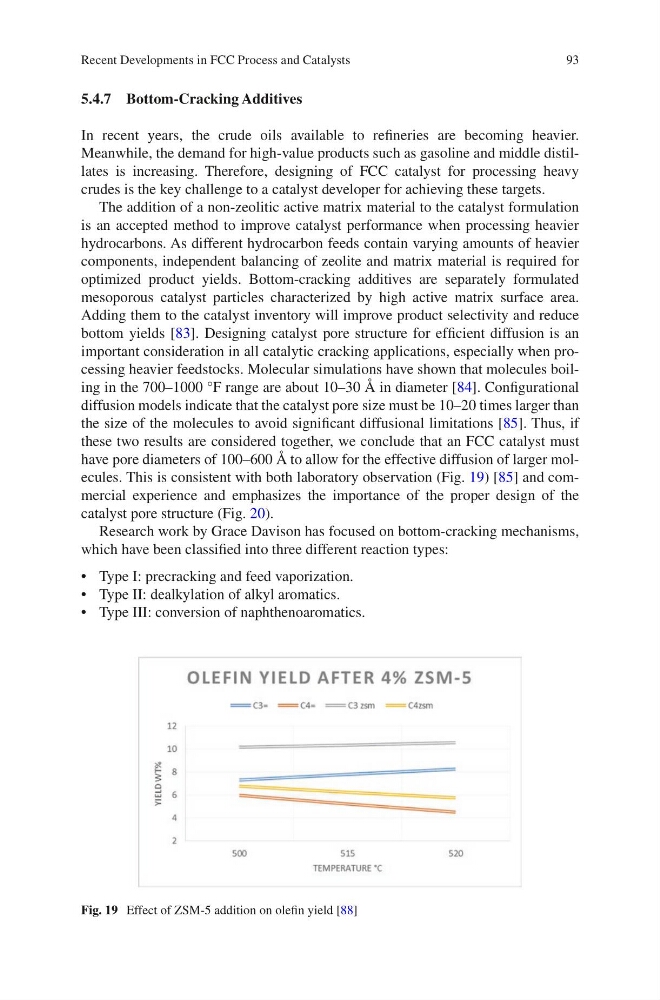
have pore diameters of 100–600 Å to allow for the effective diffusion of larger molecules. This is consistent with both laboratory observation (Fig. 19) [85] and commercial experience and emphasizes the importance of the proper design of the
catalyst pore structure (Fig. 20).
Research work by Grace Davison has focused on bottom-cracking mechanisms,
which have been classified into three different reaction types:
• Type I: precracking and feed vaporization.
• Type II: dealkylation of alkyl aromatics.
• Type III: conversion of naphthenoaromatics.
Fig. 19 Effect of ZSM-5 addition on olefin yield [88]
Recent Developments in FCC Process and Catalysts
5.4.7 Bottom-Cracking Additives
In recent years, the crude oils available to refineries are becoming heavier.
Meanwhile, the demand for high-value products such as gasoline and middle distillates is increasing. Therefore, designing of FCC catalyst for processing heavy
crudes is the key challenge to a catalyst developer for achieving these targets.
The addition of a non-zeolitic active matrix material to the catalyst formulation
is an accepted method to improve catalyst performance when processing heavier
hydrocarbons. As different hydrocarbon feeds contain varying amounts of heavier
components, independent balancing of zeolite and matrix material is required for
optimized product yields. Bottom-cracking additives are separately formulated
mesoporous catalyst particles characterized by high active matrix surface area.
Adding them to the catalyst inventory will improve product selectivity and reduce
bottom yields [83]. Designing catalyst pore structure for efficient diffusion is an
important consideration in all catalytic cracking applications, especially when processing heavier feedstocks. Molecular simulations have shown that molecules boiling in the 700–1000 °F range are about 10–30 Å in diameter [84]. Configurational
diffusion models indicate that the catalyst pore size must be 10–20 times larger than
the size of the molecules to avoid significant diffusional limitations [85]. Thus, if
these two results are considered together, we conclude that an FCC catalyst must
have pore diameters of 100–600 Å to allow for the effective diffusion of larger molecules. This is consistent with both laboratory observation (Fig. 19) [85] and commercial experience and emphasizes the importance of the proper design of the
catalyst pore structure (Fig. 20).
Research work by Grace Davison has focused on bottom-cracking mechanisms,
which have been classified into three different reaction types:
• Type I: precracking and feed vaporization.
• Type II: dealkylation of alkyl aromatics.
• Type III: conversion of naphthenoaromatics.
Fig. 19 Effect of ZSM-5 addition on olefin yield [88]
Recent Developments in FCC Process and Catalysts