

2.3 Aerodynamic Method Equations
2.3.1 Direct Form
The aerodynamic method for calculating vertical atmospheric fluxes of mass and
energy can be used under a variety of conditions. These include temperature stability,
steady-state, and homogeneous surfaces without changes in radiative or wind fields
during the observation period, and fluxes constant in height. The disturbances in the
diurnal boundary layer make the application of aerodynamic method mainly possible
in homogeneous terrain with uniform fetch, which is defined as a distance from the
measurement point to a change in surface properties or obstacle (Foken 2017).
The similarity of transfer coefficients is also assumed, for example, for water
vapor, gases, thermal convection, and momentum K v , K S , K H , and K M , respectively
K v ¼ K S ¼ K H ¼ K M
ð2:35Þ
or, from the relationship with aerodynamic resistances
r M z 1 ;z 2
ð
Þ ¼ r aH z 1 À z 2
ð
Þ¼r aV z 1 ; z 2
ð
Þ¼r aS z 1 ; z 2
ð
Þ
ð2:36Þ
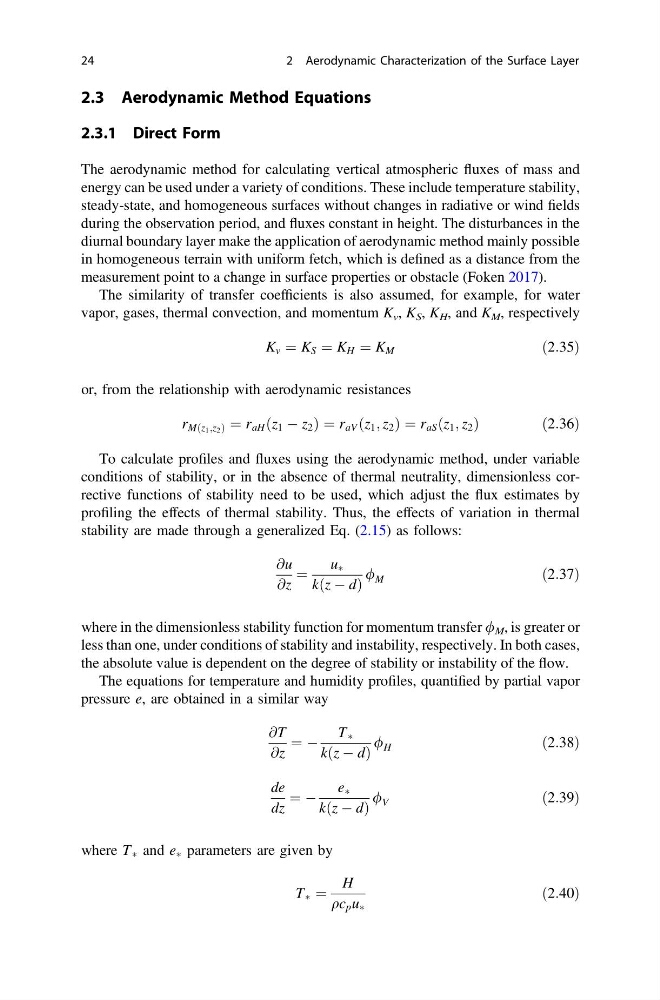
To calculate profiles and fluxes using the aerodynamic method, under variable
conditions of stability, or in the absence of thermal neutrality, dimensionless corrective functions of stability need to be used, which adjust the flux estimates by
profiling the effects of thermal stability. Thus, the effects of variation in thermal
stability are made through a generalized Eq. (2.15) as follows:
@u
@z
¼
u Ã
kðz À dÞ
/ M
ð2:37Þ
where in the dimensionless stability function for momentum transfer / M , is greater or
less than one, under conditions of stability and instability, respectively. In both cases,
the absolute value is dependent on the degree of stability or instability of the flow.
The equations for temperature and humidity profiles, quantified by partial vapor
pressure e, are obtained in a similar way
@T
@z
¼ À
T Ã
kðz À dÞ
/ H
ð2:38Þ
de
dz
¼ À
e Ã
kðz À dÞ
/ V
ð2:39Þ
where T à and e à parameters are given by
T Ã ¼
H
qc p u Ã
ð2:40Þ
24
2 Aerodynamic Characterization of the Surface Layer
2.3.1 Direct Form
The aerodynamic method for calculating vertical atmospheric fluxes of mass and
energy can be used under a variety of conditions. These include temperature stability,
steady-state, and homogeneous surfaces without changes in radiative or wind fields
during the observation period, and fluxes constant in height. The disturbances in the
diurnal boundary layer make the application of aerodynamic method mainly possible
in homogeneous terrain with uniform fetch, which is defined as a distance from the
measurement point to a change in surface properties or obstacle (Foken 2017).
The similarity of transfer coefficients is also assumed, for example, for water
vapor, gases, thermal convection, and momentum K v , K S , K H , and K M , respectively
K v ¼ K S ¼ K H ¼ K M
ð2:35Þ
or, from the relationship with aerodynamic resistances
r M z 1 ;z 2
ð
Þ ¼ r aH z 1 À z 2
ð
Þ¼r aV z 1 ; z 2
ð
Þ¼r aS z 1 ; z 2
ð
Þ
ð2:36Þ
To calculate profiles and fluxes using the aerodynamic method, under variable
conditions of stability, or in the absence of thermal neutrality, dimensionless corrective functions of stability need to be used, which adjust the flux estimates by
profiling the effects of thermal stability. Thus, the effects of variation in thermal
stability are made through a generalized Eq. (2.15) as follows:
@u
@z
¼
u Ã
kðz À dÞ
/ M
ð2:37Þ
where in the dimensionless stability function for momentum transfer / M , is greater or
less than one, under conditions of stability and instability, respectively. In both cases,
the absolute value is dependent on the degree of stability or instability of the flow.
The equations for temperature and humidity profiles, quantified by partial vapor
pressure e, are obtained in a similar way
@T
@z
¼ À
T Ã
kðz À dÞ
/ H
ð2:38Þ
de
dz
¼ À
e Ã
kðz À dÞ
/ V
ð2:39Þ
where T à and e à parameters are given by
T Ã ¼
H
qc p u Ã
ð2:40Þ
24
2 Aerodynamic Characterization of the Surface Layer