

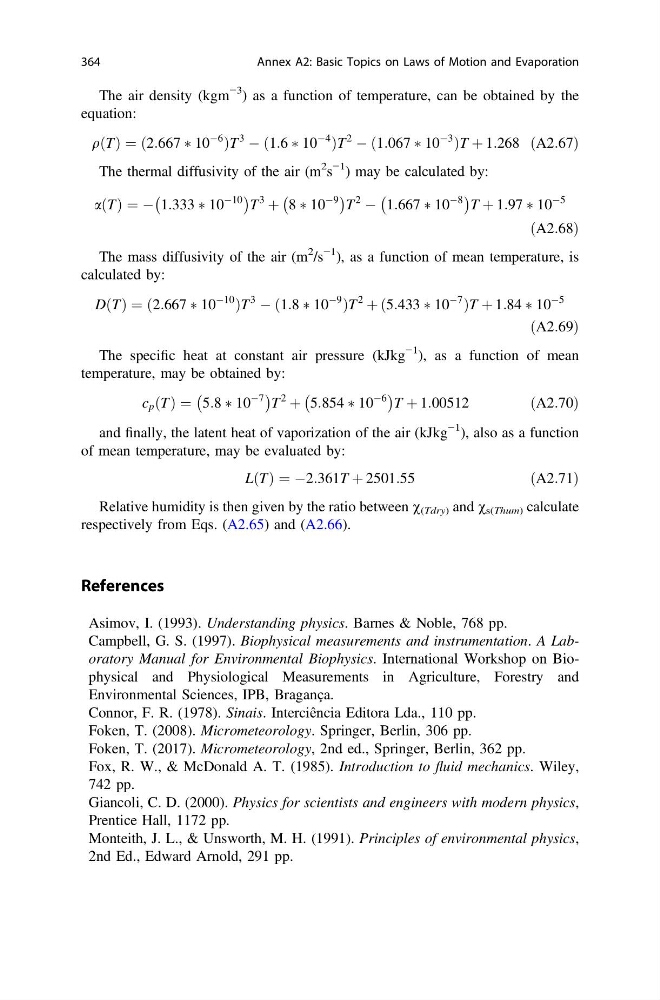
The air density (kgm
−3 ) as a function of temperature, can be obtained by the
equation:
qðTÞ ¼ ð2:667 Ã 10
À6
ÞT
3
À ð1:6 Ã 10
À4
ÞT
2
À ð1:067 Ã 10
À3
ÞT þ 1:268 ðA2:67Þ
The thermal diffusivity of the air (m
2 s
−1 ) may be calculated by:
aðTÞ ¼ À 1:333 Ã 10
À10
À
Á
T
3
þ 8 Ã 10
À9
À
Á
T
2
À 1:667 Ã 10
À8
À
Á
T þ 1:97 Ã 10
À5
ðA2:68Þ
The mass diffusivity of the air (m
2 /s
−1 ), as a function of mean temperature, is
calculated by:
DðTÞ ¼ ð2:667 Ã 10
À10
ÞT
3
À ð1:8 Ã 10
À9
ÞT
2
þ ð5:433 Ã 10
À7
ÞT þ 1:84 Ã 10
À5
ðA2:69Þ
The specific heat at constant air pressure (kJkg
−1 ), as a function of mean
temperature, may be obtained by:
c p ðTÞ ¼ 5:8 Ã 10
À7
À
Á
T
2
þ 5:854 Ã 10
À6
À
Á
T þ 1:00512
ðA2:70Þ
and finally, the latent heat of vaporization of the air (kJkg
−1 ), also as a function
of mean temperature, may be evaluated by:
LðTÞ ¼ À2:361T þ 2501:55
ðA2:71Þ
Relative humidity is then given by the ratio between v (Tdry) and v s(Thum) calculate
respectively from Eqs. (A2.65) and (A2.66).
References
Asimov, I. (1993). Understanding physics. Barnes & Noble, 768 pp.
Campbell, G. S. (1997). Biophysical measurements and instrumentation. A Laboratory Manual for Environmental Biophysics. International Workshop on Biophysical and Physiological Measurements in Agriculture, Forestry and
Environmental Sciences, IPB, Bragança.
Connor, F. R. (1978). Sinais. Interciência Editora Lda., 110 pp.
Foken, T. (2008). Micrometeorology. Springer, Berlin, 306 pp.
Foken, T. (2017). Micrometeorology, 2nd ed., Springer, Berlin, 362 pp.
Fox, R. W., & McDonald A. T. (1985). Introduction to fluid mechanics. Wiley,
742 pp.
Giancoli, C. D. (2000). Physics for scientists and engineers with modern physics,
Prentice Hall, 1172 pp.
Monteith, J. L., & Unsworth, M. H. (1991). Principles of environmental physics,
2nd Ed., Edward Arnold, 291 pp.
364
Annex A2: Basic Topics on Laws of Motion and Evaporation
−3 ) as a function of temperature, can be obtained by the
equation:
qðTÞ ¼ ð2:667 Ã 10
À6
ÞT
3
À ð1:6 Ã 10
À4
ÞT
2
À ð1:067 Ã 10
À3
ÞT þ 1:268 ðA2:67Þ
The thermal diffusivity of the air (m
2 s
−1 ) may be calculated by:
aðTÞ ¼ À 1:333 Ã 10
À10
À
Á
T
3
þ 8 Ã 10
À9
À
Á
T
2
À 1:667 Ã 10
À8
À
Á
T þ 1:97 Ã 10
À5
ðA2:68Þ
The mass diffusivity of the air (m
2 /s
−1 ), as a function of mean temperature, is
calculated by:
DðTÞ ¼ ð2:667 Ã 10
À10
ÞT
3
À ð1:8 Ã 10
À9
ÞT
2
þ ð5:433 Ã 10
À7
ÞT þ 1:84 Ã 10
À5
ðA2:69Þ
The specific heat at constant air pressure (kJkg
−1 ), as a function of mean
temperature, may be obtained by:
c p ðTÞ ¼ 5:8 Ã 10
À7
À
Á
T
2
þ 5:854 Ã 10
À6
À
Á
T þ 1:00512
ðA2:70Þ
and finally, the latent heat of vaporization of the air (kJkg
−1 ), also as a function
of mean temperature, may be evaluated by:
LðTÞ ¼ À2:361T þ 2501:55
ðA2:71Þ
Relative humidity is then given by the ratio between v (Tdry) and v s(Thum) calculate
respectively from Eqs. (A2.65) and (A2.66).
References
Asimov, I. (1993). Understanding physics. Barnes & Noble, 768 pp.
Campbell, G. S. (1997). Biophysical measurements and instrumentation. A Laboratory Manual for Environmental Biophysics. International Workshop on Biophysical and Physiological Measurements in Agriculture, Forestry and
Environmental Sciences, IPB, Bragança.
Connor, F. R. (1978). Sinais. Interciência Editora Lda., 110 pp.
Foken, T. (2008). Micrometeorology. Springer, Berlin, 306 pp.
Foken, T. (2017). Micrometeorology, 2nd ed., Springer, Berlin, 362 pp.
Fox, R. W., & McDonald A. T. (1985). Introduction to fluid mechanics. Wiley,
742 pp.
Giancoli, C. D. (2000). Physics for scientists and engineers with modern physics,
Prentice Hall, 1172 pp.
Monteith, J. L., & Unsworth, M. H. (1991). Principles of environmental physics,
2nd Ed., Edward Arnold, 291 pp.
364
Annex A2: Basic Topics on Laws of Motion and Evaporation