

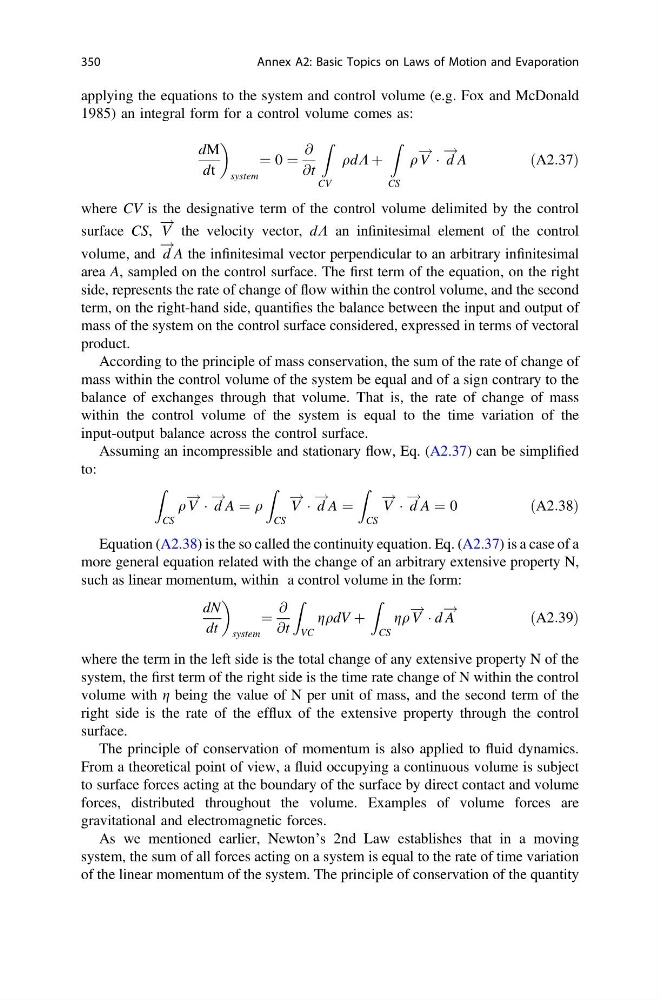
applying the equations to the system and control volume (e.g. Fox and McDonald
1985) an integral form for a control volume comes as:
dM
dt
system
¼ 0 ¼
@
@t
Z
CV
qdK þ
Z
CS
q V
! Á d
!
A
ðA2:37Þ
where CV is the designative term of the control volume delimited by the control
surface CS, V
! the velocity vector, dK an infinitesimal element of the control
volume, and d
!
A the infinitesimal vector perpendicular to an arbitrary infinitesimal
area A, sampled on the control surface. The first term of the equation, on the right
side, represents the rate of change of flow within the control volume, and the second
term, on the right-hand side, quantifies the balance between the input and output of
mass of the system on the control surface considered, expressed in terms of vectoral
product.
According to the principle of mass conservation, the sum of the rate of change of
mass within the control volume of the system be equal and of a sign contrary to the
balance of exchanges through that volume. That is, the rate of change of mass
within the control volume of the system is equal to the time variation of the
input-output balance across the control surface.
Assuming an incompressible and stationary flow, Eq. (A2.37) can be simplified
to:
Z
CS
q V
! Á d
!
A ¼ q
Z
CS
V
! Á d
!
A ¼
Z
CS
V
! Á d
!
A ¼ 0
ðA2:38Þ
Equation (A2.38) is the so called the continuity equation. Eq. (A2.37) is a case of a
more general equation related with the change of an arbitrary extensive property N,
such as linear momentum, within a control volume in the form:
dN
dt
system
¼
@
@t
Z
VC
gqdV þ
Z
CS
gq V
! Á d A
!
ðA2:39Þ
where the term in the left side is the total change of any extensive property N of the
system, the first term of the right side is the time rate change of N within the control
volume with g being the value of N per unit of mass, and the second term of the
right side is the rate of the efflux of the extensive property through the control
surface.
The principle of conservation of momentum is also applied to fluid dynamics.
From a theoretical point of view, a fluid occupying a continuous volume is subject
to surface forces acting at the boundary of the surface by direct contact and volume
forces, distributed throughout the volume. Examples of volume forces are
gravitational and electromagnetic forces.
As we mentioned earlier, Newton’s 2nd Law establishes that in a moving
system, the sum of all forces acting on a system is equal to the rate of time variation
of the linear momentum of the system. The principle of conservation of the quantity
350
Annex A2: Basic Topics on Laws of Motion and Evaporation
1985) an integral form for a control volume comes as:
dM
dt
system
¼ 0 ¼
@
@t
Z
CV
qdK þ
Z
CS
q V
! Á d
!
A
ðA2:37Þ
where CV is the designative term of the control volume delimited by the control
surface CS, V
! the velocity vector, dK an infinitesimal element of the control
volume, and d
!
A the infinitesimal vector perpendicular to an arbitrary infinitesimal
area A, sampled on the control surface. The first term of the equation, on the right
side, represents the rate of change of flow within the control volume, and the second
term, on the right-hand side, quantifies the balance between the input and output of
mass of the system on the control surface considered, expressed in terms of vectoral
product.
According to the principle of mass conservation, the sum of the rate of change of
mass within the control volume of the system be equal and of a sign contrary to the
balance of exchanges through that volume. That is, the rate of change of mass
within the control volume of the system is equal to the time variation of the
input-output balance across the control surface.
Assuming an incompressible and stationary flow, Eq. (A2.37) can be simplified
to:
Z
CS
q V
! Á d
!
A ¼ q
Z
CS
V
! Á d
!
A ¼
Z
CS
V
! Á d
!
A ¼ 0
ðA2:38Þ
Equation (A2.38) is the so called the continuity equation. Eq. (A2.37) is a case of a
more general equation related with the change of an arbitrary extensive property N,
such as linear momentum, within a control volume in the form:
dN
dt
system
¼
@
@t
Z
VC
gqdV þ
Z
CS
gq V
! Á d A
!
ðA2:39Þ
where the term in the left side is the total change of any extensive property N of the
system, the first term of the right side is the time rate change of N within the control
volume with g being the value of N per unit of mass, and the second term of the
right side is the rate of the efflux of the extensive property through the control
surface.
The principle of conservation of momentum is also applied to fluid dynamics.
From a theoretical point of view, a fluid occupying a continuous volume is subject
to surface forces acting at the boundary of the surface by direct contact and volume
forces, distributed throughout the volume. Examples of volume forces are
gravitational and electromagnetic forces.
As we mentioned earlier, Newton’s 2nd Law establishes that in a moving
system, the sum of all forces acting on a system is equal to the rate of time variation
of the linear momentum of the system. The principle of conservation of the quantity
350
Annex A2: Basic Topics on Laws of Motion and Evaporation