

W ¼ VD À Vd 1
ðA2:31Þ
whence the density of the submerged body D, is given by:
D ¼ W þ Vd 1
ð
Þ =V
ðA2:32Þ
Using Eq. (A2.32), the density of the body can be calculated as both weight of
the submerged body and the volume of liquid displaced as well as the density of the
liquid. If an immersed body has a density greater than that of the fluid in which it is
immersed, then D is greater than d 1 and VD greater than Vd 1 , so it submerges in the
liquid which it is immersed.
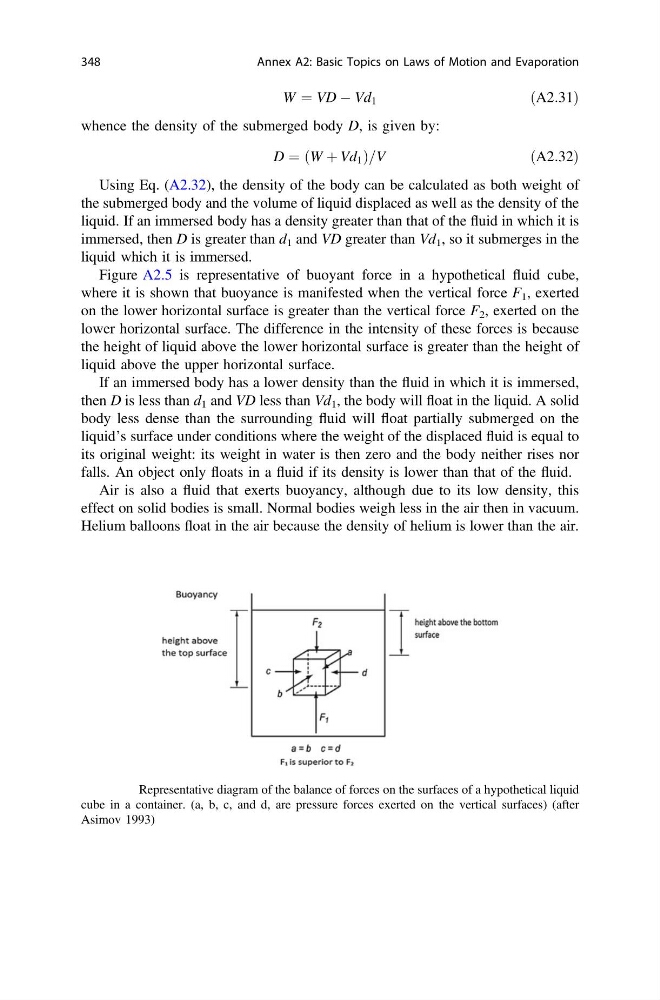
Figure A2.5 is representative of buoyant force in a hypothetical fluid cube,
where it is shown that buoyance is manifested when the vertical force F 1 , exerted
on the lower horizontal surface is greater than the vertical force F 2 , exerted on the
lower horizontal surface. The difference in the intensity of these forces is because
the height of liquid above the lower horizontal surface is greater than the height of
liquid above the upper horizontal surface.
If an immersed body has a lower density than the fluid in which it is immersed,
then D is less than d 1 and VD less than Vd 1 , the body will float in the liquid. A solid
body less dense than the surrounding fluid will float partially submerged on the
liquid’s surface under conditions where the weight of the displaced fluid is equal to
its original weight: its weight in water is then zero and the body neither rises nor
falls. An object only floats in a fluid if its density is lower than that of the fluid.
Air is also a fluid that exerts buoyancy, although due to its low density, this
effect on solid bodies is small. Normal bodies weigh less in the air then in vacuum.
Helium balloons float in the air because the density of helium is lower than the air.
Fig. A2.5 Representative diagram of the balance of forces on the surfaces of a hypothetical liquid
cube in a container. (a, b, c, and d, are pressure forces exerted on the vertical surfaces) (after
Asimov 1993)
348
Annex A2: Basic Topics on Laws of Motion and Evaporation
ðA2:31Þ
whence the density of the submerged body D, is given by:
D ¼ W þ Vd 1
ð
Þ =V
ðA2:32Þ
Using Eq. (A2.32), the density of the body can be calculated as both weight of
the submerged body and the volume of liquid displaced as well as the density of the
liquid. If an immersed body has a density greater than that of the fluid in which it is
immersed, then D is greater than d 1 and VD greater than Vd 1 , so it submerges in the
liquid which it is immersed.
Figure A2.5 is representative of buoyant force in a hypothetical fluid cube,
where it is shown that buoyance is manifested when the vertical force F 1 , exerted
on the lower horizontal surface is greater than the vertical force F 2 , exerted on the
lower horizontal surface. The difference in the intensity of these forces is because
the height of liquid above the lower horizontal surface is greater than the height of
liquid above the upper horizontal surface.
If an immersed body has a lower density than the fluid in which it is immersed,
then D is less than d 1 and VD less than Vd 1 , the body will float in the liquid. A solid
body less dense than the surrounding fluid will float partially submerged on the
liquid’s surface under conditions where the weight of the displaced fluid is equal to
its original weight: its weight in water is then zero and the body neither rises nor
falls. An object only floats in a fluid if its density is lower than that of the fluid.
Air is also a fluid that exerts buoyancy, although due to its low density, this
effect on solid bodies is small. Normal bodies weigh less in the air then in vacuum.
Helium balloons float in the air because the density of helium is lower than the air.
Fig. A2.5 Representative diagram of the balance of forces on the surfaces of a hypothetical liquid
cube in a container. (a, b, c, and d, are pressure forces exerted on the vertical surfaces) (after
Asimov 1993)
348
Annex A2: Basic Topics on Laws of Motion and Evaporation