

molecules wherein rest does not occur. Static equilibrium liquids and gases obey
the same basic laws, notwithstanding differences in behavior when the pressure and
temperature that affect the gases vary more widely.
A fundamental variable for the characterization of fluids is their pressure, P,
defined as the ratio of the total force to the surface of the fluid, on which the force
acts perpendicularly. The SI unit of pressure is Pascal, defined in terms of Nm
−2 .
The fluids exert pressure in all directions and the permanence of a fluid at rest
implies the equality and symmetry of the forces applied in its interior. This pressure
exerted by a fluid at rest is called hydrostatic pressure.
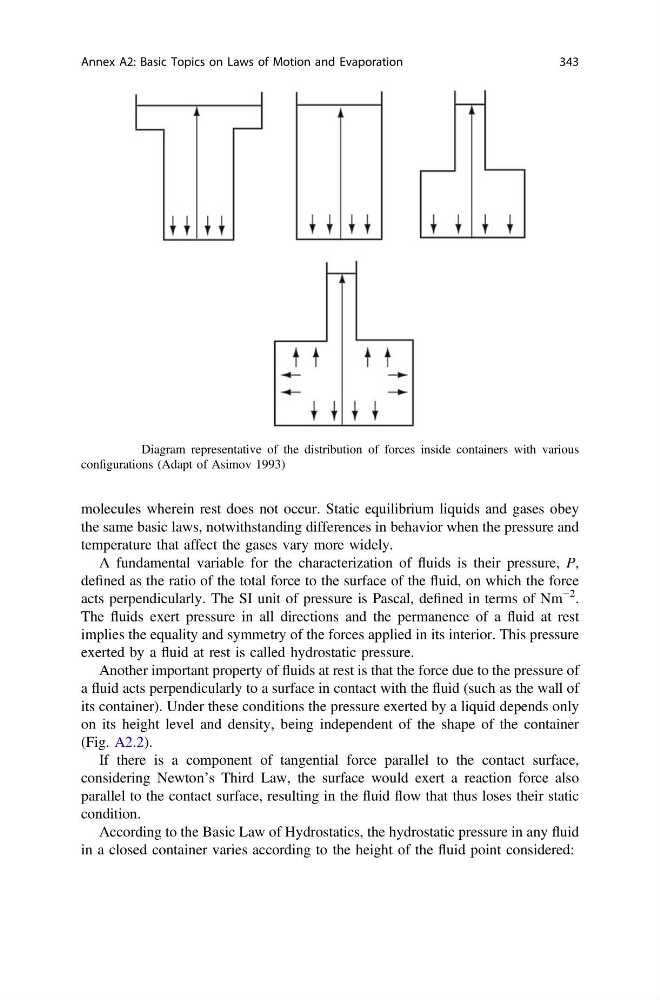
Another important property of fluids at rest is that the force due to the pressure of
a fluid acts perpendicularly to a surface in contact with the fluid (such as the wall of
its container). Under these conditions the pressure exerted by a liquid depends only
on its height level and density, being independent of the shape of the container
(Fig. A2.2).
If there is a component of tangential force parallel to the contact surface,
considering Newton’s Third Law, the surface would exert a reaction force also
parallel to the contact surface, resulting in the fluid flow that thus loses their static
condition.
According to the Basic Law of Hydrostatics, the hydrostatic pressure in any fluid
in a closed container varies according to the height of the fluid point considered:
Fig. A2.2 Diagram representative of the distribution of forces inside containers with various
configurations (Adapt of Asimov 1993)
Annex A2: Basic Topics on Laws of Motion and Evaporation
343
the same basic laws, notwithstanding differences in behavior when the pressure and
temperature that affect the gases vary more widely.
A fundamental variable for the characterization of fluids is their pressure, P,
defined as the ratio of the total force to the surface of the fluid, on which the force
acts perpendicularly. The SI unit of pressure is Pascal, defined in terms of Nm
−2 .
The fluids exert pressure in all directions and the permanence of a fluid at rest
implies the equality and symmetry of the forces applied in its interior. This pressure
exerted by a fluid at rest is called hydrostatic pressure.
Another important property of fluids at rest is that the force due to the pressure of
a fluid acts perpendicularly to a surface in contact with the fluid (such as the wall of
its container). Under these conditions the pressure exerted by a liquid depends only
on its height level and density, being independent of the shape of the container
(Fig. A2.2).
If there is a component of tangential force parallel to the contact surface,
considering Newton’s Third Law, the surface would exert a reaction force also
parallel to the contact surface, resulting in the fluid flow that thus loses their static
condition.
According to the Basic Law of Hydrostatics, the hydrostatic pressure in any fluid
in a closed container varies according to the height of the fluid point considered:
Fig. A2.2 Diagram representative of the distribution of forces inside containers with various
configurations (Adapt of Asimov 1993)
Annex A2: Basic Topics on Laws of Motion and Evaporation
343