

reference. The reference systems where the Law of Inertia is not valid are referred
to as non-inertial references. An example is that of a speeding car in which a body
in its interior such as a cup on a tray, at rest while the car kept constant speed,
shifted because of the increase of speed without any force exerting on the car cup
(Giancoli 2000).
The concept of relative velocity concerning the motion velocity experienced by
the observer, is dependent on his reference frame. The frame usually considered is
the earth’s ground. If the observer is moving, the relative motion of the observer
relative to a given object will be given by the difference between the velocities of
the observer relative to the object and of the object relative to the reference frame.
From common experience, we know that a moving body tends to stop, because
of the retarding effect of surface friction, even when there is apparently no force
inducing such a result. On the other hand, a body that is supported and dropped in
free fall moves with increasing speed, due to the force of gravity, even in the
absence of any known force that induces such movement. Such phenomena can be
explained by the introduction into the balance of external forces of more subtle
forces whose existence is not obvious, such as surface friction, gravity, or air
resistance. The Law of Inertia applicable as referred to in inertial frames is only
strictly valid in an ideal imaginary world without any forces, (e.g., Asimov 1993)
even those as indicated, e.g., friction forces, not directly obvious.
The force is a vector quantity and if the addition of the force vectors defining their
balance is non-zero then the body starts moving at variable speed in the direction of
the resulting force. If this result is null, by Newton’s First Law, the body or particle
remains in rest or in motion condition with uniform velocity. In the real world, there
are always acting forces, at least the force of gravity, and a given body,
e.g. a particle, can remain at rest, if the vector sum of the applied forces is null.
Newton’s First Law explains the concept of force, but it is not enough to
quantify it. For this, Newton introduced the notion of mass to quantify the amount
of inertia possessed by the body in question. A larger mass body has more inertia
than a smaller mass body. In this context, Newton’s Second Law states that the
acceleration of a body is equal to the ratio of the balance of forces acting on it and
its mass, or rate of change of movement. The direction of movement is in the
direction of the resultant of forces.
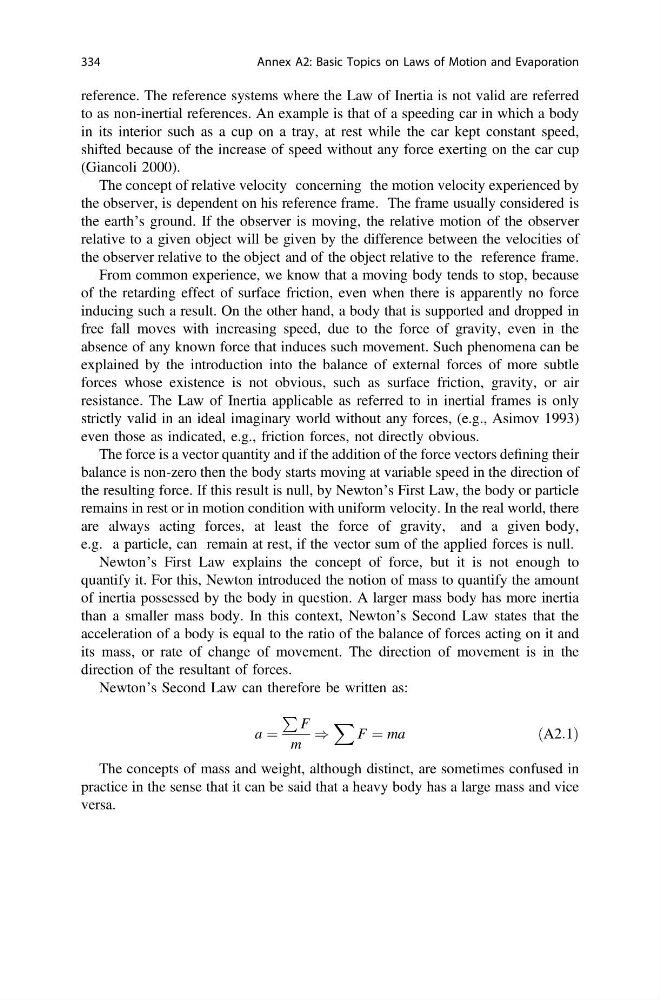
Newton’s Second Law can therefore be written as:
a ¼
P
F
m
)
X
F ¼ ma
ðA2:1Þ
The concepts of mass and weight, although distinct, are sometimes confused in
practice in the sense that it can be said that a heavy body has a large mass and vice
versa.
334
Annex A2: Basic Topics on Laws of Motion and Evaporation
to as non-inertial references. An example is that of a speeding car in which a body
in its interior such as a cup on a tray, at rest while the car kept constant speed,
shifted because of the increase of speed without any force exerting on the car cup
(Giancoli 2000).
The concept of relative velocity concerning the motion velocity experienced by
the observer, is dependent on his reference frame. The frame usually considered is
the earth’s ground. If the observer is moving, the relative motion of the observer
relative to a given object will be given by the difference between the velocities of
the observer relative to the object and of the object relative to the reference frame.
From common experience, we know that a moving body tends to stop, because
of the retarding effect of surface friction, even when there is apparently no force
inducing such a result. On the other hand, a body that is supported and dropped in
free fall moves with increasing speed, due to the force of gravity, even in the
absence of any known force that induces such movement. Such phenomena can be
explained by the introduction into the balance of external forces of more subtle
forces whose existence is not obvious, such as surface friction, gravity, or air
resistance. The Law of Inertia applicable as referred to in inertial frames is only
strictly valid in an ideal imaginary world without any forces, (e.g., Asimov 1993)
even those as indicated, e.g., friction forces, not directly obvious.
The force is a vector quantity and if the addition of the force vectors defining their
balance is non-zero then the body starts moving at variable speed in the direction of
the resulting force. If this result is null, by Newton’s First Law, the body or particle
remains in rest or in motion condition with uniform velocity. In the real world, there
are always acting forces, at least the force of gravity, and a given body,
e.g. a particle, can remain at rest, if the vector sum of the applied forces is null.
Newton’s First Law explains the concept of force, but it is not enough to
quantify it. For this, Newton introduced the notion of mass to quantify the amount
of inertia possessed by the body in question. A larger mass body has more inertia
than a smaller mass body. In this context, Newton’s Second Law states that the
acceleration of a body is equal to the ratio of the balance of forces acting on it and
its mass, or rate of change of movement. The direction of movement is in the
direction of the resultant of forces.
Newton’s Second Law can therefore be written as:
a ¼
P
F
m
)
X
F ¼ ma
ðA2:1Þ
The concepts of mass and weight, although distinct, are sometimes confused in
practice in the sense that it can be said that a heavy body has a large mass and vice
versa.
334
Annex A2: Basic Topics on Laws of Motion and Evaporation