

fluxes vary up to 10%. In this layer, convective fluxes of momentum, evapotranspiration, water vapor, and convective heat flux, also known as sensible heat, can be
considered constant.
Typically, heat and mass fluxes are higher in the surface layer, decreasing to zero
at the top of the planetary boundary layer (PBL). The height of the surface layer
varies over daytime and nighttime periods. On clear nights, in the absence of wind,
the height of the surface layer can be down to only 10 m, which limits its practical
value. In contrast, during the daytime under normal wind conditions, its height can
be about 100 m or more.
In surfaces with vegetation or urban canopies, rates of mass and energy transfer
between these areas and the atmosphere are determined by measuring vertical fluxes
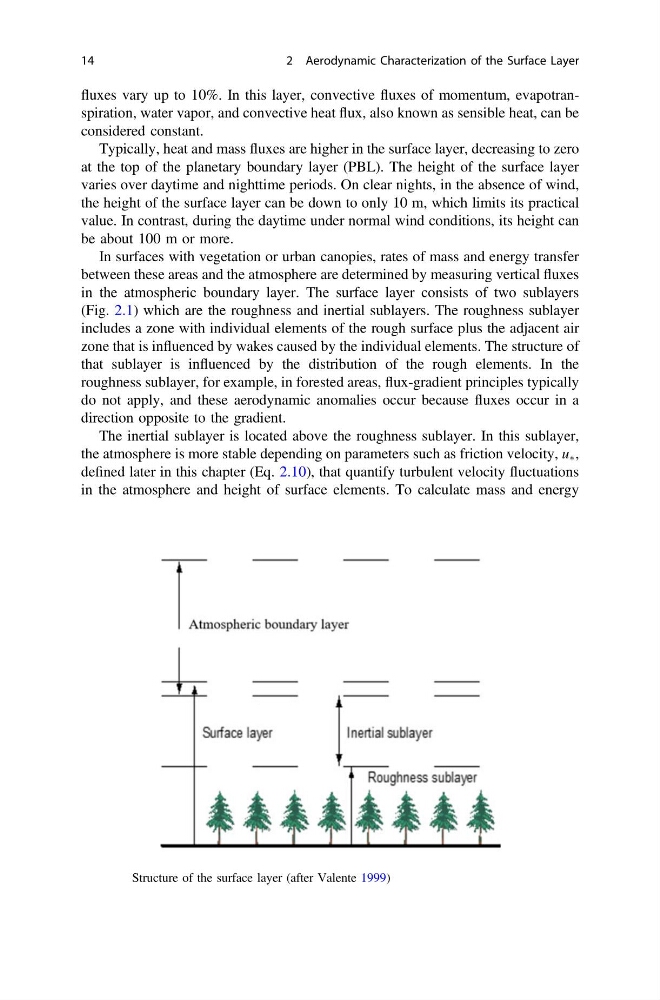
in the atmospheric boundary layer. The surface layer consists of two sublayers
(Fig. 2.1) which are the roughness and inertial sublayers. The roughness sublayer
includes a zone with individual elements of the rough surface plus the adjacent air
zone that is influenced by wakes caused by the individual elements. The structure of
that sublayer is influenced by the distribution of the rough elements. In the
roughness sublayer, for example, in forested areas, flux-gradient principles typically
do not apply, and these aerodynamic anomalies occur because fluxes occur in a
direction opposite to the gradient.
The inertial sublayer is located above the roughness sublayer. In this sublayer,
the atmosphere is more stable depending on parameters such as friction velocity, u à ,
defined later in this chapter (Eq. 2.10), that quantify turbulent velocity fluctuations
in the atmosphere and height of surface elements. To calculate mass and energy
Fig. 2.1 Structure of the surface layer (after Valente 1999)
14
2 Aerodynamic Characterization of the Surface Layer
considered constant.
Typically, heat and mass fluxes are higher in the surface layer, decreasing to zero
at the top of the planetary boundary layer (PBL). The height of the surface layer
varies over daytime and nighttime periods. On clear nights, in the absence of wind,
the height of the surface layer can be down to only 10 m, which limits its practical
value. In contrast, during the daytime under normal wind conditions, its height can
be about 100 m or more.
In surfaces with vegetation or urban canopies, rates of mass and energy transfer
between these areas and the atmosphere are determined by measuring vertical fluxes
in the atmospheric boundary layer. The surface layer consists of two sublayers
(Fig. 2.1) which are the roughness and inertial sublayers. The roughness sublayer
includes a zone with individual elements of the rough surface plus the adjacent air
zone that is influenced by wakes caused by the individual elements. The structure of
that sublayer is influenced by the distribution of the rough elements. In the
roughness sublayer, for example, in forested areas, flux-gradient principles typically
do not apply, and these aerodynamic anomalies occur because fluxes occur in a
direction opposite to the gradient.
The inertial sublayer is located above the roughness sublayer. In this sublayer,
the atmosphere is more stable depending on parameters such as friction velocity, u à ,
defined later in this chapter (Eq. 2.10), that quantify turbulent velocity fluctuations
in the atmosphere and height of surface elements. To calculate mass and energy
Fig. 2.1 Structure of the surface layer (after Valente 1999)
14
2 Aerodynamic Characterization of the Surface Layer