

sonic anemometers used mainly for analyzing turbulence structure instead of
average winds.
The functioning of the latter has already been analyzed in Chap. 3. Cup
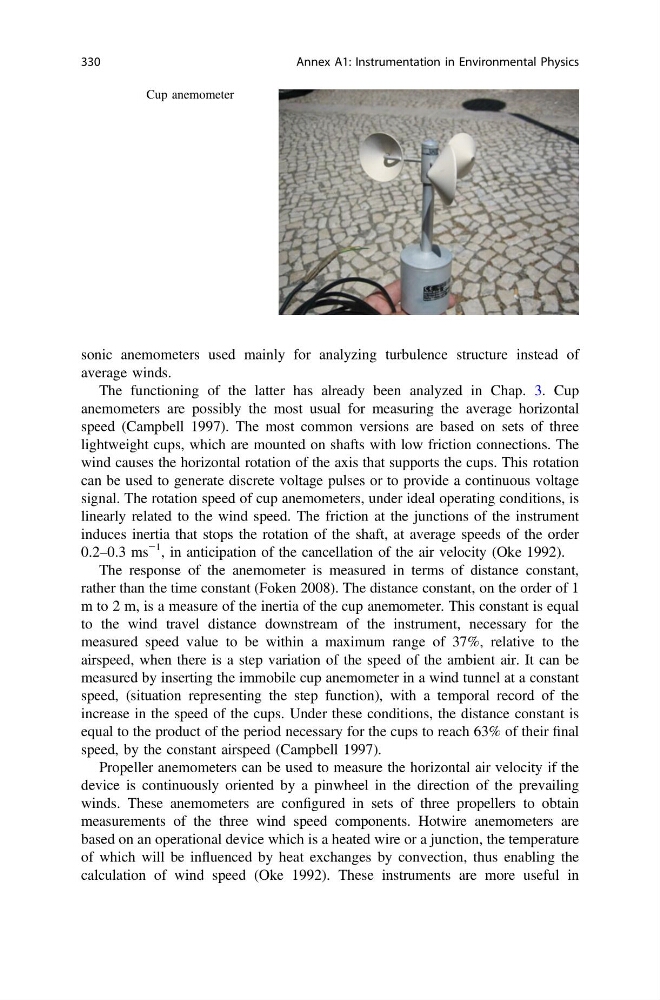
anemometers are possibly the most usual for measuring the average horizontal
speed (Campbell 1997). The most common versions are based on sets of three
lightweight cups, which are mounted on shafts with low friction connections. The
wind causes the horizontal rotation of the axis that supports the cups. This rotation
can be used to generate discrete voltage pulses or to provide a continuous voltage
signal. The rotation speed of cup anemometers, under ideal operating conditions, is
linearly related to the wind speed. The friction at the junctions of the instrument
induces inertia that stops the rotation of the shaft, at average speeds of the order
0.2–0.3 ms
−1 , in anticipation of the cancellation of the air velocity (Oke 1992).
The response of the anemometer is measured in terms of distance constant,
rather than the time constant (Foken 2008). The distance constant, on the order of 1
m to 2 m, is a measure of the inertia of the cup anemometer. This constant is equal
to the wind travel distance downstream of the instrument, necessary for the
measured speed value to be within a maximum range of 37%, relative to the
airspeed, when there is a step variation of the speed of the ambient air. It can be
measured by inserting the immobile cup anemometer in a wind tunnel at a constant
speed, (situation representing the step function), with a temporal record of the
increase in the speed of the cups. Under these conditions, the distance constant is
equal to the product of the period necessary for the cups to reach 63% of their final
speed, by the constant airspeed (Campbell 1997).
Propeller anemometers can be used to measure the horizontal air velocity if the
device is continuously oriented by a pinwheel in the direction of the prevailing
winds. These anemometers are configured in sets of three propellers to obtain
measurements of the three wind speed components. Hotwire anemometers are
based on an operational device which is a heated wire or a junction, the temperature
of which will be influenced by heat exchanges by convection, thus enabling the
calculation of wind speed (Oke 1992). These instruments are more useful in
Fig. A1.11 Cup anemometer
330
Annex A1: Instrumentation in Environmental Physics
average winds.
The functioning of the latter has already been analyzed in Chap. 3. Cup
anemometers are possibly the most usual for measuring the average horizontal
speed (Campbell 1997). The most common versions are based on sets of three
lightweight cups, which are mounted on shafts with low friction connections. The
wind causes the horizontal rotation of the axis that supports the cups. This rotation
can be used to generate discrete voltage pulses or to provide a continuous voltage
signal. The rotation speed of cup anemometers, under ideal operating conditions, is
linearly related to the wind speed. The friction at the junctions of the instrument
induces inertia that stops the rotation of the shaft, at average speeds of the order
0.2–0.3 ms
−1 , in anticipation of the cancellation of the air velocity (Oke 1992).
The response of the anemometer is measured in terms of distance constant,
rather than the time constant (Foken 2008). The distance constant, on the order of 1
m to 2 m, is a measure of the inertia of the cup anemometer. This constant is equal
to the wind travel distance downstream of the instrument, necessary for the
measured speed value to be within a maximum range of 37%, relative to the
airspeed, when there is a step variation of the speed of the ambient air. It can be
measured by inserting the immobile cup anemometer in a wind tunnel at a constant
speed, (situation representing the step function), with a temporal record of the
increase in the speed of the cups. Under these conditions, the distance constant is
equal to the product of the period necessary for the cups to reach 63% of their final
speed, by the constant airspeed (Campbell 1997).
Propeller anemometers can be used to measure the horizontal air velocity if the
device is continuously oriented by a pinwheel in the direction of the prevailing
winds. These anemometers are configured in sets of three propellers to obtain
measurements of the three wind speed components. Hotwire anemometers are
based on an operational device which is a heated wire or a junction, the temperature
of which will be influenced by heat exchanges by convection, thus enabling the
calculation of wind speed (Oke 1992). These instruments are more useful in
Fig. A1.11 Cup anemometer
330
Annex A1: Instrumentation in Environmental Physics