

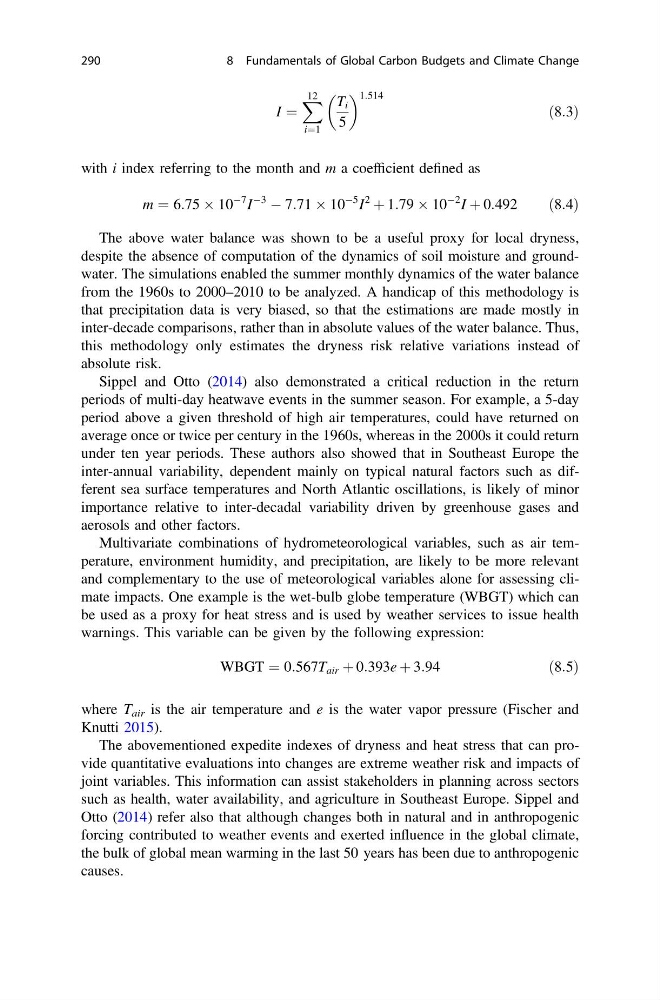
I ¼
X 12
i¼1
T i
5
1:514
ð8:3Þ
with i index referring to the month and m a coefficient defined as
m ¼ 6:75 Â 10
À7 I
À3
À 7:71 Â 10
À5 I
2
þ 1:79 Â 10
À2 I þ 0:492
ð8:4Þ
The above water balance was shown to be a useful proxy for local dryness,
despite the absence of computation of the dynamics of soil moisture and groundwater. The simulations enabled the summer monthly dynamics of the water balance
from the 1960s to 2000–2010 to be analyzed. A handicap of this methodology is
that precipitation data is very biased, so that the estimations are made mostly in
inter-decade comparisons, rather than in absolute values of the water balance. Thus,
this methodology only estimates the dryness risk relative variations instead of
absolute risk.
Sippel and Otto (2014) also demonstrated a critical reduction in the return
periods of multi-day heatwave events in the summer season. For example, a 5-day
period above a given threshold of high air temperatures, could have returned on
average once or twice per century in the 1960s, whereas in the 2000s it could return
under ten year periods. These authors also showed that in Southeast Europe the
inter-annual variability, dependent mainly on typical natural factors such as different sea surface temperatures and North Atlantic oscillations, is likely of minor
importance relative to inter-decadal variability driven by greenhouse gases and
aerosols and other factors.
Multivariate combinations of hydrometeorological variables, such as air temperature, environment humidity, and precipitation, are likely to be more relevant
and complementary to the use of meteorological variables alone for assessing climate impacts. One example is the wet-bulb globe temperature (WBGT) which can
be used as a proxy for heat stress and is used by weather services to issue health
warnings. This variable can be given by the following expression:
WBGT ¼ 0:567T air þ 0:393e þ 3:94
ð8:5Þ
where T air is the air temperature and e is the water vapor pressure (Fischer and
Knutti 2015).
The abovementioned expedite indexes of dryness and heat stress that can provide quantitative evaluations into changes are extreme weather risk and impacts of
joint variables. This information can assist stakeholders in planning across sectors
such as health, water availability, and agriculture in Southeast Europe. Sippel and
Otto (2014) refer also that although changes both in natural and in anthropogenic
forcing contributed to weather events and exerted influence in the global climate,
the bulk of global mean warming in the last 50 years has been due to anthropogenic
causes.
290
8 Fundamentals of Global Carbon Budgets and Climate Change
X 12
i¼1
T i
5
1:514
ð8:3Þ
with i index referring to the month and m a coefficient defined as
m ¼ 6:75 Â 10
À7 I
À3
À 7:71 Â 10
À5 I
2
þ 1:79 Â 10
À2 I þ 0:492
ð8:4Þ
The above water balance was shown to be a useful proxy for local dryness,
despite the absence of computation of the dynamics of soil moisture and groundwater. The simulations enabled the summer monthly dynamics of the water balance
from the 1960s to 2000–2010 to be analyzed. A handicap of this methodology is
that precipitation data is very biased, so that the estimations are made mostly in
inter-decade comparisons, rather than in absolute values of the water balance. Thus,
this methodology only estimates the dryness risk relative variations instead of
absolute risk.
Sippel and Otto (2014) also demonstrated a critical reduction in the return
periods of multi-day heatwave events in the summer season. For example, a 5-day
period above a given threshold of high air temperatures, could have returned on
average once or twice per century in the 1960s, whereas in the 2000s it could return
under ten year periods. These authors also showed that in Southeast Europe the
inter-annual variability, dependent mainly on typical natural factors such as different sea surface temperatures and North Atlantic oscillations, is likely of minor
importance relative to inter-decadal variability driven by greenhouse gases and
aerosols and other factors.
Multivariate combinations of hydrometeorological variables, such as air temperature, environment humidity, and precipitation, are likely to be more relevant
and complementary to the use of meteorological variables alone for assessing climate impacts. One example is the wet-bulb globe temperature (WBGT) which can
be used as a proxy for heat stress and is used by weather services to issue health
warnings. This variable can be given by the following expression:
WBGT ¼ 0:567T air þ 0:393e þ 3:94
ð8:5Þ
where T air is the air temperature and e is the water vapor pressure (Fischer and
Knutti 2015).
The abovementioned expedite indexes of dryness and heat stress that can provide quantitative evaluations into changes are extreme weather risk and impacts of
joint variables. This information can assist stakeholders in planning across sectors
such as health, water availability, and agriculture in Southeast Europe. Sippel and
Otto (2014) refer also that although changes both in natural and in anthropogenic
forcing contributed to weather events and exerted influence in the global climate,
the bulk of global mean warming in the last 50 years has been due to anthropogenic
causes.
290
8 Fundamentals of Global Carbon Budgets and Climate Change