

duration of the longest event between 4 and 12 days. The influence from internal
climate variability evaluated through the CESM ensemble models was found as
low, with very small intraregional variations of coefficients per °C of mean global
warming, compared with using CIMP5. Thus, a conclusion to be drawn is that the
overall variations in the rate of heatwave events are strictly dependent on differences in physical methodologies between climate models in terms of parameterization schemes, resolution, and overall climate sensitivity.
The role of internal climate variability becomes more visible when projecting
changes in regional heatwaves per individual global mean warming threshold. Over
the same regions and for the same heatwave characteristics, under a rate of expected
heatwave changes per 0.5 °C of the mean global warming, internal variability
accounted for at least 50% of these changes, and in most cases accounted for 20–
30% of them.
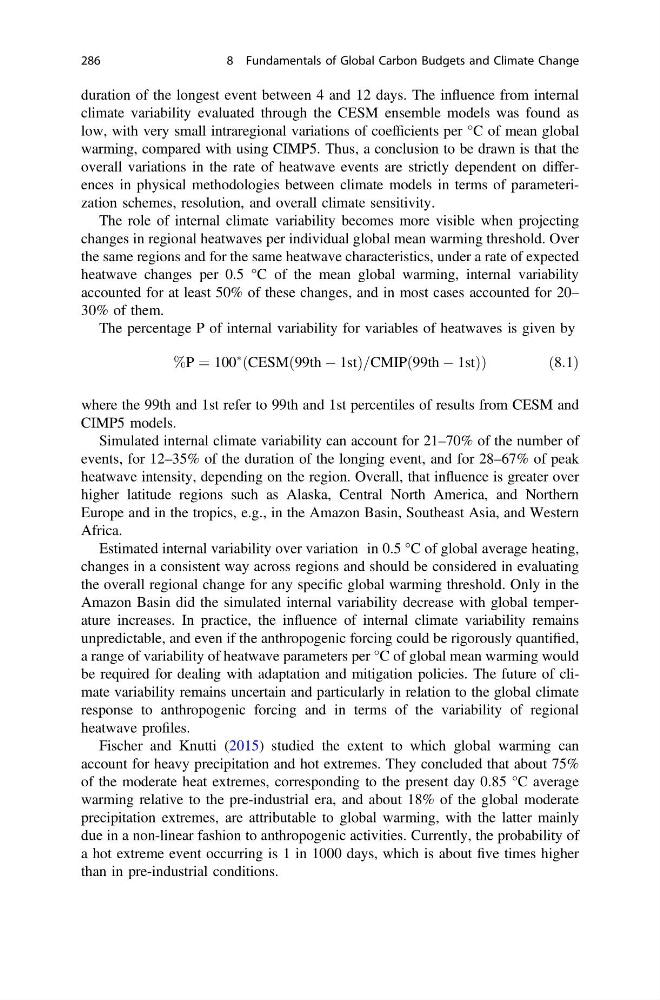
The percentage P of internal variability for variables of heatwaves is given by
%P ¼ 100
Ã
CESM 99th À 1st
ð
Þ =CMIP 99th À 1st
ð
Þ
ð
Þ
ð 8:1Þ
where the 99th and 1st refer to 99th and 1st percentiles of results from CESM and
CIMP5 models.
Simulated internal climate variability can account for 21–70% of the number of
events, for 12–35% of the duration of the longing event, and for 28–67% of peak
heatwave intensity, depending on the region. Overall, that influence is greater over
higher latitude regions such as Alaska, Central North America, and Northern
Europe and in the tropics, e.g., in the Amazon Basin, Southeast Asia, and Western
Africa.
Estimated internal variability over variation in 0.5 °C of global average heating,
changes in a consistent way across regions and should be considered in evaluating
the overall regional change for any specific global warming threshold. Only in the
Amazon Basin did the simulated internal variability decrease with global temperature increases. In practice, the influence of internal climate variability remains
unpredictable, and even if the anthropogenic forcing could be rigorously quantified,
a range of variability of heatwave parameters per °C of global mean warming would
be required for dealing with adaptation and mitigation policies. The future of climate variability remains uncertain and particularly in relation to the global climate
response to anthropogenic forcing and in terms of the variability of regional
heatwave profiles.
Fischer and Knutti (2015) studied the extent to which global warming can
account for heavy precipitation and hot extremes. They concluded that about 75%
of the moderate heat extremes, corresponding to the present day 0.85 °C average
warming relative to the pre-industrial era, and about 18% of the global moderate
precipitation extremes, are attributable to global warming, with the latter mainly
due in a non-linear fashion to anthropogenic activities. Currently, the probability of
a hot extreme event occurring is 1 in 1000 days, which is about five times higher
than in pre-industrial conditions.
286
8 Fundamentals of Global Carbon Budgets and Climate Change
climate variability evaluated through the CESM ensemble models was found as
low, with very small intraregional variations of coefficients per °C of mean global
warming, compared with using CIMP5. Thus, a conclusion to be drawn is that the
overall variations in the rate of heatwave events are strictly dependent on differences in physical methodologies between climate models in terms of parameterization schemes, resolution, and overall climate sensitivity.
The role of internal climate variability becomes more visible when projecting
changes in regional heatwaves per individual global mean warming threshold. Over
the same regions and for the same heatwave characteristics, under a rate of expected
heatwave changes per 0.5 °C of the mean global warming, internal variability
accounted for at least 50% of these changes, and in most cases accounted for 20–
30% of them.
The percentage P of internal variability for variables of heatwaves is given by
%P ¼ 100
Ã
CESM 99th À 1st
ð
Þ =CMIP 99th À 1st
ð
Þ
ð
Þ
ð 8:1Þ
where the 99th and 1st refer to 99th and 1st percentiles of results from CESM and
CIMP5 models.
Simulated internal climate variability can account for 21–70% of the number of
events, for 12–35% of the duration of the longing event, and for 28–67% of peak
heatwave intensity, depending on the region. Overall, that influence is greater over
higher latitude regions such as Alaska, Central North America, and Northern
Europe and in the tropics, e.g., in the Amazon Basin, Southeast Asia, and Western
Africa.
Estimated internal variability over variation in 0.5 °C of global average heating,
changes in a consistent way across regions and should be considered in evaluating
the overall regional change for any specific global warming threshold. Only in the
Amazon Basin did the simulated internal variability decrease with global temperature increases. In practice, the influence of internal climate variability remains
unpredictable, and even if the anthropogenic forcing could be rigorously quantified,
a range of variability of heatwave parameters per °C of global mean warming would
be required for dealing with adaptation and mitigation policies. The future of climate variability remains uncertain and particularly in relation to the global climate
response to anthropogenic forcing and in terms of the variability of regional
heatwave profiles.
Fischer and Knutti (2015) studied the extent to which global warming can
account for heavy precipitation and hot extremes. They concluded that about 75%
of the moderate heat extremes, corresponding to the present day 0.85 °C average
warming relative to the pre-industrial era, and about 18% of the global moderate
precipitation extremes, are attributable to global warming, with the latter mainly
due in a non-linear fashion to anthropogenic activities. Currently, the probability of
a hot extreme event occurring is 1 in 1000 days, which is about five times higher
than in pre-industrial conditions.
286
8 Fundamentals of Global Carbon Budgets and Climate Change