

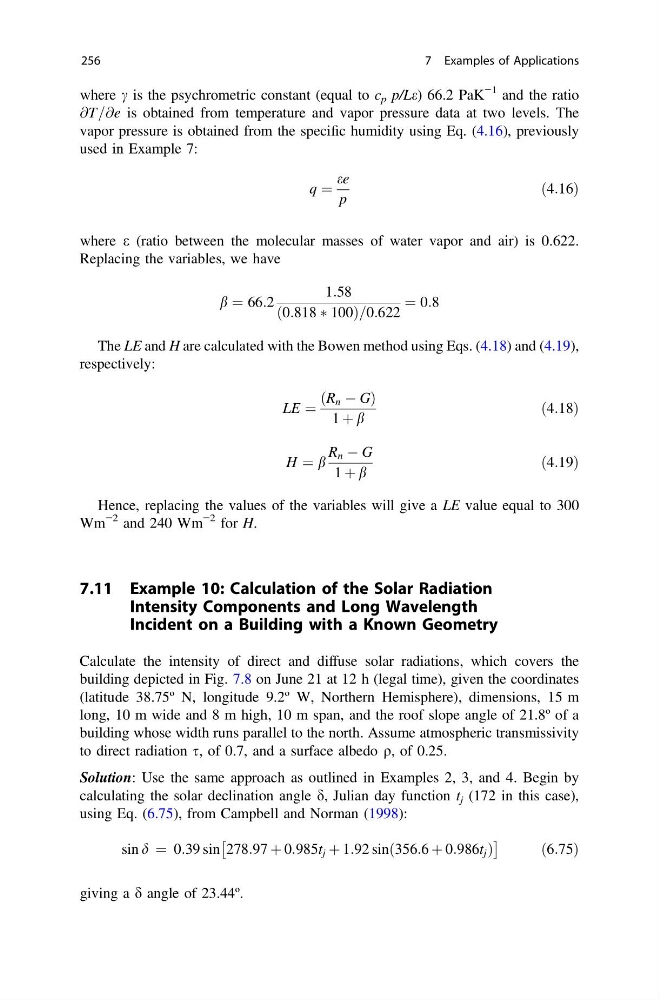
where c is the psychrometric constant (equal to c p p/Le) 66.2 PaK
−1 and the ratio
@T=@e is obtained from temperature and vapor pressure data at two levels. The
vapor pressure is obtained from the specific humidity using Eq. (4.16), previously
used in Example 7:
q ¼
ee
p
ð4:16Þ
where e (ratio between the molecular masses of water vapor and air) is 0.622.
Replacing the variables, we have
b ¼ 66:2
1:58
0:818 Ã 100
ð
Þ =0:622
¼ 0:8
The LE and H are calculated with the Bowen method using Eqs. (4.18) and (4.19),
respectively:
LE ¼
ðR n À GÞ
1 þ b
ð4:18Þ
H ¼ b
R n À G
1 þ b
ð4:19Þ
Hence, replacing the values of the variables will give a LE value equal to 300
Wm
−2 and 240 Wm
−2 for H.
7.11 Example 10: Calculation of the Solar Radiation
Intensity Components and Long Wavelength
Incident on a Building with a Known Geometry
Calculate the intensity of direct and diffuse solar radiations, which covers the
building depicted in Fig. 7.8 on June 21 at 12 h (legal time), given the coordinates
(latitude 38.75º N, longitude 9.2º W, Northern Hemisphere), dimensions, 15 m
long, 10 m wide and 8 m high, 10 m span, and the roof slope angle of 21.8º of a
building whose width runs parallel to the north. Assume atmospheric transmissivity
to direct radiation s, of 0.7, and a surface albedo q, of 0.25.
Solution: Use the same approach as outlined in Examples 2, 3, and 4. Begin by
calculating the solar declination angle d, Julian day function t j (172 in this case),
using Eq. (6.75), from Campbell and Norman (1998):
sin d ¼ 0:39 sin 278:97 þ 0:985t j þ 1:92 sinð356:6 þ 0:986t j Þ
Â
Ã
ð6:75Þ
giving a d angle of 23.44º.
256
7 Examples of Applications
−1 and the ratio
@T=@e is obtained from temperature and vapor pressure data at two levels. The
vapor pressure is obtained from the specific humidity using Eq. (4.16), previously
used in Example 7:
q ¼
ee
p
ð4:16Þ
where e (ratio between the molecular masses of water vapor and air) is 0.622.
Replacing the variables, we have
b ¼ 66:2
1:58
0:818 Ã 100
ð
Þ =0:622
¼ 0:8
The LE and H are calculated with the Bowen method using Eqs. (4.18) and (4.19),
respectively:
LE ¼
ðR n À GÞ
1 þ b
ð4:18Þ
H ¼ b
R n À G
1 þ b
ð4:19Þ
Hence, replacing the values of the variables will give a LE value equal to 300
Wm
−2 and 240 Wm
−2 for H.
7.11 Example 10: Calculation of the Solar Radiation
Intensity Components and Long Wavelength
Incident on a Building with a Known Geometry
Calculate the intensity of direct and diffuse solar radiations, which covers the
building depicted in Fig. 7.8 on June 21 at 12 h (legal time), given the coordinates
(latitude 38.75º N, longitude 9.2º W, Northern Hemisphere), dimensions, 15 m
long, 10 m wide and 8 m high, 10 m span, and the roof slope angle of 21.8º of a
building whose width runs parallel to the north. Assume atmospheric transmissivity
to direct radiation s, of 0.7, and a surface albedo q, of 0.25.
Solution: Use the same approach as outlined in Examples 2, 3, and 4. Begin by
calculating the solar declination angle d, Julian day function t j (172 in this case),
using Eq. (6.75), from Campbell and Norman (1998):
sin d ¼ 0:39 sin 278:97 þ 0:985t j þ 1:92 sinð356:6 þ 0:986t j Þ
Â
Ã
ð6:75Þ
giving a d angle of 23.44º.
256
7 Examples of Applications