

7.3 Example 2: Estimation of Solar Hourly Radiation
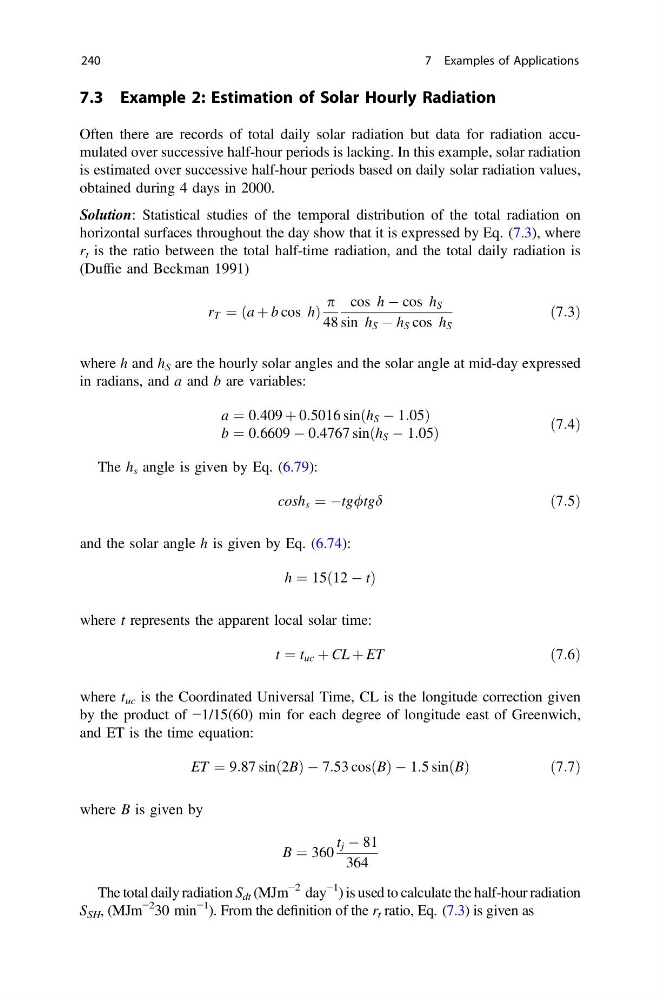
Often there are records of total daily solar radiation but data for radiation accumulated over successive half-hour periods is lacking. In this example, solar radiation
is estimated over successive half-hour periods based on daily solar radiation values,
obtained during 4 days in 2000.
Solution: Statistical studies of the temporal distribution of the total radiation on
horizontal surfaces throughout the day show that it is expressed by Eq. (7.3), where
r t is the ratio between the total half-time radiation, and the total daily radiation is
(Duffie and Beckman 1991)
r T ¼ a þ b cos h
ð
Þ
p
48
cos h À cos h S
sin h S À h S cos h S
ð7:3Þ
where h and h S are the hourly solar angles and the solar angle at mid-day expressed
in radians, and a and b are variables:
a ¼ 0:409 þ 0:5016 sin h S À 1:05
ð
Þ
b ¼ 0:6609 À 0:4767 sin h S À 1:05
ð
Þ
ð7:4Þ
The h s angle is given by Eq. (6.79):
cosh s ¼ Àtg/tgd
ð7:5Þ
and the solar angle h is given by Eq. (6.74):
h ¼ 15ð12 À tÞ
where t represents the apparent local solar time:
t ¼ t uc þ CL þ ET
ð7:6Þ
where t uc is the Coordinated Universal Time, CL is the longitude correction given
by the product of −1/15(60) min for each degree of longitude east of Greenwich,
and ET is the time equation:
ET ¼ 9:87 sinð2BÞ À 7:53 cosðBÞ À 1:5 sinðBÞ
ð 7:7Þ
where B is given by
B ¼ 360
t j À 81
364
The total daily radiation S dt (MJm
−2 day
−1
) is used to calculate the half-hour radiation
S SH , (MJm
−2
30 min
−1
). From the definition of the r t ratio, Eq. (7.3) is given as
240
7 Examples of Applications
Often there are records of total daily solar radiation but data for radiation accumulated over successive half-hour periods is lacking. In this example, solar radiation
is estimated over successive half-hour periods based on daily solar radiation values,
obtained during 4 days in 2000.
Solution: Statistical studies of the temporal distribution of the total radiation on
horizontal surfaces throughout the day show that it is expressed by Eq. (7.3), where
r t is the ratio between the total half-time radiation, and the total daily radiation is
(Duffie and Beckman 1991)
r T ¼ a þ b cos h
ð
Þ
p
48
cos h À cos h S
sin h S À h S cos h S
ð7:3Þ
where h and h S are the hourly solar angles and the solar angle at mid-day expressed
in radians, and a and b are variables:
a ¼ 0:409 þ 0:5016 sin h S À 1:05
ð
Þ
b ¼ 0:6609 À 0:4767 sin h S À 1:05
ð
Þ
ð7:4Þ
The h s angle is given by Eq. (6.79):
cosh s ¼ Àtg/tgd
ð7:5Þ
and the solar angle h is given by Eq. (6.74):
h ¼ 15ð12 À tÞ
where t represents the apparent local solar time:
t ¼ t uc þ CL þ ET
ð7:6Þ
where t uc is the Coordinated Universal Time, CL is the longitude correction given
by the product of −1/15(60) min for each degree of longitude east of Greenwich,
and ET is the time equation:
ET ¼ 9:87 sinð2BÞ À 7:53 cosðBÞ À 1:5 sinðBÞ
ð 7:7Þ
where B is given by
B ¼ 360
t j À 81
364
The total daily radiation S dt (MJm
−2 day
−1
) is used to calculate the half-hour radiation
S SH , (MJm
−2
30 min
−1
). From the definition of the r t ratio, Eq. (7.3) is given as
240
7 Examples of Applications