

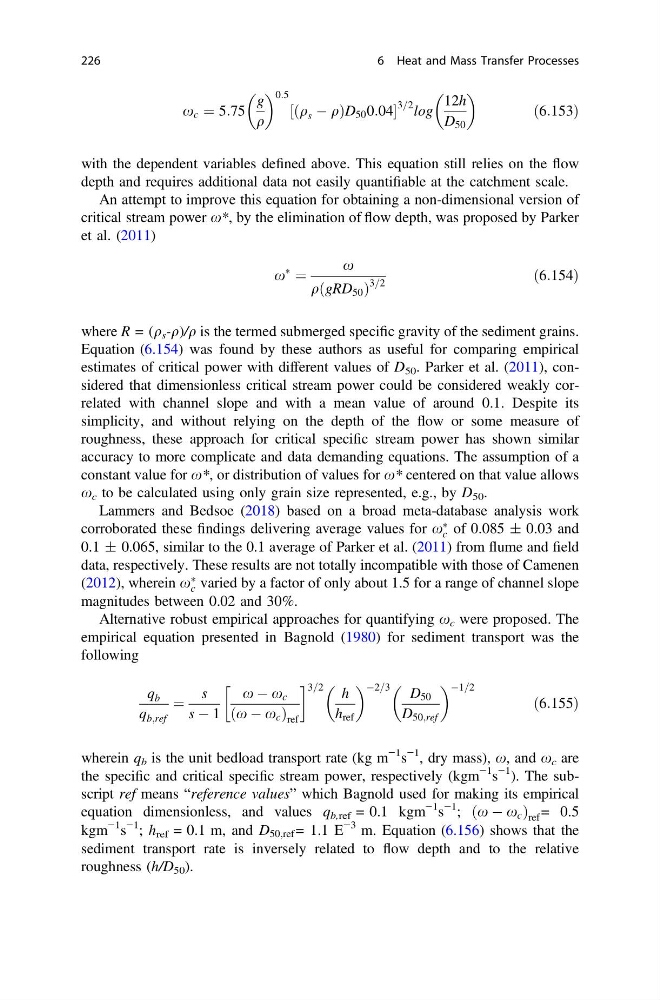
x c ¼ 5:75
g
q
0:5
q s À q
ð
ÞD 50 0:04
½
3=2 log
12h
D 50
ð6:153Þ
with the dependent variables defined above. This equation still relies on the flow
depth and requires additional data not easily quantifiable at the catchment scale.
An attempt to improve this equation for obtaining a non-dimensional version of
critical stream power x*, by the elimination of flow depth, was proposed by Parker
et al. (2011)
x
Ã
¼
x
q gRD 50
ð
Þ
3=2
ð6:154Þ
where R = (q s -q)/q is the termed submerged specific gravity of the sediment grains.
Equation (6.154) was found by these authors as useful for comparing empirical
estimates of critical power with different values of D 50 . Parker et al. (2011), considered that dimensionless critical stream power could be considered weakly correlated with channel slope and with a mean value of around 0.1. Despite its
simplicity, and without relying on the depth of the flow or some measure of
roughness, these approach for critical specific stream power has shown similar
accuracy to more complicate and data demanding equations. The assumption of a
constant value for x*, or distribution of values for x* centered on that value allows
x c to be calculated using only grain size represented, e.g., by D 50 .
Lammers and Bedsoe (2018) based on a broad meta-database analysis work
corroborated these findings delivering average values for x
Ã
c of 0.085 ± 0.03 and
0.1 ± 0.065, similar to the 0.1 average of Parker et al. (2011) from flume and field
data, respectively. These results are not totally incompatible with those of Camenen
(2012), wherein x
Ã
c varied by a factor of only about 1.5 for a range of channel slope
magnitudes between 0.02 and 30%.
Alternative robust empirical approaches for quantifying x c were proposed. The
empirical equation presented in Bagnold (1980) for sediment transport was the
following
q b
q b;ref
¼
s
s À 1
x À x c
x À x c
ð
Þ ref
! 3=2 h
h ref
À2=3 D 50
D 50;ref
À1=2
ð6:155Þ
wherein q b is the unit bedload transport rate (kg m
−1 s
−1 , dry mass), x, and x c are
the specific and critical specific stream power, respectively (kgm
−1 s
−1 ). The subscript ref means “reference values” which Bagnold used for making its empirical
equation dimensionless, and values q b,ref = 0.1 kgm
−1 s
−1 ; x À x c
ð
Þ ref = 0.5
kgm
−1 s
−1 ; h ref = 0.1 m, and D 50;ref = 1.1 E
−3 m. Equation (6.156) shows that the
sediment transport rate is inversely related to flow depth and to the relative
roughness (h/D 50 ).
226
6 Heat and Mass Transfer Processes
g
q
0:5
q s À q
ð
ÞD 50 0:04
½
3=2 log
12h
D 50
ð6:153Þ
with the dependent variables defined above. This equation still relies on the flow
depth and requires additional data not easily quantifiable at the catchment scale.
An attempt to improve this equation for obtaining a non-dimensional version of
critical stream power x*, by the elimination of flow depth, was proposed by Parker
et al. (2011)
x
Ã
¼
x
q gRD 50
ð
Þ
3=2
ð6:154Þ
where R = (q s -q)/q is the termed submerged specific gravity of the sediment grains.
Equation (6.154) was found by these authors as useful for comparing empirical
estimates of critical power with different values of D 50 . Parker et al. (2011), considered that dimensionless critical stream power could be considered weakly correlated with channel slope and with a mean value of around 0.1. Despite its
simplicity, and without relying on the depth of the flow or some measure of
roughness, these approach for critical specific stream power has shown similar
accuracy to more complicate and data demanding equations. The assumption of a
constant value for x*, or distribution of values for x* centered on that value allows
x c to be calculated using only grain size represented, e.g., by D 50 .
Lammers and Bedsoe (2018) based on a broad meta-database analysis work
corroborated these findings delivering average values for x
Ã
c of 0.085 ± 0.03 and
0.1 ± 0.065, similar to the 0.1 average of Parker et al. (2011) from flume and field
data, respectively. These results are not totally incompatible with those of Camenen
(2012), wherein x
Ã
c varied by a factor of only about 1.5 for a range of channel slope
magnitudes between 0.02 and 30%.
Alternative robust empirical approaches for quantifying x c were proposed. The
empirical equation presented in Bagnold (1980) for sediment transport was the
following
q b
q b;ref
¼
s
s À 1
x À x c
x À x c
ð
Þ ref
! 3=2 h
h ref
À2=3 D 50
D 50;ref
À1=2
ð6:155Þ
wherein q b is the unit bedload transport rate (kg m
−1 s
−1 , dry mass), x, and x c are
the specific and critical specific stream power, respectively (kgm
−1 s
−1 ). The subscript ref means “reference values” which Bagnold used for making its empirical
equation dimensionless, and values q b,ref = 0.1 kgm
−1 s
−1 ; x À x c
ð
Þ ref = 0.5
kgm
−1 s
−1 ; h ref = 0.1 m, and D 50;ref = 1.1 E
−3 m. Equation (6.156) shows that the
sediment transport rate is inversely related to flow depth and to the relative
roughness (h/D 50 ).
226
6 Heat and Mass Transfer Processes