

6.5.5 Sediment Transportation in Rivers
Another typical environmental management issue where mass transfer principles
are fundamental is the quantification of sediment fluxes in rivers. The typical
dimension of transported particle sediments is around 1 mm or smaller because air
is a light fluid with low viscosity, and therefore, not able to deliver much shear on
its bed. Fluvial transport with flowing water in natural systems such as rivers or
streams with higher density and viscosity is larger than air.
Water transport of sediments in rivers can result in the formation of structures
like ripples, dunes, fractal shapes, or floodplains. This problem is strictly related to
increases in, e.g., channel erosion and deposition potential or in flood risks or in the
degradation of the benthic zone. The movement of bed material begins as soon as
the critical values of shear stress (s = qghS on average terms with q being the water
density, g the gravity acceleration, h the mean flow depth, and S the channel slope)
or specific stream power (x = sU with the U representing the mean water velocity)
are surpassed. Above this threshold, the transport rate increases nonlinearly with
excess stress or power, meaning that estimates of sediment transport flow duration
or total bed material flux are highly sensitive to the values of critical shear stress or
specific stream power.
In this context, effective management of fluvial resources requires a quantitative
catchment-scale approach which must be based on variables such as discharge rates,
slopes, channel widths, or grain sizes. Stream bedload transport is highly intermittent in streams and rivers with beds consisting mainly of gravel or boulders.
These are examples of easily estimable and/or collectible variables, e.g., by remote
sensing, existing databases, or direct measurement. Many sediment transport
models, following empirical or theoretical approaches, exist with each one developed under a specific context and objective, and thereby a major goal to achieve
should be the evaluation of model sediment transport with limited data available
(Lammers and Bledsoe 2018).
Fluvial sediment fluxes depend on variables in theoretical transport equations,
related to shear stress, velocity fields, or flow depths. However, due to their
complex temporal and spatial variability, these variables are difficult to measure or
model turning thus impracticable their application in quantification, e.g., of load
transport in equations at the catchment-scale level. A main attempt to overcome
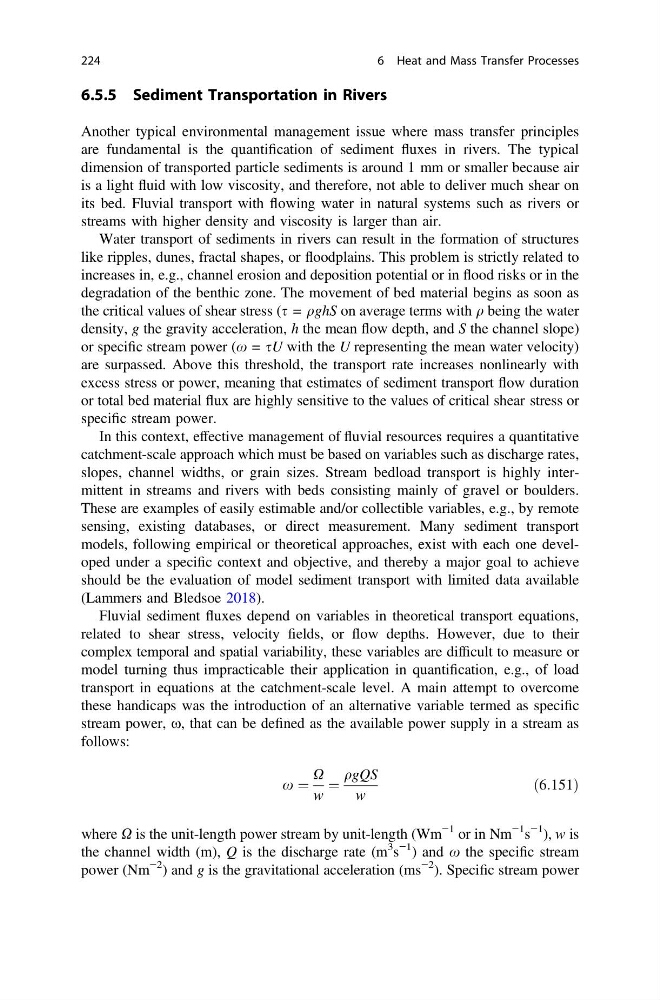
these handicaps was the introduction of an alternative variable termed as specific
stream power, x, that can be defined as the available power supply in a stream as
follows:
x ¼
X
w
¼
qgQS
w
ð6:151Þ
where X is the unit-length power stream by unit-length (Wm
−1 or in Nm
−1 s
−1 ), w is
the channel width (m), Q is the discharge rate (m
3 s
−1 ) and x the specific stream
power (Nm
−2 ) and g is the gravitational acceleration (ms
−2 ). Specific stream power
224
6 Heat and Mass Transfer Processes
Another typical environmental management issue where mass transfer principles
are fundamental is the quantification of sediment fluxes in rivers. The typical
dimension of transported particle sediments is around 1 mm or smaller because air
is a light fluid with low viscosity, and therefore, not able to deliver much shear on
its bed. Fluvial transport with flowing water in natural systems such as rivers or
streams with higher density and viscosity is larger than air.
Water transport of sediments in rivers can result in the formation of structures
like ripples, dunes, fractal shapes, or floodplains. This problem is strictly related to
increases in, e.g., channel erosion and deposition potential or in flood risks or in the
degradation of the benthic zone. The movement of bed material begins as soon as
the critical values of shear stress (s = qghS on average terms with q being the water
density, g the gravity acceleration, h the mean flow depth, and S the channel slope)
or specific stream power (x = sU with the U representing the mean water velocity)
are surpassed. Above this threshold, the transport rate increases nonlinearly with
excess stress or power, meaning that estimates of sediment transport flow duration
or total bed material flux are highly sensitive to the values of critical shear stress or
specific stream power.
In this context, effective management of fluvial resources requires a quantitative
catchment-scale approach which must be based on variables such as discharge rates,
slopes, channel widths, or grain sizes. Stream bedload transport is highly intermittent in streams and rivers with beds consisting mainly of gravel or boulders.
These are examples of easily estimable and/or collectible variables, e.g., by remote
sensing, existing databases, or direct measurement. Many sediment transport
models, following empirical or theoretical approaches, exist with each one developed under a specific context and objective, and thereby a major goal to achieve
should be the evaluation of model sediment transport with limited data available
(Lammers and Bledsoe 2018).
Fluvial sediment fluxes depend on variables in theoretical transport equations,
related to shear stress, velocity fields, or flow depths. However, due to their
complex temporal and spatial variability, these variables are difficult to measure or
model turning thus impracticable their application in quantification, e.g., of load
transport in equations at the catchment-scale level. A main attempt to overcome
these handicaps was the introduction of an alternative variable termed as specific
stream power, x, that can be defined as the available power supply in a stream as
follows:
x ¼
X
w
¼
qgQS
w
ð6:151Þ
where X is the unit-length power stream by unit-length (Wm
−1 or in Nm
−1 s
−1 ), w is
the channel width (m), Q is the discharge rate (m
3 s
−1 ) and x the specific stream
power (Nm
−2 ) and g is the gravitational acceleration (ms
−2 ). Specific stream power
224
6 Heat and Mass Transfer Processes