

Heat and mass exchanges in the biosphere that interface the Earth and the
atmosphere enable anthropogenic and natural processes relevant in environmental
physics. These processes occur predominantly within the bottom of the atmospheric
boundary layer, corresponding to about 10% of its height, known as the surface
layer or constant flux layer, or Prandtl layer. When the layering is unstable its height
range is between 20 and 200 m, but it may decrease to a few meters when the
layering is stable. The designation of constant flux layer arises from the assumption
of constant fluxes with height allowing to estimate the fluxes of, e.g., sensible and
latent heat within this layer (Foken 2017).
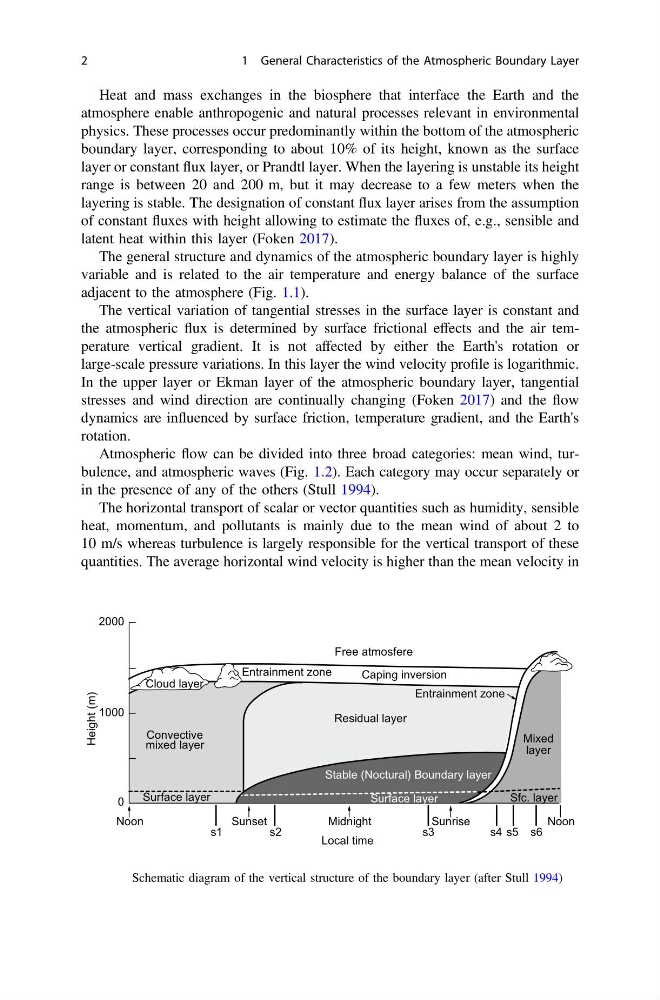
The general structure and dynamics of the atmospheric boundary layer is highly
variable and is related to the air temperature and energy balance of the surface
adjacent to the atmosphere (Fig. 1.1).
The vertical variation of tangential stresses in the surface layer is constant and
the atmospheric flux is determined by surface frictional effects and the air temperature vertical gradient. It is not affected by either the Earth's rotation or
large-scale pressure variations. In this layer the wind velocity profile is logarithmic.
In the upper layer or Ekman layer of the atmospheric boundary layer, tangential
stresses and wind direction are continually changing (Foken 2017) and the flow
dynamics are influenced by surface friction, temperature gradient, and the Earth's
rotation.
Atmospheric flow can be divided into three broad categories: mean wind, turbulence, and atmospheric waves (Fig. 1.2). Each category may occur separately or
in the presence of any of the others (Stull 1994).
The horizontal transport of scalar or vector quantities such as humidity, sensible
heat, momentum, and pollutants is mainly due to the mean wind of about 2 to
10 m/s whereas turbulence is largely responsible for the vertical transport of these
quantities. The average horizontal wind velocity is higher than the mean velocity in
Free atmosfere
Caping inversion
Residual layer
Cloud layer
Convective
mixed layer
Stable (Noctural) Boundary layer
Mixed
layer
Sfc. layer
Surface layer
Surface layer
Local time
Midnight
Sunrise
Noon
Noon
Sunset
Entrainment zone
Entrainment zone
2000
Height (m)
1000
0
6
s
5
s
4
s
3
s
2
s
1
s
Fig. 1.1 Schematic diagram of the vertical structure of the boundary layer (after Stull 1994)
2
1 General Characteristics of the Atmospheric Boundary Layer
atmosphere enable anthropogenic and natural processes relevant in environmental
physics. These processes occur predominantly within the bottom of the atmospheric
boundary layer, corresponding to about 10% of its height, known as the surface
layer or constant flux layer, or Prandtl layer. When the layering is unstable its height
range is between 20 and 200 m, but it may decrease to a few meters when the
layering is stable. The designation of constant flux layer arises from the assumption
of constant fluxes with height allowing to estimate the fluxes of, e.g., sensible and
latent heat within this layer (Foken 2017).
The general structure and dynamics of the atmospheric boundary layer is highly
variable and is related to the air temperature and energy balance of the surface
adjacent to the atmosphere (Fig. 1.1).
The vertical variation of tangential stresses in the surface layer is constant and
the atmospheric flux is determined by surface frictional effects and the air temperature vertical gradient. It is not affected by either the Earth's rotation or
large-scale pressure variations. In this layer the wind velocity profile is logarithmic.
In the upper layer or Ekman layer of the atmospheric boundary layer, tangential
stresses and wind direction are continually changing (Foken 2017) and the flow
dynamics are influenced by surface friction, temperature gradient, and the Earth's
rotation.
Atmospheric flow can be divided into three broad categories: mean wind, turbulence, and atmospheric waves (Fig. 1.2). Each category may occur separately or
in the presence of any of the others (Stull 1994).
The horizontal transport of scalar or vector quantities such as humidity, sensible
heat, momentum, and pollutants is mainly due to the mean wind of about 2 to
10 m/s whereas turbulence is largely responsible for the vertical transport of these
quantities. The average horizontal wind velocity is higher than the mean velocity in
Free atmosfere
Caping inversion
Residual layer
Cloud layer
Convective
mixed layer
Stable (Noctural) Boundary layer
Mixed
layer
Sfc. layer
Surface layer
Surface layer
Local time
Midnight
Sunrise
Noon
Noon
Sunset
Entrainment zone
Entrainment zone
2000
Height (m)
1000
0
6
s
5
s
4
s
3
s
2
s
1
s
Fig. 1.1 Schematic diagram of the vertical structure of the boundary layer (after Stull 1994)
2
1 General Characteristics of the Atmospheric Boundary Layer