

6.3.5.2 Greenhouses, Water, and Soil
Heating inside greenhouses depends on the spectral absorption properties of glass
that readily transmits shorter wavelength radiation and is opaque to thermal or
long-wavelength radiation. Short-wavelength radiation is readily transmitted into
greenhouses and can be absorbed by the soil and plants. However, thermal radiation
emitted by soil and plants is retained by total absorption by the glass and emitted
back to the interior (Linacre et al. 1964). Glass enhances radiation emitted by the
inner surfaces of the greenhouse, thereby increasing heat.
Albedos of greenhouse roofs can be high, especially at angles with low sun
height and can reduce transmitted radiation by about 50%. Moreover, factors such
as dirt in glass walls or short- wavelength scattered radiation after attenuation can
further reduce radiation inside the greenhouse. When recording greenhouse energy
balances, it is necessary to also quantify net visible and thermal radiation. It is even
possible for the radiative balance in the greenhouse to be lower than that outside
(Levit and Gaspar 1987). At night, when only long-wavelength radiation exchanges
occur, greenhouse covers serve to minimize radiation losses (Seginer 1984)
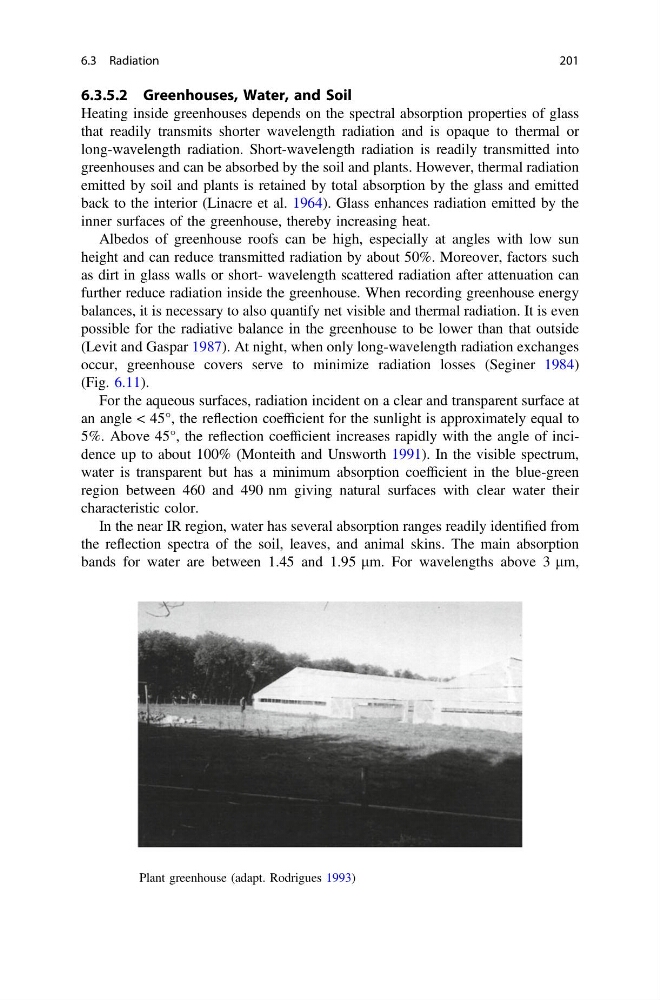
(Fig. 6.11).
For the aqueous surfaces, radiation incident on a clear and transparent surface at
an angle < 45°, the reflection coefficient for the sunlight is approximately equal to
5%. Above 45°, the reflection coefficient increases rapidly with the angle of incidence up to about 100% (Monteith and Unsworth 1991). In the visible spectrum,
water is transparent but has a minimum absorption coefficient in the blue-green
region between 460 and 490 nm giving natural surfaces with clear water their
characteristic color.
In the near IR region, water has several absorption ranges readily identified from
the reflection spectra of the soil, leaves, and animal skins. The main absorption
bands for water are between 1.45 and 1.95 lm. For wavelengths above 3 lm,
Fig. 6.11 Plant greenhouse (adapt. Rodrigues 1993)
6.3 Radiation
201
Heating inside greenhouses depends on the spectral absorption properties of glass
that readily transmits shorter wavelength radiation and is opaque to thermal or
long-wavelength radiation. Short-wavelength radiation is readily transmitted into
greenhouses and can be absorbed by the soil and plants. However, thermal radiation
emitted by soil and plants is retained by total absorption by the glass and emitted
back to the interior (Linacre et al. 1964). Glass enhances radiation emitted by the
inner surfaces of the greenhouse, thereby increasing heat.
Albedos of greenhouse roofs can be high, especially at angles with low sun
height and can reduce transmitted radiation by about 50%. Moreover, factors such
as dirt in glass walls or short- wavelength scattered radiation after attenuation can
further reduce radiation inside the greenhouse. When recording greenhouse energy
balances, it is necessary to also quantify net visible and thermal radiation. It is even
possible for the radiative balance in the greenhouse to be lower than that outside
(Levit and Gaspar 1987). At night, when only long-wavelength radiation exchanges
occur, greenhouse covers serve to minimize radiation losses (Seginer 1984)
(Fig. 6.11).
For the aqueous surfaces, radiation incident on a clear and transparent surface at
an angle < 45°, the reflection coefficient for the sunlight is approximately equal to
5%. Above 45°, the reflection coefficient increases rapidly with the angle of incidence up to about 100% (Monteith and Unsworth 1991). In the visible spectrum,
water is transparent but has a minimum absorption coefficient in the blue-green
region between 460 and 490 nm giving natural surfaces with clear water their
characteristic color.
In the near IR region, water has several absorption ranges readily identified from
the reflection spectra of the soil, leaves, and animal skins. The main absorption
bands for water are between 1.45 and 1.95 lm. For wavelengths above 3 lm,
Fig. 6.11 Plant greenhouse (adapt. Rodrigues 1993)
6.3 Radiation
201